




Short Drivers Need to Be Part of the Work Truck Spec, Too
The average truck driver may be around 5'9" for men and 5'4" for women, but fleets aren't spec'ing trucks for averages. Here's what shorter drivers need fleets to consider, from seat height and visibility to 360 cameras, seat belts, and cab access.

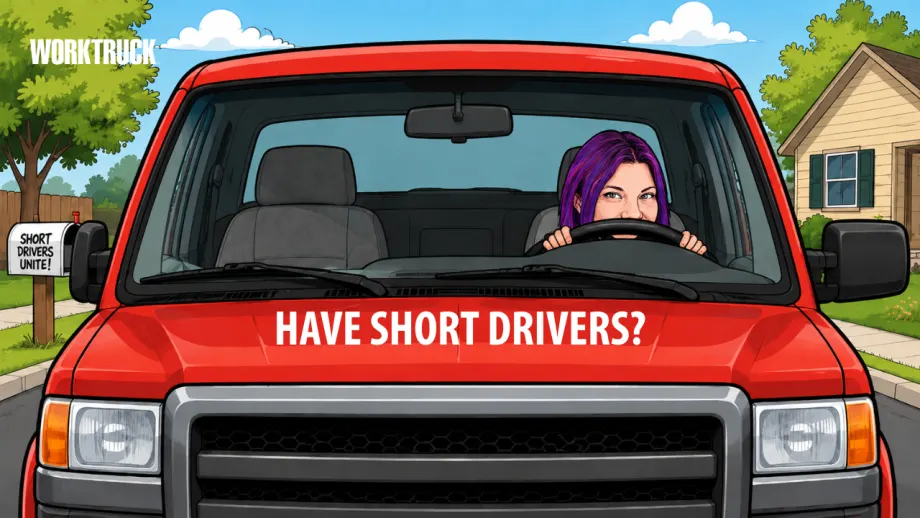
Work Truck | This image was generated with OpenAI. Please refer to our terms of use.
- Fleets need to consider the needs of shorter drivers, not just average height statistics, when specifying work trucks.
- Important features for shorter drivers include appropriate seat height, improved visibility, and reliable 360-degree cameras.
- Ensuring accessible cab entry, properly adjusted seat belts, and accommodating design are crucial for the safety and comfort of shorter drivers.
*Summarized by AI
How tall is the average truck driver? Federal research puts male truck drivers at about 5 feet 9 inches and female truck drivers at about 5 feet 4 inches, but an average doesn't tell you much about whether an actual driver can comfortably reach the pedals, see over the hood, or get in and out of a work truck all day. At 5'3", I know that firsthand.
I am 5'3", which means I have spent a good portion of my driving life moving seats forward, raising them as high as they'll go, lowering steering wheels, readjusting mirrors, and occasionally wondering whether the person who placed a particular grab handle had ever met someone my height.
In a passenger car, some of that is just annoying. In a work truck, it can affect how comfortably you reach the pedals, how much of the road and vehicle you can actually see, how close you have to sit to the steering wheel, whether the seat belt fits correctly, and how easily you can get in and out of the cab over and over again during a workday.
We spend plenty of time talking about making sure taller drivers have enough headroom and legroom, and we should. But ergonomics work in both directions. A truck that fits someone who is 6'4" beautifully can be a very different experience for someone who is 5'2" or 5'3".
Work trucks also make those differences harder to ignore. Drivers may be climbing in and out dozens of times, wearing work boots and PPE, maneuvering around jobsites, backing toward equipment, reaching controls, checking large mirrors, and trying to judge the end of a hood that can look approximately six miles long when you're sitting where I am.
So, "Can the driver fit?" isn't really a good enough question.
What Is the Average Height of a Truck Driver?
There isn't one authoritative number for the average height of a "fleet driver," especially when fleet drivers operate everything from sedans and vans to pickups, medium-duty trucks, and Class 8 equipment. But there is federal research specifically looking at the body dimensions of U.S. medium- and heavy-duty truck drivers.
The National Institute for Occupational Safety and Health conducted a large anthropometric study of 1,950 U.S. truck drivers, including 1,779 men and 171 women. Measurements were collected in 2009 and 2010, and NIOSH published the comprehensive findings in 2015 to provide better information for the ergonomic design of truck cabs. According to the NIOSH Anthropometric Study of U.S. Truck Drivers, male drivers in the study averaged 1,757 millimeters tall, or about 5 feet 9 inches, while female drivers averaged 1,626 millimeters, or about 5 feet 4 inches.
For comparison, the CDC's current adult body-measurement data puts average U.S. adult height at 68.9 inches for men and 63.5 inches for women, which also works out to just under 5'9" and 5'4", respectively.
But I wouldn't take those averages and start spec'ing every truck around a 5'9" man or a 5'4" woman, because the more interesting part of the NIOSH research is everything else researchers measured.
The study included 35 body dimensions, including leg and arm measurements, seated eye height, reach, and other factors that affect how someone actually fits inside a cab. Two drivers who are both 5'4" can have different leg lengths, torso lengths, arm reach, and seated eye heights, which means the exact same seat and steering-wheel position isn't necessarily going to work for both of them.
That's really the point.
A fleet isn't spec'ing for an average driver. It's spec'ing for the actual people who are going to use the truck.
Reaching the Pedals Is Only the Beginning
I can make myself reach the pedals in almost anything if I keep sliding the seat forward. The problem is what happens to everything else by the time I get there.
If I have to move too far forward to comfortably reach the accelerator and brake, I'm now closer to the steering wheel and air bag. My legs may be in a less natural position, the steering wheel probably needs to move, and the seat position that gets my feet where they need to be may not be the position that gives me the best visibility.
That isn't just about comfort. The National Highway Traffic Safety Administration recommends keeping at least 10 inches between the driver's breastbone and the air bag cover in the center of the steering wheel, while positioning the seat as far back as possible and still being able to comfortably reach the pedals.
For a shorter driver, that's the balancing act. I need to reach the pedals without sitting on top of the steering wheel, while also sitting high enough to see what I'm doing.
This is why fleets need to look beyond whether the spec sheet simply says "adjustable driver's seat."
A bare-bones manual seat may move forward and backward, but can it move up? Seat-height adjustment can make a huge difference for shorter drivers because it improves visibility without forcing us closer to the dashboard. A power seat with greater adjustability makes finding that position even easier, especially when a truck is shared by drivers who may differ by a foot or more in height.
The steering wheel matters, too. Tilt helps, but tilt and telescoping is much better because I can bring the steering wheel toward me instead of bringing my entire body toward the wheel.
This is one of those places where a fleet can save some money by ordering a lower trim level and accidentally remove something that isn't really a luxury for every driver.
Sometimes the upgrade is what makes the truck fit.
I Would Put 360 Cameras on the Short-Driver Must-Have List
There are trucks I've gotten into where my first thought is simply, "Wow. That is a lot of hood." Where your eyes sit changes what you can see around a vehicle, which is one reason seated eye height was among the dimensions included in the NIOSH truck-driver research. NIOSH has also noted that when a truck cab doesn't fit the driver's dimensions well, visibility can suffer and driving controls can become harder to reach.
You can read more in NIOSH's One Size Does Not Fit All overview of the research. And, this is also why I feel pretty strongly about 360-degree cameras.
For a shorter driver operating a pickup or medium-duty truck, I would put a good surround-view camera very close to the must-have list. No, a driver shouldn't rely on the camera instead of mirrors, turning their head, or knowing what's happening around the truck. That's not what I'm suggesting.
But another driver may physically have a better view over the hood or around part of the vehicle simply because their seated eye position is several inches higher than mine. A camera can give me information I can't get from the same physical vantage point.
A good 360-degree system is incredibly useful when parking, navigating a tight jobsite, judging the passenger-side corner, lining the truck up with equipment, or simply trying to figure out exactly how much vehicle is hiding below your natural line of sight. Front cameras are especially useful on trucks with tall hoods.
And I wouldn't stop at checking "backup camera" on the order sheet. Look at the screen size and image quality, whether the driver can call up a front or surround view while maneuvering at low speeds, what areas the cameras actually cover, and whether a body, rack, plow, or other upfit could interfere with them.
Parking sensors, blind-spot monitoring, and cross-traffic alerts can all add another layer of useful information as well. Not every work truck needs every technology available, but I also wouldn't automatically toss visibility tech into the same bucket as the nice-to-have features you're trying to eliminate to keep acquisition cost down.
Sometimes the tech earns its keep.
Bare Bones Isn't Always Better
I completely understand why work truck fleets gravitate toward basic trims. These trucks are tools, and there is no reason to load them up with features drivers don't need just because they're available. But there's a difference between skipping the fancy stuff and eliminating equipment that helps different-sized drivers properly operate the vehicle.
Power seats are a good example, as are power mirrors, a tilt-and-telescoping steering wheel, and meaningful seat-height adjustment. In a shared truck, being able to quickly reset those things is practical, especially if one driver is 5'3" and the next one is 6'2".
This is where I think fleet managers need to look past the trim-level name and really compare what's included. If the cheapest configuration leaves a portion of your driver population struggling to see over the hood or sitting closer to the steering wheel than they should just to comfortably reach the pedals, did you really spec the best truck for the job?
Are Telescoping Steering Wheels a Good Replacement for Adjustable Pedals?
Not really. A telescoping steering wheel helps a shorter driver bring the wheel closer without moving the seat as far forward, but it doesn't change how far their feet have to reach. Power-adjustable pedals did something different by bringing the accelerator and brake closer to the driver, which could make it easier to sit farther back while still maintaining comfortable pedal control.
For shorter drivers, the best setup is really about adjustability working together. Seat height, fore-and-aft travel, a tilt-and-telescoping steering wheel, and adjustable pedals all solve different parts of the fit problem. Adjustable pedals have become much harder to find (if possible at all) on newer pickups, but I maintain they still offer a benefit that a telescoping steering wheel alone can't completely replace.
Don't Forget the Seat Belt
Seat-belt fit is another small thing on the order sheet that gets much more noticeable when you're the short person wearing it for eight hours.
If the shoulder belt comes from a fixed point that's too high, it can end up riding against a driver's neck instead of sitting where it should across your shoulder and chest. The NHTSA seat-belt guidance says the shoulder belt should cross the middle of the chest and stay away from the neck, and it specifically recommends checking for seat-belt adjusters that can help provide a better fit.
Pay attention to whether the truck has an adjustable shoulder-belt anchor when you're evaluating vehicles that will be used by people of different sizes. It's a tiny feature often overlooked (and omitted from some base truck packages) until you're the one wearing it all day.
Getting Into the Truck Counts, Too
Work truck ergonomics can't stop once the driver is sitting behind the wheel. Of course I can still get into a taller truck. But the better question is how I'm getting into it and how often I'm going to repeat that movement during a shift.
A driver climbing in and out 20 or 30 times a day is going to notice step height, running-board placement, and grab-handle location very differently than someone who gets into the truck once in the morning and gets out at the end of the day. NIOSH has also pointed to easier truck entry as one of the practical applications of better anthropometric cab design.
For shorter drivers, a step that feels completely normal to someone taller can be a bigger reach. For taller folks, think about skipping a step up a staircase every time you go upstairs — sure you can do it, but it gets tiring quickly and can easily add strain on your muscles. The same applies to grab handles. Now put that driver in work boots, add gloves, rain, snow, mud, tools, or whatever equipment they may be carrying, and that small difference gets repeated throughout the day.
Running boards and intermediate steps can help, but placement matters. A step isn't particularly useful if reaching the first one already requires a minor rock-climbing expedition.
When evaluating the truck, have drivers climb in and out more than once and actually watch how they do it. There's a meaningful difference between "yes, I can get in" and "yes, I can comfortably do this all day."
The Upfit Can Change Everything
Then there is the part of work truck spec'ing that makes this different from selecting a normal passenger vehicle. You're probably going to add stuff. Probably a lot of stuff.
The truck that felt great during the demo may eventually have a tablet mount, center console, switch bank, radio, camera monitor, partition, or other equipment added to the cab. Once that happens, put your drivers back in it.
Can a shorter driver reach the tablet without leaning forward every time? Can they see the screen clearly from the seating position they need for pedal reach? Did a monitor or mount interfere with part of their view? Did anything move frequently used controls outside a comfortable reach zone?
The NIOSH anthropometric project was built around providing better information for ergonomic truck-cab design, and the same thinking needs to carry through to the upfit. The chassis that arrives from the OEM is not necessarily the truck your employee is going to spend the next several years driving.
The finished truck is what matters.
Don't Spec Around an Average Driver
The research gives us useful numbers. Male drivers in the NIOSH study averaged about 5'9", while female drivers averaged about 5'4". But I think the more useful lesson is why NIOSH measured nearly 2,000 drivers and 35 different body dimensions in the first place.
One average can't represent every "body." Luckily, fleets don't need their own federal research project to figure this out. Get your drivers in the truck, and don't just grab the 6-foot guy walking past the demo vehicle and decide that because he likes it, everybody is good.
Find your 5'2" driver, your 5'8" driver, and your 6'3" driver. Have them adjust the seat and steering wheel, set the mirrors, buckle the seat belt, use the cameras, drive it, back it up, park it, reach the controls, and climb in and out a few times.
Then, most importantly, ask what they noticed. You will learn more in 20 minutes than you will staring at three pages of specifications.
Spec the Truck for the People Doing the Work
Fleet spec'ing has always been about matching the truck to the job. Payload, towing, GVWR, body configuration, axle ratios, powertrains, storage, equipment, and cost all matter. But the person driving the truck is part of the application, too.
A truck can be perfectly spec'ed for what it needs to carry and still be a lousy fit for the person expected to operate it every day. Those little compromises show up every time someone has to stretch for a pedal, crane a little to improve their view, pull themselves into the cab, reach too far for a touchscreen, adjust a seat belt off their neck, or creep forward because they would really like to know where the front of that hood ends.
Over a full workday, those little things aren't so little anymore. So yes, make sure your 6'5" drivers fit. But don't forget those of us down here at 5'3". We need to reach the pedals safely, too. And being able to see over the hood would be a nice bonus.
Have taller drivers in your fleet, too? Our sister publication, Automotive Fleet, has a few things to say about that side of the ergonomics equation. Check out its guide to choosing the right vehicle for tall fleet drivers.
Quick Answers
Fleet managers should consider drivers' height to ensure comfort, enhance safety, and improve accessibility for all drivers, particularly shorter individuals who might face challenges with standard truck specifications.
*Summarized by AI
More Blog Posts
You Can't Tariff an Aluminum Smelter Into Existence
The U.S. wants to rebuild domestic aluminum production, but work truck manufacturers still need material today. What happens to costs and supply in the meantime?
Read More →
Can America Replace Canadian Truck Production Without Hurting U.S. Fleets?
U.S. tariffs are targeting Canadian truck production, but Ford and GM show why moving that manufacturing south isn’t so simple. After 60 years of building one North American supply chain, what could fleets lose by pulling it apart?
Read More →
The Fleet Skills We Keep Missing on Veterans’ Resumes
What if some of the strongest candidates are already out there, but we are overlooking them because their experience is written in a language our industry does not always recognize?
Read More →
Technicians Are Doing More Than Turning Wrenches
Technicians do far more than repair vehicles. Six professionals reveal the problem-solving, pressure, and pride behind keeping fleets moving.
Read More →
WWCD? What Would Coach Do?
A personal reflection on Ed "Coach" Bobit, the mentor who shaped my career, and why I still ask myself one question 12 years later: WWCD?
Read More →
What the Fleet Industry Still Gets Wrong About Talent
What can the fleet industry learn from the women helping shape its future? A look at talent, leadership, sponsorship, and why new perspectives drive progress.
Read More →
AI Isn’t Killing Content, but Lazy Expertise Is
Thought leadership loses value when AI does the thinking. Here’s why authentic industry voices still matter most.
Read More →
Do I Need a U.S. DOT Number?
Whether you operate a small fleet of light-, medium-, or heavy-duty units, or are merely the owner of one truck wanting to ensure you adhere to the law, knowing if you can need a U.S. DOT number can be confusing.
Read More →
Is Retirement in Fleet Now More Like ‘Rewiring’?
Fleet professionals rarely retire for good. They return as advisors, mentors, and consultants, keeping hard-won experience in the industry.
Read More →
What Does Visibility in Fleet Really Look Like?
Advocacy changes things. Visible trust changes things. Structure changes things. Access changes things. A willingness to share connections, rooms, and opportunities, and a belief in someone before it is convenient, changes things.
Read More →