




Do Pickups Need Better Seat Belt Reminders?
Out of 10 pickup trucks recently evaluated by the Insurance Institute for Highway Safety (IIHS), only one earned a good rating. Which Toyota made the cut?

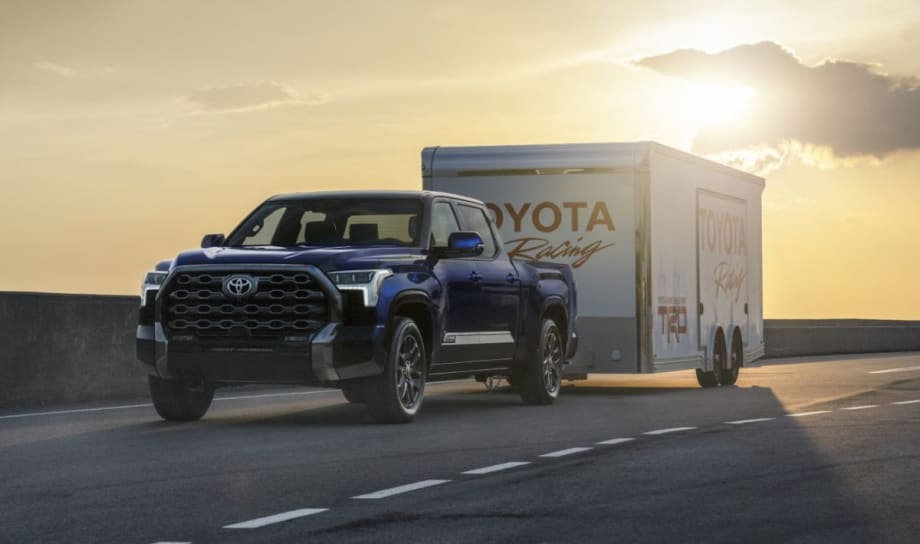
Only the Toyota Tundra Crew Cab earned a good rating on the seat belt reminder test from the IIHS.
Photo: Toyota
Pickups are falling short when it comes to effective seat belt reminders. Out of 10 recently evaluated by the Insurance Institute for Highway Safety (IIHS), only one — the Toyota Tundra crew cab — earns a good rating, while five are rated poor.
“National belt use observations show that people driving or riding in pickups are less likely to buckle up than occupants of other vehicles, so effective reminders are especially important for these vehicles,” says IIHS President David Harkey.
Nearly a third of pickup occupant deaths in 2020 occurred in rollover crashes, in which seat belt use plays a key role because of the risk of ejection. IIHS launched a new ratings program in March to encourage manufacturers to improve their seat belt reminders.
Federal standards specify that seat belt reminders must include an audible signal that lasts for 4-8 seconds total and a visual alert that lasts at least 60 seconds when the driver’s seat belt is unbuckled at ignition. However, previous IIHS research has shown that more noticeable and persistent alerts could increase belt use among those who do not routinely buckle up by as much as 34%, preventing around 1,500 fatalities a year.
“This is a solvable problem,” Harkey says.
To earn a good rating from IIHS, a seat belt reminder system must generate an audible signal and visual alert on the dashboard display, overhead panel or center console when the vehicle is moving at least 6 mph and the system detects an unbelted occupant in the driver or passenger seat or the unfastening of a second-row belt that was previously buckled. Along with other specifications, the audible alert must be loud enough to be heard over the background noise in the vehicle cabin and last at least 90 seconds. A visual indicator must show second-row belt use when the driver starts the vehicle, and an audible and visual reminder lasting at least 30 seconds is required when a fastened second-row belt is unbuckled. Of the pickups evaluated — all crew cab versions — only the Tundra meets all those requirements.
Two small pickups, the Hyundai Santa Cruz and Nissan Frontier, satisfy the requirements for the front row but only earn an acceptable rating because neither vehicle features a second-row reminder. Five of the 10 vehicles tested are rated poor: the Chevrolet Colorado, Chevrolet Silverado, Ford F-150, Ford Maverick, and Ford Ranger.
Most of these pickups have front-row reminders that are loud enough, but all are shorter than 8 seconds in duration — the minimum length needed for a marginal rating.
The Ram 1500 and Toyota Tacoma each earn marginal ratings. Both vehicles meet the volume and frequency requirements for the front-row belt reminder. However, at only 30 seconds in duration, the Tacoma’s reminder is too short. The Ram 1500’s reminder does not begin soon enough when a front occupant is unbuckled at the 25 mph test speed.
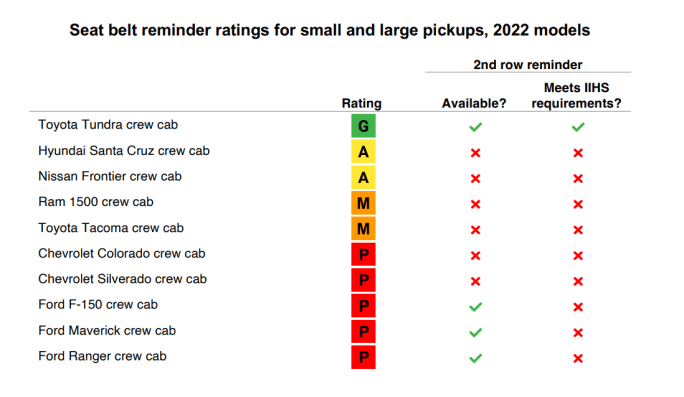
Out of 10 pickup trucks evaluated by the IIHS, only one earned a good rating.
Source: IIHS
Next, check out how to prevent accidents through technology.
More Safety
When Work Trucks Under 26,001 Pounds Need IRP Registration
Think trucks under 26,001 pounds are automatically in the clear when it comes to IRP? Not always. Learn where lighter vehicles can still run into trip permit, apportioned registration, and IFTA compliance requirements when crossing state or provincial lines.
Read More →
Volvo Trucks Releases New Safety Recommendations for Traveling with Pets
One of the most important recommendations for professional drivers traveling with pets is to ensure pets are properly restrained while the truck is moving. Other tips are available in the new guide from Volvo Trucks North America and Center for Pet Safety.
Read More →
API Issues Refueling Safety Guidelines
The American Petroleum Institute offers a list of safe vehicle refueling guidelines, including ways to avoid potential problems with static electricity discharges in fall, winter, and early spring.
Read More →
Winter Fleet Prep: Expert Tips to Keep Vehicles Running Smoothly
Cold weather can expose weak batteries, tires, fuel systems, and maintenance gaps fast. Use this winter fleet checklist to prepare trucks and drivers before temperatures drop.
Read More →
When a Work Truck Breaks Down, the Job Can Stop, Too
A work truck breakdown can stop more than the vehicle. Discover how payloads, jobsites, and specialty equipment change the roadside response.
Read More →
What Stronger Long-Term Fleet Service Partnerships Actually Require
Fleet service partnerships rarely fall apart all at once. Learn the three warning signs that trust is eroding and what fleets and providers can do before downtime, frustration, and lost revenue follow.
Read More →
Applause & TRUCE Software Partner to Improve Driver Safety Through AI-Powered Telematics & Employee Performance Management
Applause has integrated TRUCE driving metrics directly into its employee-first performance and safety platform that transforms mobile devices into AI-powered telematics.
Read More →
How Detroit Assurance with Active Brake Assist Works
Do you want to see what it is like to experience Detroit Assurance’s Active Brake Assist? In this video, Work Truck will put you in the cab to see how it all works and then hear more details from DTNA’s Mike Young.
Read More →
Get Left of Loss: A 5-Step Workplace Violence Prevention Framework for Fleet Operators
Violence risks do not stop at the driver’s door. Learn five practical steps fleets can take to spot threats early and protect workers before loss occurs.
Read More →
How Better Visibility Cut Speeding Violations by 48%
Fleet leaders don't need more data, they need clearer visibility into what the data is saying. This case study explores how one utility replaced speeding-event counts with a single metric — miles driven in violation — to strengthen safety and significantly reduce speeding violations.
Read More →