





Keep Learning: Innovative Truck and Van Upfits
How Pest Control Fleets Reduce Downtime and Control Costs
Working hard to keep the pests away, these vocational fleets have varied upfitting requirements and have to do all they can to reduce downtime and keep vehicles on the road.
October 12, 2016
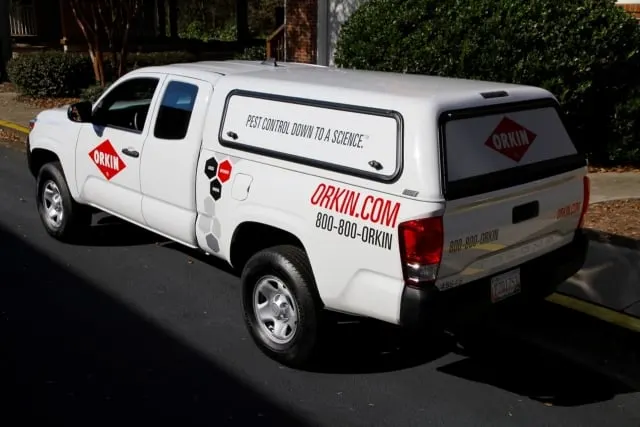
The majority of the Rollins fleet are light-duty Toyota Tacoma trucks, with decals, a topper, toolbox, telematics, cargo net, and other items as standard upfits.
Credit:
Rollins, Inc.
5 min to read
- Pest control fleets work diligently to maintain pest-free environments.
- These fleets face diverse upfitting needs to stay operational.
- Minimizing downtime is crucial to keeping their vehicles active.
*Summarized by AI
Pest control fleets are crucial to helping keep businesses and residences pest- and rodent-free. Most pest control fleets have both sales and service vehicles, with service vehicles requiring a variety of upfits for storing tools and products.
Two pest control fleets share their challenges and successes in their specific vocational industry.
Massey Services Reduces Downtime
Massey Services, Inc., is a pest prevention, termite protection, and landscape care company headquartered in Orlando, Florida. Fleet vehicles are driven to homes for meetings with prospective customers or to provide services to current customers.
The fleet of 1,777 vehicles includes around 1,000 light-duty trucks, with the remainder consisting of medium-duty trucks, cars, and vans. Each vehicle drives approximately 18,000 miles annually. In the company’s GreenUP landscaping division, upfitting has a major impact.
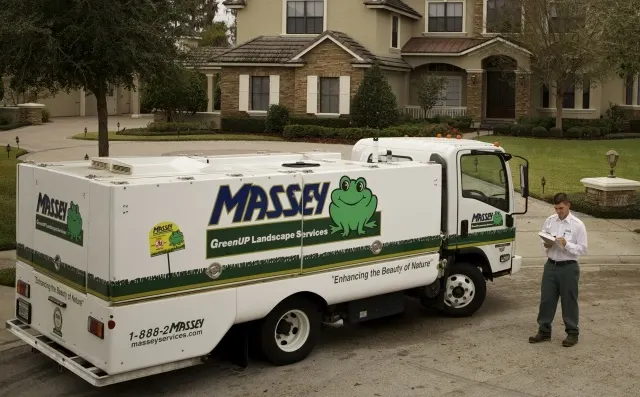
The 1,777-vehicle fleet mostly uses light-duty trucks and upfitting in its GreenUP landscaping business, as well as in its pest control fleet.
Credit:
Massey Services
“We install several tanks and a pumping system onto the chassis of our medium-duty vehicles. This is a significant investment and requires two months of production time to prepare the vehicle so it is ready for service,” explained Eric Hernandez, vice president, Fleet and Assets for Massey Services.
The company noted recent success in streamlining its vehicle ordering process.
“We have been working with our local dealers and decal company to get vehicles issued in a timelier manner and, as a result, have cut our vehicle procurement time by 40%. Additionally, we have implemented monthly training on safe driving to keep awareness a top priority,” Hernandez said. “Massey Services does not have a fixed time frame for taking vehicles out of service. We have service centers that cover a small portion of a zip code and service centers that cover several counties, which allows us to move higher mileage vehicles to service centers with smaller geographical areas so they can remain in service as long as possible.”
Being a service provider, downtime is a top challenge for Massey Services.
“We have developed great working relationships with our local repair vendors to ensure a quick turnaround when our vehicles require repairs,” Hernandez said.
One item causing both economic and downtime impacts is related to vehicle production.
“Our biggest economic factor is the car industry does not mass produce vehicles and have them ‘sitting on a lot’ ready for purchase. This requires more planning on our part, which is challenging when we require replacement immediately. We run a lean fleet so we don’t have non-producing vehicles readily available,” Hernandez said.
A second challenge is maintenance/repair awareness, which means taking care of a vehicle through routine maintenance education, according to Hernandez.
“Our third challenge is just-in-time vehicle ordering, which requires knowing how to manage your fleet not just by age and mileage reports, but by monitoring repairs to determine when it is no longer cost-effective to maintain older vehicles,” he said.
To succeed in the pest prevention fleet industry, Massey Services follows the following top three best practices:
- Lean lease management by budgeting three times a year.
- Continuous repair and maintenance of vehicles to ensure they remain in service.
- Monthly vehicle inspections to ensure they reflect the Massey image.
Rollins Focuses on Safety & TCO
Rollins, Inc., is a global consumer and commercial services company. Through its wholly owned subsidiaries, which include Orkin LLC, Western Pest Services, HomeTeam Pest Defense, Critter Control, Inc., Crane Pest Control, Waltham Services, and others, the company provides pest control services and protection against termite damage, rodents, and insects to more than 2 million customers.
The fleet travels approximately 210 million miles each year and is utilized for the delivery and sales of pest control services. The fleet of 9,500 vehicles consists mainly of light-duty trucks, but also includes cars, medium-duty trucks, vans, and crossovers.
Upfitting plays a major role in the pest control fleet industry, and Rollins utilizes it in some fashion on all fleet vehicles.
“All sales, service, and branch management vehicles go through upfitting. Sales and management sedans install decals and telematics, while our light-duty service trucks have a standard install of decals, topper, toolbox, telematics, cargo net, and several miscellaneous items. Available optional equipment includes water tanks, spray units, and special toolboxes,” according to Paul Youngpeter, managing director, Fleet & Corporate Services for Rollins, Inc.
In 2012, the Rollins fleet transitioned from closed-end leases to open-end leases. “Since the transition, we have realized savings of $12 million in depreciation expense over the past three years,” Youngpeter said.
For Rollins, one of the top challenges revolves around accident reduction and safety.
“To address safety, we have implemented company-wide driver-specific training (Alert Driving) and are testing cell phone control technology aimed at disabling phones while the vehicle is moving,” Youngpeter said.
In addition, upfitting is a challenge, with specialized upfits needed and the goal to reduce downtime.
“To ensure smooth upfitting processes, we conduct an annual planning meeting with all vendors associated with the ordering, upfitting, and delivery of our trucks. We cover everyone’s role and lay out specific delivery timelines and expectations, then walk through each step of the process to ensure good coordination and communications,” he said.
One additional challenge has been increasing acquisition costs.
“Over the past five years, the cost of our primary vehicle has doubled due to the elimination of the Ford Ranger,” Youngpeter said.
To remain successful in the pest control fleet industry, Youngpeter follows three best practices:
- Delivery planning and meetings to ensure all vehicles arrive within the target time frame.
- Upfitting to ensure a job-ready vehicle upon delivery and consistent appearance of our brands.
- Annual total cost of ownership (TCO) analysis to offset the impact of rising vehicle costs.
In the pest control industry, fleet is the third-largest line item expense behind payroll and materials, according to Youngpeter.
“As such, it receives plenty of attention and has a significant impact on the bottom line. On the good side, we receive a lot of executive management support for our initiatives,” he concluded.
Quick Answers
Reducing downtime ensures that pest control fleets can maintain continuous operational efficiency and remain available to meet client demands, which is crucial for business success.
*Summarized by AI
Subscribe to Our Newsletter
More Safety
When Work Trucks Under 26,001 Pounds Need IRP Registration
Think trucks under 26,001 pounds are automatically in the clear when it comes to IRP? Not always. Learn where lighter vehicles can still run into trip permit, apportioned registration, and IFTA compliance requirements when crossing state or provincial lines.
Read More →
Volvo Trucks Releases New Safety Recommendations for Traveling with Pets
One of the most important recommendations for professional drivers traveling with pets is to ensure pets are properly restrained while the truck is moving. Other tips are available in the new guide from Volvo Trucks North America and Center for Pet Safety.
Read More →
API Issues Refueling Safety Guidelines
The American Petroleum Institute offers a list of safe vehicle refueling guidelines, including ways to avoid potential problems with static electricity discharges in fall, winter, and early spring.
Read More →
Winter Fleet Prep: Expert Tips to Keep Vehicles Running Smoothly
Cold weather can expose weak batteries, tires, fuel systems, and maintenance gaps fast. Use this winter fleet checklist to prepare trucks and drivers before temperatures drop.
Read More →
When a Work Truck Breaks Down, the Job Can Stop, Too
A work truck breakdown can stop more than the vehicle. Discover how payloads, jobsites, and specialty equipment change the roadside response.
Read More →
What Stronger Long-Term Fleet Service Partnerships Actually Require
Fleet service partnerships rarely fall apart all at once. Learn the three warning signs that trust is eroding and what fleets and providers can do before downtime, frustration, and lost revenue follow.
Read More →
Applause & TRUCE Software Partner to Improve Driver Safety Through AI-Powered Telematics & Employee Performance Management
Applause has integrated TRUCE driving metrics directly into its employee-first performance and safety platform that transforms mobile devices into AI-powered telematics.
Read More →
How Detroit Assurance with Active Brake Assist Works
Do you want to see what it is like to experience Detroit Assurance’s Active Brake Assist? In this video, Work Truck will put you in the cab to see how it all works and then hear more details from DTNA’s Mike Young.
Read More →
Get Left of Loss: A 5-Step Workplace Violence Prevention Framework for Fleet Operators
Violence risks do not stop at the driver’s door. Learn five practical steps fleets can take to spot threats early and protect workers before loss occurs.
Read More →
Sponsored•July 17, 2026
How Better Visibility Cut Speeding Violations by 48%
Fleet leaders don't need more data, they need clearer visibility into what the data is saying. This case study explores how one utility replaced speeding-event counts with a single metric — miles driven in violation — to strengthen safety and significantly reduce speeding violations.
Read More →