




McKenna Meets the Downtime Problem Head On
Downtime equals lost revenue, and this is especially the case in the construction fleet industry. When a McKenna truck or piece of equipment goes down, the mechanic truck comes to the rescue.

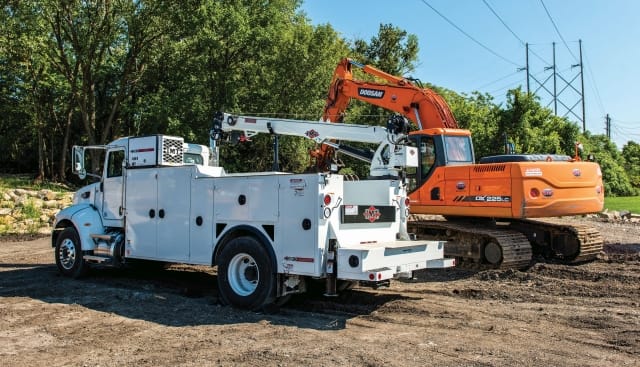
For its service truck fleet, McKenna General Engineering Inc. uses the Dominator II mechanics truck.
IMT
- Downtime in the construction fleet industry leads to lost revenue for companies like McKenna.
- McKenna addresses equipment downtime by deploying a mechanic truck to perform necessary repairs.
- Ensuring prompt maintenance helps McKenna minimize disruptions and maintain operational efficiency.
*Summarized by AI
Construction fleets are unique in their vehicle fleet composition and operation. But one commonality they have with most other fleets is the impact and cost of vehicle and equipment downtime.
The McKenna General Engineering, Inc., fleet consists of around 90 units, including 23 light- and medium-duty trucks, two SUVs, and 60 pieces of heavy construction equipment, including scrapers, loaders, excavators, dozers, rollers, compaction equipment, and water towers.
Three of the fleet’s medium-duty vehicles are mechanics trucks (including a Dominator II mechanics truck with an IMT 10000 telescopic crane, a Dominator II mechanics truck with an IMT 6000 telescopic crane).
Additionally, the fleet operates one fuel truck and one low-bed hauler. The fuel truck is dispatched from the yard and visits multiple job sites each day to refill machines. The low-bed hauler is dispatched from the yard and is used to perform moves and part deliveries when necessary.
The fleet’s scrapers, loaders, excavators, dozers, compaction equipment, water towers, and rollers are used for site prep and engineering construction on residential, municipal, and commercial projects.
The Downtime Challenge
Founded in 2002, McKenna General Engineering, Inc. is a heavy engineering construction company based in Corona, California. And as with any fleet, McKenna only makes money when its equipment is up and running.
“Because time is money in construction, any downtime negatively impacts the bottom line, costing everyone. When I need to fix a machine, I need the tooling, parts, and capabilities to make that repair, no matter where that machine happens to be,” explained Jason Caufield, VP of McKenna and manager of the fleet’s service trucks.
The solution? A mechanics truck with the right crane, welding equipment, parts storage, and tooling helps the company remain efficient and get broken-down machines and equipment up and running again.
“The equipment we have is expensive to move, and we don’t have it in the budget for our jobs to be moving it, so it really needs to be repaired onsite. Usually, we can repair them ourselves within an hour,” Caufield said.
Mechanics trucks are dispatched to job sites for equipment service and repairs. Depending on the need, they can drive between sites or stay at one site for an extended period.
“We try to use a mechanics truck to bring the workshop to the worksite. We proactively stock our mechanics trucks with the parts we know we’re going to be replacing most often. Because these repairs are just normal wear-and-tear items, not really damage so to speak, we know to stock small, simple components such as hoses, electrical switches, breakers, bolts, bolt bends, electrical switches, and sensors,” Caufield noted. “We also try to keep up with the latest technology on the trucks and maintain the trucks to the best of our ability. The reliability of the newer trucks is worth the investment because nobody wants to spend extra time servicing a service vehicle.”
Additionally, remote controls have made operating the mechanics trucks and service cranes much more efficient.
“Instead of having to climb on and around the truck to turn items on and operate them, the remote control consolidates these onto one device, saving time and hassle. Crane size and speed have made operations more efficient, and the shrinking size of air compressors has freed up more usable space for parts storage,” Caufield said.
The Bottom Line
In the end, if McKenna had to bring every out-of-service machine back to the yard, “it could put us out of business,” Caufield commented.
“Not only would it cost us between $600 and $1,000 each way to transport a machine back to the yard, but that’s also time the machine is not working. And, because our area of operations includes all of California and occasionally jobs in Arizona and Nevada, that could cost us days of possible uptime. Instead, we make many of our repairs within an hour, and rarely does a machine go out of service for more than six hours,” he concluded.
More Operations
Family Ties Inside the Fleet Families Building Careers Across Generations
Three fleet families share what it really takes to work together, learn across generations, and keep business from following them home.
Read More →
Shades of Fleet Call for Voices: Fleet's Hidden Heroes
Fleet’s hidden heroes are often the ones keeping everything moving behind the scenes. September’s Shades of Fleet is looking for dispatchers, coordinators, parts specialists, and other support pros to share their stories.
Read More →
Truck Centers, Inc. Celebrates National Truck Driver Appreciation Week with $1,000 Fuel Card Giveaways
During National Truck Driver Appreciation Week, Truck Centers, Inc. is offering customers a chance to fuel up for free. Customers at all Truck Centers locations can enter to win one of four $1,000 fuel cards from Sept. 14 - 18.
Read More →
Fleet Guides, AI Time-Savers, Truck Tariffs & Fuel Strategy Lead the News
This week’s Truck Chat Cheat Sheet covers new fleet vehicle guides, practical AI use cases, U.S.-Canada truck production, mixed-energy strategy, and more.
Read More →
What Fleet Employers Are Missing When Hiring Veterans
What if some of the strongest candidates for fleet are already out there, but their experience is written in a language our industry does not always recognize?
Read More →
Automotive Fleet Opens 2026 Personal Use Survey for Commercial Fleet Managers
Less than two weeks left! Commercial and corporate fleet managers are invited to share how their organizations handle company vehicle personal-use policies, charges, and driver eligibility.
Read More →
What Resilient Fleets Do Differently When Conditions Change
Fleet resilience is about more than reacting to disruption. Lauren Fletcher talks with AP Fleet’s Alex Coveney about flexibility, planning, scaling, and what helps fleets adapt when business conditions shift.
Read More →
If We Want the Next Generation in Automotive, We Have to Give Them a Reason to Care
The automotive industry talks constantly about its workforce shortage. But before we can recruit the next generation, we may need to do a better job giving kids a reason to care about automotive in the first place.
Read More →
Ram ProMaster City Under $40K, Truck Tariffs, and AI Maintenance Lead the News
A sub-$40K commercial van, tariff questions, AI-powered maintenance, and a new EV production strategy headline this week’s Truck Chat Cheat Sheet.
Read More →
Bob Adamsky Shares the Fleet Lessons You Usually Learn the Hard Way
After more than 30 years in fleet, Arrow International’s Bob Adamsky has learned that the job is about far more than vehicles. He shares the lessons he wishes every fleet manager could learn a little earlier.
Read More →