





Learn More: Your Disaster Response & Preparation Guide
Free Online Disaster Planning Resources for Fleets
When fleet managers are planning to mitigate the risks associated with natural disasters, they have online tools at their disposal. Most are provided by government agencies. Here are details about several valuable resources that are free.
May 29, 2025
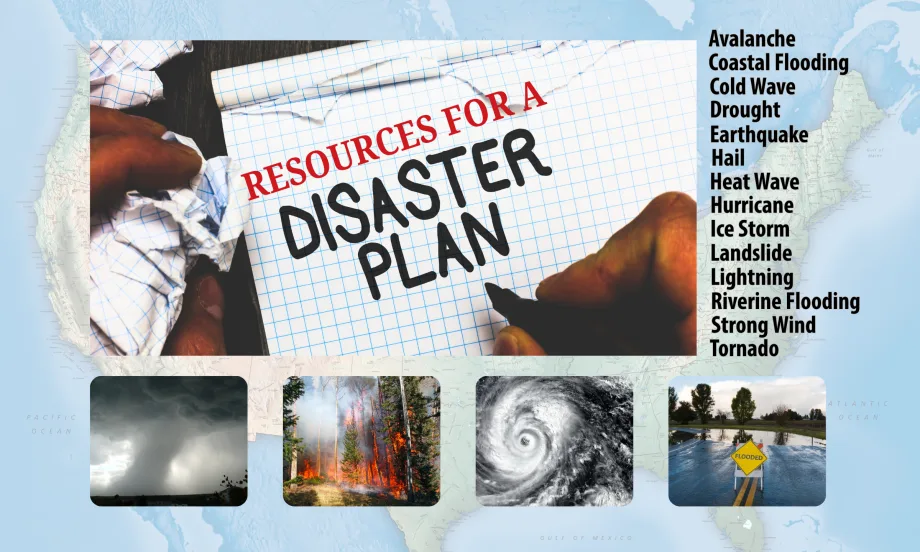
There are 18 recognized natural hazards in the U.S. and fleet managers can use online tools to assess the risk for specific locations well ahead of any natural disaster. Many are provided by government agencies, free.
Photo: Work Truck
5 min to read
While fleet managers have an abundance of information at their fingertips from fleet management companies, fuel management companies, and telematics providers, there are still some additional resources available to help them prepare for natural disasters.
Want to know what the greatest natural disaster risks are for your location, or any of your locations?
Want to track inbound weather that might threaten a jobsite or one of your facilities?
What if you want to help your employees and drivers be better prepared for a natural disaster?
Those answers are easy to find online and, for the most part, are provided by the federal government.
The Federal Emergency Management Agency (FEMA) recognizes 18 natural hazards. For each of those hazards, FEMA provides extensive data that any fleet manager can sort to create a detailed report of the risk profile for one or even multiple locations
The 18 natural hazards, as outlined by FEMA, are:
Avalanche
Coastal Flooding
Cold Wave
Drought
Earthquake
Hail
Heat Wave
Landslide
Lightning
Riverine Flooding
Strong Wind
Tornado
Tsunami
Volcanic Activity
Winter Weather
FEMA National Risk Index
The Federal Emergency Management Agency (FEMA) provides the National Risk Index Map as a tool for individuals, businesses, governments, and communities to evaluate risk from 18 natural disasters.
It leverages available source data for natural hazards and community risk factors to develop a baseline risk measurement for each United States county and Census tract.
How to use it:
Click Explore the Map
Enter your location of interest by city, county, or address
This generates a Risk Index Overview for that location
Use this to review which natural disasters are most likely and see Hazard Type Risk Ratings for each of the 18 natural disaster types.
Create Report – A button located at the lower right allows you to create a report, which can be shared or printed for use in disaster planning.
Compare to Other Counties – This will generate a report that compares multiple locations. For example, if you have fleet offices in multiple locations, this allows you to gain a single-pane view of risk factors across your entire operation.
This is a powerful tool that assembles the data you need to determine which natural disasters can potentially impact your fleet and provides insights into the level of risk associated with each.
You can explore the National Risk Index Map on FEMA’s website.
National Weather Service Radar
The National Weather Service is a valuable resource for evaluating current and impending weather risks. A great starting point is to visit the NWS Radar webpage directly.
The main landing page provides an overview of the U.S. map. However, when you enter a location in the search window, the map displays warnings by county. Alerts are provided in a drop-down menu for the selected area.
A good approach is to watch the weather that is heading into your area before it arrives.
Suppose you are under a tornado watch in your location, meaning conditions exist for a possible tornado to develop. But, to the west of you, a neighboring county is under a tornado warning, typically meaning rotation has been detected on radar.
On the NWS Radar page, you can see the details of the warnings for that community and watch the storm’s track to know when it is heading your way. While many apps and smartphone features will sound an alert when your area is issued a warning, using this map allows you to see warnings in other adjacent areas and explore the details, providing an advanced look at potential threats that may reach your location.
National Hurricane Center
The National Hurricane Center and Central Pacific Hurricane Center, part of the National Oceanic and Atmospheric Administration, are a resource when understanding the risk and threat of hazardous tropical weather.
The purpose of each, according to the federal website, is:
“The NHC mission is to save lives, mitigate property loss, and improve economic efficiency by issuing the best watches, warnings, forecasts, and analyses of hazardous tropical weather and by increasing understanding of these hazards.”
“The CPHC issues tropical cyclone warnings, watches, advisories, discussions, and statements for tropical cyclones between 140 degrees west longitude to the International Dateline.”
The centers provide estimates of the number of named storms each year with analysis.
When storm season kicks into gear, the National Hurricane Center’s website provides a Seven-Day Graphical Tropical Weather Outlook with a map and details. The maps, which include Atlanta, the Eastern Pacific, and the Central Pacific, also provide a two-day outlook.
The NHC also provides a series of preparedness articles, which can be found on the center’s website.
Preparing Disaster Kits for Home, Office & Drivers
There are several online options available for those seeking guidance on assembling disaster kits and supplies. While most offer tips and lists for disaster kits for homes and families, fleets may want to assemble appropriate kits for drivers who may be stranded in unique situations, like extreme heat, extreme cold, or winter weather.
Ready.gov: Tips from Homeland Security
The U.S. Department of Homeland Security provides a website, Ready.gov, as a resource for disaster education and preparedness. Included among the resources is a downloadable set of Hazard Information Sheets.
The site also provides downloads such as “Know Your Alerts and Warnings,” “Are You Ready? Guide,” and “Document and Insure Your Property.”
Also, a checklist of essential items is available to help individuals prepare a disaster kit that can sustain them for several days. Suggested items include food, water, a first aid kit, a local map, cell phone chargers, and more.
Other online sources for disaster kit planning include:
Get Prepared, Government of Canada website
British Columbia’s emergency management website
U.S. states' emergency management agencies’ websites
Develop Crisis Communications Plans
Another aspect of preparing for natural disasters is developing crisis communications plans.
According to Ready.gov, “The crisis communications plan is an important component of a business’ preparedness program. A business must be able to respond promptly, accurately, and confidently during an emergency in the hours and days that follow.”
In advance, you should plan methods of communicating with:
Employees
Customers
Suppliers
Management
Government officials and regulators
Contact information for each category should be compiled in advance and accessible during and after a disaster. Ready.gov provides additional information on communication planning.
Subscribe to Our Newsletter
More Operations

ATRI Names Next President and CEO
Page Siplon, a longtime transportation and logistics industry executive, has been chosen as the next president and CEO of the American Transportation Research Institute (ATRI).
Read More →
Coltrain Onsite Fleet Care Sponsors 2026 Cure Bowl to Support Cancer Research
The mobile fleet maintenance provider is supporting the annual college football bowl game, which has helped raise $6.83 million for cancer research since 2015.
Read More →
Racing Lessons, Electric Fleet Growth, and Ghostbusters Lead This Week's Work Truck News
Racing lessons for fleets, Republic Services' electric truck expansion, 40 years of fleet wisdom, truck trivia, autonomous yard trucks, and more headline this week's Truck Chat Cheat Sheet.
Read More →From Our Partners
Basic Tracking vs Next Generation Fleet Technology
Sponsored by AT&T Business

5 Facts Every Fleet Manager Should Know About Embedded Telematics
Sponsored by Stellantis/Mobilisights

How AI Video Telematics Boosts Driver Safety and Helps to Avoid Unnecessary Costs
Sponsored by Verizon Connect

Charting the 8 Bottom-Line Benefits of Workforce Optimization
Sponsored by Verizon Connect

Sponsored•October 14, 2026
A buyer's guide to fleet management software in 2027
Buying fleet management software in 2027 means looking beyond features and price. As fleet operations, technology and expectations evolve, this guide explores what today’s fleet professionals should consider when choosing a system that can deliver value now and adapt to what comes next.
Read More →
How to Build a Lasting Fleet Career by Staying Curious and Connected
Tina Kourakos never planned on a career in fleet. More than 30 years later, she says curiosity, strong relationships, and a willingness to keep learning helped turn an unexpected assignment into a career spanning fleet management and OEM leadership.
Read More →
Think You Know Trucks? Take Our 19-Question Fleet Trivia Challenge
From chicken lights to diesel engines and trucking history, test your knowledge with 19 questions from the 2026 Work Truck Exchange and Heavy Duty Trucking Exchange.
Read More →
Where’s My Truck: Inside the Fleet Logistics Work Nobody Sees
Shades of Fleet video thumbnail featuring Lauren Fletcher beside the text “The People Behind the Process, Keeping Fleets Moving,” with fleet vehicles and logistics imagery in the background.
Read More →
Work Truck Seeks Fleet and Industry Insights on 2026 Trends and 2027 Forecasts
Work Truck is seeking insights from fleet leaders and industry partners on the trends that shaped 2026 and what commercial fleets should prepare for in 2027. Participate today!
Read More →
It's 10 p.m... Do You Know Who Has Access to Your Fleet?
Preventing cargo theft requires investment in technology, operational processes, and employee training. In an industry with tight margins, it can be difficult to justify investments whose value is measured by incidents that might never occur.
Read More →
GeoFencing Adds to Your Truck Security Arsenal
Geofencing is a familiar fleet tool today, but its early adoption marked a major shift in vehicle tracking, route monitoring, and the debate over employee privacy.
Read More →