





Motive Unifies Cold Chain Visibility & Cargo Security into a Single Sensor
Motive Focuses on Integration & Automation as it Rolls Out New AI-Driven Systems & Hardware
Motive unveiled new AI-driven safety tools, systems, and hardware during its annual innovation summit. New launches included the Atlas AI assistant, Automations, AI Omnicam Plus, and updates to AI Dashcam Plus.
May 28, 2026
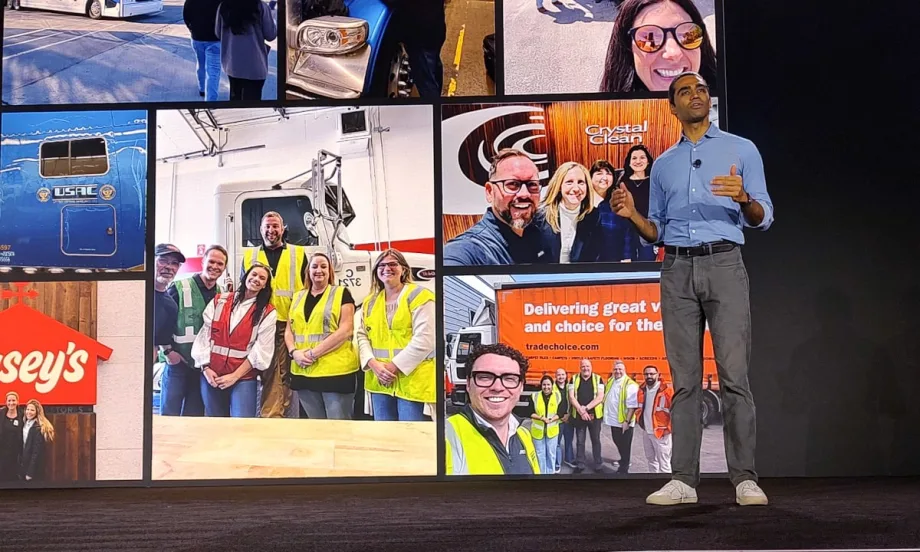
Shoaib Makani, CEO and co-founder of Motive, talks about how his team has worked closely with a variety of customers while addressing the audience at Motive Vision26, the company’s annual innovation summit. Motive employees have traveled more than eight million miles collectively in the past year to meet with customers.
Credit:
Wayne Parham
9 min to read
As Shoaib Makani, CEO and co-founder of Motive, kicked off the opening keynote for this year’s Vision conference, he said the company is focused on two things that will help fleets: integration and automation.
Motive Vision26, this week in Nashville, Tennessee, marked the company’s third annual innovation summit and the largest attendance to date, with more than 1,000 people. The signature Motive event brought together fleet leaders from across the United States, Mexico, Canada, and the United Kingdom. Collectively, those fleet professionals represent companies that employ more than three million people and operate more than two million vehicles and assets.
But, he explained that Motive's interaction with fleets and organizations extends far beyond just the annual conference.
“One of the great privileges of working at Motive is getting to spend time with you all in the field and on the road. In the last year, our team racked up more than eight million miles on the road and in the air,” Makani said. “We had more than 4,000 meetings at your offices, your depots, your terminals, your yards, and everywhere else that you do work.”
Makani explained what he sees as the key challenges facing fleets and other businesses that manage assets.
“There's too much fragmentation in the tools you use, which leads to operational complexity, and there's far too much manual work, which is dragging on your productivity,” he explained.
The solution, Makani added, is integration and automation — two areas in which Motive has been providing solutions, either through new product launches or updates to existing products.
“These are two North Stars when we think about building technology for you. How can we build products that work together to break down data silos and give you one integrated view of your operations, and how can we automate the manual workflows so that you can focus on the things that matter most?” Makani said.
“What started as a simple fleet management solution has evolved into an integrated operations platform,” he continued. “Six products each can be used standalone, but the magic happens when you use them together: driver safety, fleet management, equipment monitoring, spend management, workforce management, and AI vision.”
“This year, we took integration beyond software into the world of hardware.”
Makani said the standard paradigm in this industry has been a telematics device for fleet management and a dash cam for driver safety, adding that it made sense in a world where dash cams were options, but today they are essential.
“We combined telematics and cameras into one device. That means faster install, one point of failure instead of two, and a horizontal profile that looks great in your vehicles and doesn't obstruct your driver's view,” Makani explained. “We added three times more processing power to learn more AI models, two noise-canceling microphones, and a speaker to enable live two-way communication.”
With AI Dashcam Plus, Motive also added two forward-facing cameras for stereo vision and a narrow-field-of-view camera to capture more details.
“This is truly the next generation of telematics and safety technology, and it will future-proof your operations,” Makani said.
AI Dashcam Plus: Advanced AI to Detect More Risks
To dig into the details of new capabilities now added to Motive’s AI Dashcam Plus, Makani yielded the stage to Nihar Gupta, vice president of product at Motive.
“It's 2026, and AI is dominating every conversation at Motive. We put it to work where it matters the most, keeping drivers safe,” Gupta said.
“That starts with the AI Dashcam Plus. It’s not just another dash cam, but a new platform enabling the next leap in driver safety that allows us to tackle one of the hardest problems on the road, those split-second moments where timing is everything,” Gupta added.
Today, according to Gupta, most cameras rely on a single road-facing lens. They detect objects, but Gupta said they struggle to estimate distance, speed, and motion, and the computing time is limited.
“Yesterday's silicon can't run today's AI,” he added.
Gupta pointed out how forward collision warning has served fleets well for years, but the systems on the road today run on rules: distance, speed, time to hit, calculated frame by frame. But, Gupta said the alert can be too late, costing drivers valuable seconds before they can react.
The AI Dashcam Plus enables a fundamentally different approach.
It’s Motive’s latest commercial vehicle AI dash cam that combines telematics and cameras in a unified device, and enables advanced AI to detect unsafe behavior and alert drivers in real time. AI Dashcam Plus enables teams to see more, act faster, and prevent more collisions, Gupta pointed out.
New capabilities include:
Collision Avoidance Alerts
Two road-facing lenses and a powerful Qualcomm AI processor enables AI Dashcam Plus to "see" like a human does. It tracks everything on the road, from cars and bikes to people and animals, and predicts where they are heading. By calculating if someone is about to cross the driver's path, it delivers earlier, more accurate alerts that give drivers the seconds they need to act fast and prevent collisions.
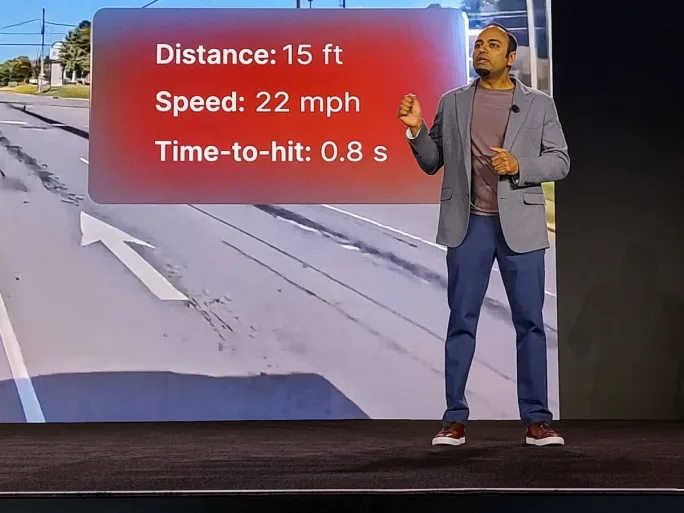
Nihar Gupta, vice president of product at Motive, explains how additional processing power now delivers faster collision-avoidance alerts to AI Dashcam Plus.
Credit:
Wayne Parham
“This isn't just a better forward collision reporting model, it's a new approach to predicting collisions, and reasons about vehicles, cyclists, animals, and even pedestrians,” Gupta explained. “Our AI sees multiple possible future trajectories in real time. We reason about which trajectory puts your driver at risk, and we alert seconds earlier, while there's still time to act, not after.”
Automated License Plate Recognition (ALPR)
AI Dashcam Plus features a 1440p zoom lens with a narrow field of view that captures license plates while a vehicle is in motion. This provides essential evidence for hit-and-runs, road rage, theft, and other incidents to expedite investigations and exonerate drivers.
AI-Powered Speed Sign Detection
Advanced computer vision reads speed limit signs directly off the road instead of relying on often outdated map databases. Tracking speed limit signs in real time ensures drivers are only alerted when they are truly speeding. Gupta said this eliminates false alerts, builds driver trust, and enables more effective coaching.
Live Two-Way Calling
This new feature enables direct, hands-free communication between drivers and managers through the device. Managers can check in with drivers about issues such as fatigue or severe weather. Drivers can connect with managers instantly for updates without relying on mobile phones, reducing distraction and enabling faster response in critical moments.
Atlas: AI Assistant Turns Insights Into Action
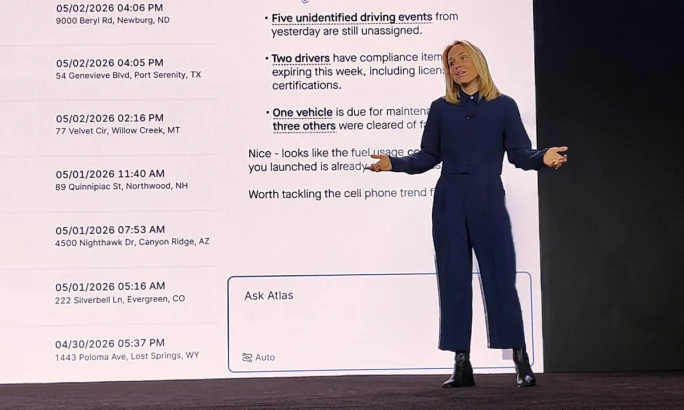
Emily Parsons, staff product manager at Motive, demonstrates Atlas, the company’s new AI assistant for fleets.
Credit:
Wayne Parham
Motive also unveiled Atlas, its new AI assistant, which allows customers to ask questions, analyze data, and take action in one place.
Powered by Motive AI, it surfaces insights instantly from across the platform, reducing the need to search across systems or rely on static reports.
Emily Parsons, staff product manager at Motive, explained that whether checking vehicle health, reviewing safety events, or resolving compliance issues, what once took hours now happens in seconds when fleets deploy Atlas.
She demonstrated how Atlas, through Motive’s new Model Context Protocol (MCP) integration, extends beyond the Motive Dashboard into third-party AI tools, such as ChatGPT, Claude, Copilot, and Google Gemini.
By connecting Motive data with other internal and third-party data sources, Atlas can automate complex strategic tasks, like benchmarking insurance rates and generating data-backed renegotiation proposals, in seconds.
Atlas also has a place in the cab and aids drivers through the Motive Voice Assistant.
With simple voice commands such as “Hey Motive, call dispatch” or “Hey Motive, record video,” drivers can get help, capture critical information, and stay connected without taking their eyes off the road.
Automations: AI That Acts Instantly
As Motive continued to roll out the latest innovations, Sean Santschi, director of product management at Motive, introduced Automations, which helps fleet managers move from insight to action instantly.
Santschi explained how Automations can trigger immediate action based on real-time signals so fleet managers no longer need to catch and respond to every issue themselves.
For example, if a vehicle reports a critical fault code, Motive can immediately contact the driver and instruct them to pull over, before the driver or manager even notices the issue.
Managers can apply Automations across safety, maintenance, and operations to address time-sensitive and hard-to-monitor tasks. With a few clicks, managers can:
- Detect excessive idling and prompt drivers to shut off the engine.
- Flag hours-of-service and compliance risks before they become violations.
- Trigger Atlas to contact drivers when fatigue or critical fault codes are detected.
- Automatically assign and instantly push a Motive Card to a new driver’s digital wallet so they can get on the road on day one.
By automating manual and urgent work, Motive said it helps organizations reduce risk, improve productivity, and ensure critical actions occur exactly when needed.
AI Vision: Turning Visual Intelligence into Automated Action
Motive also introduced new ways AI Vision is automating manual tasks across industries in the physical economy.
Traditionally, according to Motive, drivers and field workers have had to manually document their observations in the field, such as service issues or site hazards.
AI Vision eliminates this manual burden by "observing" the environment and automatically identifying and logging critical data in real time. By transforming video into structured actionable data, AI Vision solves complex operational problems across the physical economy, from public sector infrastructure monitoring to construction site safety.
For industries like waste services, AI Vision delivers immediate financial impact through specialized models for overage detection, recycling contamination detection, and service verification.
AI Omnicam Plus: 360-Degree View & Alerts
Makani returned to the stage and introduced AI Omnicam Plus, a 360-degree camera system built on the AI Dashcam Plus platform. It's powered by the same high-performance Qualcomm processor, allowing Motive to run more complex AI models to proactively detect unsafe situations and alert drivers in real time. It features built-in LTE connectivity, which means it can operate as a standalone system that can go anywhere, and it supports four HD camera inputs and a live in-cab display.
“It's awesome to see what AI Dashcam Plus can do for visibility inside and ahead of the vehicle, but what about everything around it? Look at where accidents actually happen; 40-70% of accidents with injuries are caused by side swipes and rear-end collisions, and many happen outside the driver's line of sight, in blind spots, during lane changes, or while turning or backing,” Makani said.
Fleets can connect the cameras they already have installed in vehicles, or they can use Motive’s new side cameras, internal cameras, or rear-view cameras to also provide cargo or passenger visibility inside the cab.
Drivers can see what is happening around the vehicle in real time through an in-cab monitor. Right and left views activate automatically in coordination with turn signals, supporting safer lane changes and turns, and when reversing, the rear view appears instantly.
“But seeing isn't always enough, especially when it comes to vulnerable road users,” Makani added.
“That's where AI comes in. AI Opticam Plus monitors for pedestrians and cyclists. Anytime a vulnerable road user is in a risk zone, your driver gets an audio and visual alert, and we know how important this is for so many of you in the room who operate large vehicles, particularly in dense urban settings,” Makani continued. “This is going to be a life-saving product, and we can't wait to get it in your hands later this year.”
More Technology & AI
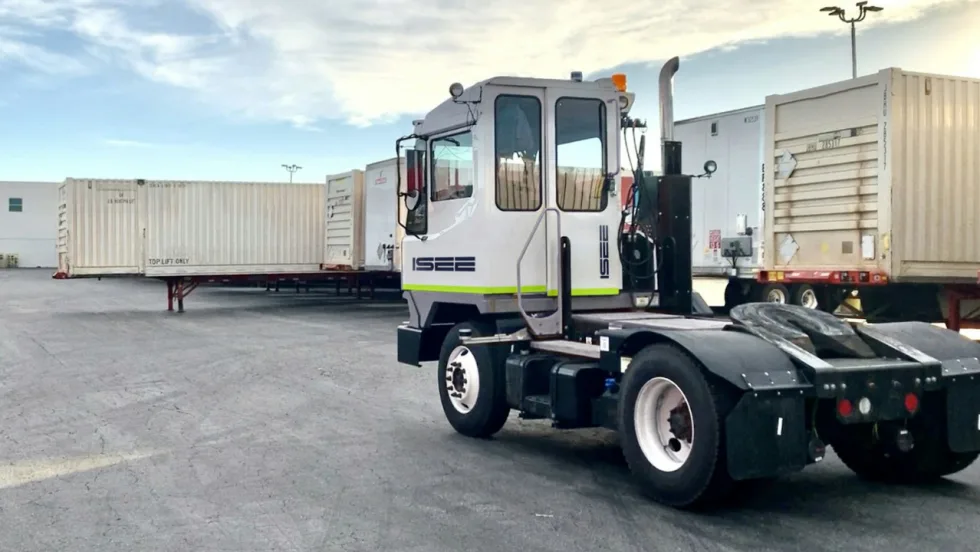
Holman and ISEE Partner to Expand Autonomous Yard Truck Operations
The partnership combines Holman's fleet management and upfitting capabilities with ISEE's autonomous driving technology to help businesses deploy and manage driverless yard trucks.
Read More →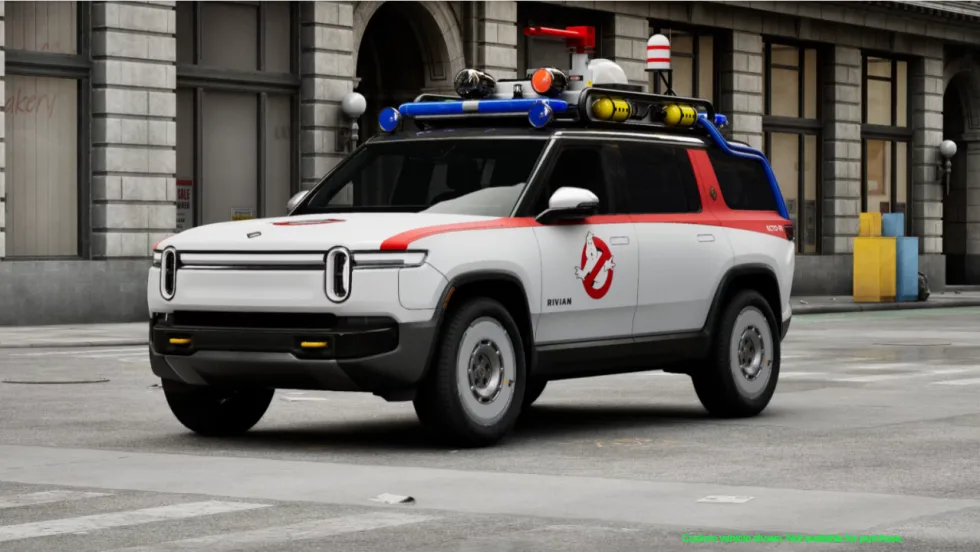
Who You Gonna Call? Rivian Turns Electric Vehicles Into Ghostbusters Rides
Rivian teams up with Sony Pictures for a Ghostbusters-inspired Halloween software update, complete with custom sounds, lighting effects, and a special Ecto-R1.
Read More →
The Second Trip and What Missing Tools Really Cost a Service Business
For service fleets, missing tools and equipment can lead to second trips, lost technician time, higher operating costs, and delayed jobs. Equipment tracking can help HVAC, plumbing, electrical, landscaping, and other service businesses improve visibility and reduce downtime.
Read More →From Our Partners
Basic Tracking vs Next Generation Fleet Technology
Sponsored by AT&T Business
5 Facts Every Fleet Manager Should Know About Embedded Telematics
Sponsored by Stellantis/Mobilisights
How AI Video Telematics Boosts Driver Safety and Helps to Avoid Unnecessary Costs
Sponsored by Verizon Connect
Charting the 8 Bottom-Line Benefits of Workforce Optimization
Sponsored by Verizon Connect

GeoFencing Adds to Your Truck Security Arsenal
Geofencing is a familiar fleet tool today, but its early adoption marked a major shift in vehicle tracking, route monitoring, and the debate over employee privacy.
Read More →
Geotab Data Shows Regional Trucking Growing Faster as Last Mile Routes Get Denser
Geotab's first U.S. supply chain report finds stable long-haul activity, stronger regional freight movement, tighter hub-and-spoke utilization, and more last-mile trips on shorter routes.
Read More →
When Fleet Technology Helps and When It Just Adds Complexity
New technology can help fleets work smarter, but only if it solves the right problem. Lauren Fletcher talks with AP Fleet’s Alex Coveney about innovation, AI, data, and knowing when a new solution is actually worth adopting.
Read More →
Volvo Trucks’ 'Lock and Leave' Software Updates Go Live Across North America
Unattended over-the-air software updates are now available in Volvo trucks across the U.S. and Canada. The new capability lets trucks stay current with the latest software without interrupting operations or requiring a dealership visit.
Read More →
GM Brings New Truck Focused Interface to 2027 Silverado and Sierra
GM's new pickup interface puts trailering data, camera views, vehicle controls, and smartphone integration closer to the driver in the 2027 Silverado and Sierra.
Read More →
Samsara Driver Perks Expands Rewards Beyond the Long Haul Driver
Samsara’s new driver rewards program was built with a broader professional driver in mind, including employees who split their day between driving, job sites, service calls, and other work.
Read More →
AI Service Advisor Aims to Cut Fleet Repair Downtime
Fleetio said its AI Service Advisor can help fleets cut repair downtime by an average of 2.5 hours per repair while reducing manual maintenance work.
Read More →