




Creative Fuel-Saving Strategies
Learn how four fleets use driver input — and driver accountability — along with rightsizing, route optimization and new technology to achieve fuel savings of 10-20%.


Vision Restoration and Building Co. uses Fleetmatics to manage vehicle location, which integrates with the company’s Wright Express fuel cards, allowing managers to track exactly when, where and which vehicle was actually at the tank.
- Four fleets successfully achieve fuel savings of 10-20 percent by leveraging driver input and accountability.
- The implementation of rightsizing and route optimization plays a crucial role in reducing fuel consumption.
- New technology is being adopted to enhance fuel efficiency and operational performance.
*Summarized by AI
Rightsizing vehicles, improving route management, driver behavior training — which is the best and most worthwhile strategy when trying to save on fuel? They all are, if you can refine the solution to your fleet’s specific needs.
From all-employee email notifications on speeding and “idle tip jars,” to a device that changes engine calibrations, these four companies, through trial and error, have found their “sweet spots” for saving fuel.
Managing Driver Behavior and Truckloads
RedPeg Marketing, an “experiential marketing company” with 31 fleet vehicles, has decreased its fuel spend by about 20 percent in less than three years, according to Martin Codd, RedPeg’s vice president of production. “Our primary concern is idle time,” Codd says, adding that this is why RedPeg decided on installing a telematics system through PHH, its fleet management provider.
By tracking its vehicles, the mobile marketing company can evaluate how much time drivers spend idling and how they start and stop the vehicles. And using telematics to ensure drivers are following planned routes — especially for a company that builds custom, Transformer-like vehicles for marketing campaigns — is an important aspect to keeping the company’s assets safe. One employee took a vehicle off-route while on tour, and “when we found out, his employment with our company came to a very quick end,” Codd says.
RedPeg also uses a web-based software called Flex, which delivers a complete inventory analysis of the company’s equipment to achieve a near-perfect pack load for each truck.
“You’re creating greater efficacy in how you’re transporting your equipment, so you’re determining your pack load and then you’re choosing the right vehicle to transport it,” Codd says, adding that his drivers usually have less than 10 percent of space left on any given vehicle.
RedPeg also checks tire pressures and performs other pre-trip inspections before leaving for a campaign, which Codd says can add up to significant fuel savings over the course of a year. In helping to offset stationary fuel costs, RedPeg integrated solar panels onto the vehicles to use as an energy source once onsite.
The company has a fuel card system through PHH, which gives them “lower-than-commercial rates,” on diesel fuel, according to Codd.
RedPeg also addresses bad fuel-economy driving behaviors through annual training sessions, and the company is even considering holding a mid-year training. “Over time, we’ve become aware of the importance of training and having a relationship with your drivers,” Codd says. “We’ve invested an enormous amount in our managers and field drivers. The importance of forging a very concrete and dynamic relationship can’t be underestimated.”
Optimizing Engine Calibration
Bob Adamsky, former fleet director of Sanford, Fla.-based HVAC provider Del Air, was able to reduce the company’s fuel expense through a software technology that allows users to change engine calibrations. “We could basically program the vehicle to obtain better fuel mileage,” he says.
Manufactured by SCT Fleet Solutions, a handheld device is plugged into the vehicle’s OBDII diagnostic port that allows fleets to program vehicles’ top speed, manage idle rpms, change shift schedules and optimize ignition timing for towing.
Adamsky’s focus was on limiting engine speed and idling, so he reduced idle speed to 800 rpms versus the factory calibration of 900. He says the change didn’t affect cooling, charging and other factors, and ultimately increased fuel efficiency by reducing idle time by about 10 percent. Del Air also adjusted different shift points, torque converter lock-ups and other aspects that did save on fuel but didn’t affect performance.
Overall, Adamsky says SCT Fleet Solutions reduced fuel use by about 10 percent — not including the enhanced safety of vehicle speed reduction.
Adamsky adds that he went with a solution like SCT Fleet Solutions because fuel mileage can vary greatly depending on the driver, but by altering vehicle parameters, driver behavior becomes much less of an issue. “For a lot of fleet drivers, it’s either full throttle or full brake; not a whole lot in between,” he says.
For immediate fuel savings, Adamsky recommends checking tire pressure and tire temperature. The temperature can indicate whether your wheel camber angle is correct, your truckload is too heavy or if there’s too much pressure on an axle, among other factors.
He also recommends that fleets rotate tires before they start showing “chop” and wear patterns. “We just kept testing ourselves,” he says. Adamsky also suggests changing spark plugs in shorter intervals than recommended by the OEM because fresh plugs will misfire less often.
Empowering Drivers with Telematics
For Vision Restoration & Building Co. Inc. in Dearborn Heights, Mich., the ability to track driver behavior, location and speed was enough to convince Steve Carson, the company’s general manager, to invest in a telematics system from FleetMatics.

Vision Restoration and Building Co. uses Fleetmatics to manage vehicle location, which integrates with the company’s Wright Express fuel cards, allowing managers to track exactly when, where and which vehicle was actually at the tank.
“Two of the vans are taken home by the employees at the end of the day, so it’s about knowing that the vans aren’t going off and doing extra jobs on the weekend or doing the little run-around stuff that costs a good deal on gas on the long run,” Carson says. Vision Restoration, a full-service, general contracting company that specializes in building restoration, operates 15 vehicles and tracks six.
Carson had the telematics system installed for about a month before telling his employees so he could get a clear look at how much his driver’s habits shifted once they knew they were being observed. “At first it was a matter of control and eliminating the issue, such as when some of the guys were taking their lunch with the vehicles running, but now that they know (the system) is there and that they’re tracked, it has all but stopped completely,” he says.
Through FleetMatics, Vision Restoration is alerted whenever a driver exceeds 70 mph.
Carson says he had to speak with a few drivers about going over the limit, but after a warning or two, the speeding virtually stopped. Shift managers are also sent an immediate notification on their phone when a driver goes over the company limit.
Vision Restoration’s telematics capabilities extend to the field. Most managers and crew leaders have the Fleetmatics app on their phone, allowing them to locate crew members without a phone call. In addition, all drivers are equipped with GPS-enabled smartphones with Google Maps, which empowers them to navigate on their own, Carson says.
The company uses Wright Express fuel cards, which can connect with the Fleetmatics software. This integration allows Carson to run fuel-card reports directly through the telematics system and marry them to location data.
“The biggest benefit is the ability to know where the van was when the fuel card was being used,” Carson says. The integration does incur an extra cost, he says, but “mainly it’s about the idea of all the fuel purchases in one place: the one bill, the one way of maintaining control.”
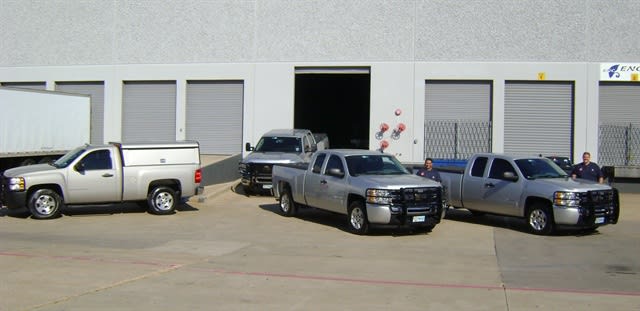
Metro Mobile Electronics has undertaken considerable measures to rightsize its fleet, but after moving from camper shells to tonneau covers — among other changes, such as cab and engine size — the company has been able to save 3-4 miles to the gallon per truck.
Rightsizing, Batching Jobs and ‘Idle Jars’
Devin Warner, Metro Mobile Electronics’ national installation and service manager, says the Grapevine, Texas company started building its fleet of 20 half-ton Chevrolet crew cab pickups, but workers found the cab space went underutilized. Working closely with the company’s dealership and with driver input, Warner embarked on a rightsizing initiative that eventually increased each vehicle’s fuel efficiency by 3-4 miles per gallon.
Warner began by testing body configurations. While the standard cabs were too small, “We found that the extended cabs were a happy medium; it reduced the price and the overall weight of the vehicle and also kept the operator happy,” he says. “It also allowed us to carry all the equipment we need inside the vehicle and out of the weather.”
When Warner swapped his old V-8s for V-6s, drivers complained that the new engines were underpowered. Worse yet, the V-6 engines didn’t really help on fuel economy, especially when loaded on uphill runs. “The engines are screaming. It maxes them out and takes them almost to the red line if you’re climbing hills on cruise control,” he says.
So, Warner went back to a V-8 on subsequent models. The new V-8s are more efficient, and they feature cylinder deactivation for fuel savings. “We didn’t have the engines racing on cruise control when they encountered a hill, and the drivers didn’t complain of lack of power — and we’ve also got reduced fuel consumption,” he says.
The next big initiative involved the camper shells. Warner says the company liked having campers with no windows so onlookers wouldn’t be encouraged to break in for tools. He says the campers “worked pretty well until drivers started getting sloppy and not watching behind them as they were backing up, so we found a tonneau cover with heavy-duty, thick metal-gauge construction — very secure — and we experimented with it.”
The tonneau covers offer good rear visibility and lessen the weight of the vehicle, and pullout drawer systems were installed to aid organization. And while the cost “is essentially the same,” Warner says Metro Mobile noticed most of the trucks picked up fuel savings of at least a mile or two per gallon.
As an installation company, batching jobs whenever possible naturally decreased fuel consumption, but it also increased technician productivity by 20-30 percent, Warner says. Though batching doesn’t always work as some customers insist on particular dates, when it is possible, “It reduces our costs by sending a technician up to the area to complete more than just the one job, and then it also reduces costs for our customers and their customers — and it just trickles down the line,” he says.
At the end of the day, the best solutions sometimes come from employees. As a GPS tracking system installer, the company uses its own system to measure fleet performance. Originally, the system flagged excessive idling — as well as speeding — and sent email alerts only to field supervisors, until Warner decided to extend the notifications to all employees.
“What evolved in that process is the techs will actually call each other and say, ‘Dude, you need to shut off your truck, I’m tired of getting emails,’” Warner says. In response, an employee came up with the “Idle Jar,” which has everyone putting in their dues each time they idle for too long — money that is eventually pooled to buy fajitas.
Quick Answers
Driver input can significantly contribute to fuel savings by providing insights into daily operations, identifying inefficiencies, and suggesting practical solutions to optimize fuel consumption.
*Summarized by AI
More Fuel

The Smart Way to Build a Mixed-Energy Fleet Isn’t About Picking a Side
Mixed-energy fleets aren’t about picking a winning fuel. Sarah Booth of WEX explains how vehicle data, duty cycles, charging strategy, and real-world costs can help fleets choose the right energy source for each job.
Read More →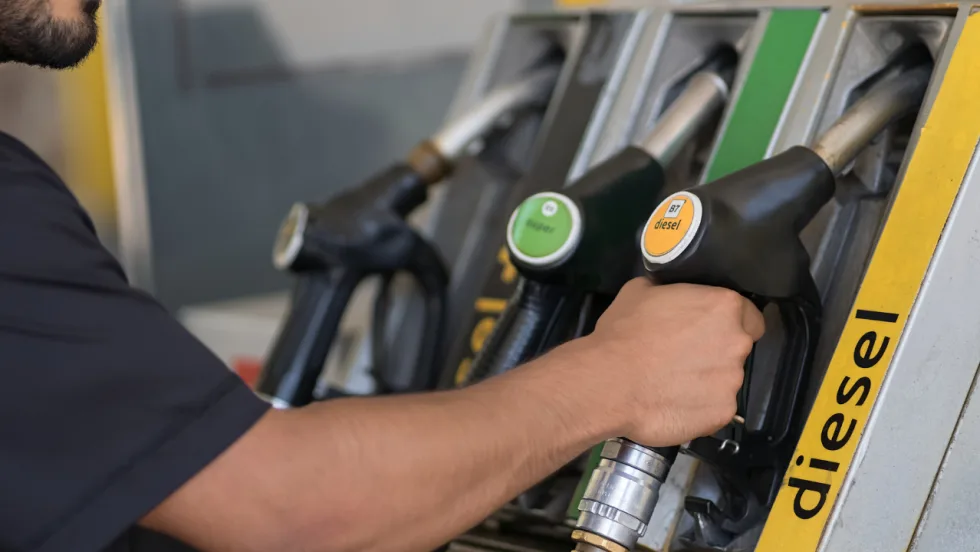
Ignoring This Dashboard Warning Could Cost Your Fleet Thousands in Fuel
New research suggests neglected diesel aftertreatment systems could waste up to $30 in fuel per vehicle each day. Here's why vocational fleets should pay attention.
Read More →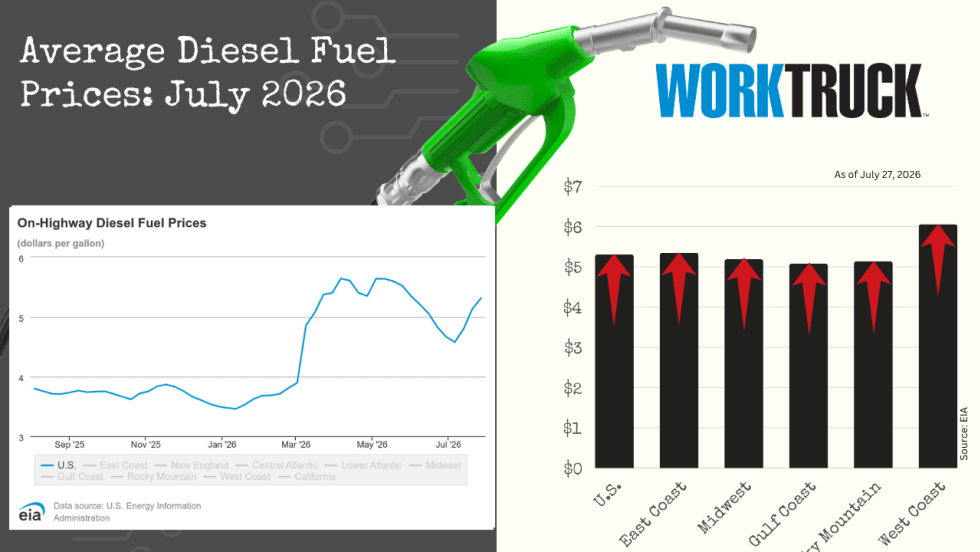
July Diesel Trends Update
The average price of a gallon of diesel increased again this week, and the EIA reported a new national average of $5.31 at the start of the week.
Read More →
WEX Brings Standard Fleet's Connected Vehicle Platform to Fleet Customers
This week’s product launch with Standard Fleet’s connected vehicle platform reflects WEX Venture Capital's strategy of turning startup innovation into customer solutions. Standard Fleet is now available to WEX fleet customers.
Read More →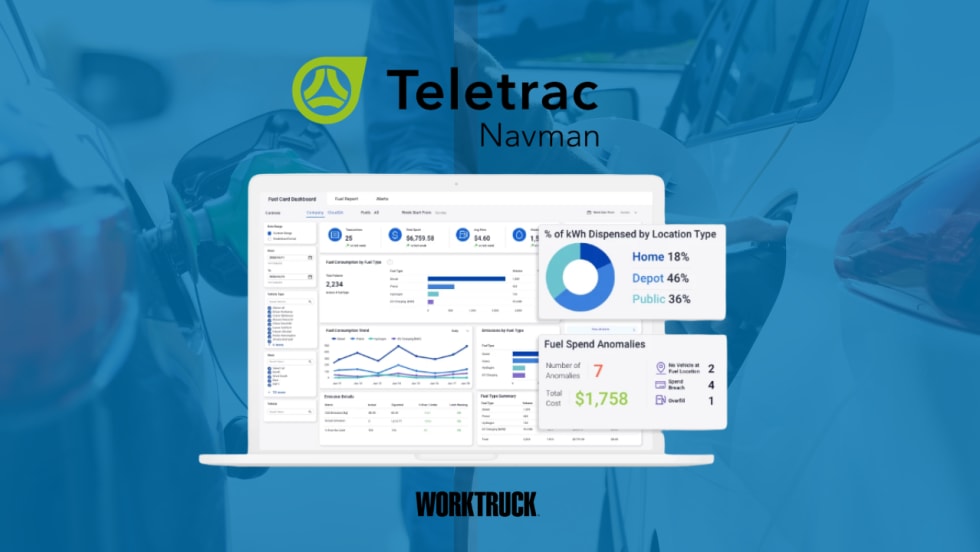
Teletrac Navman Adds Mixed-Energy Fleet Tools to TN360
The new Energy Hub combines fuel transactions, EV charging data, vehicle range, and energy costs in one dashboard for fleets operating multiple vehicle and energy types.
Read More →
WEX DriverDash adds CITGO, Expands Nationwide Access for Fleets
The DriverDash mobile payment app, by WEX, has been integrated into the CITGO merchant network, which means WEX has expanded its U.S. station footprint with the addition of approximately 4,000 CITGO locations.
Read More →
Mixed Energy Fleet Tips for Balancing EVs, Gas and Diesel Vehicles
Mixed energy fleets are becoming the new normal. Learn how fleet managers are balancing EVs, gas and diesel vehicles while controlling costs and planning for the future.
Read More →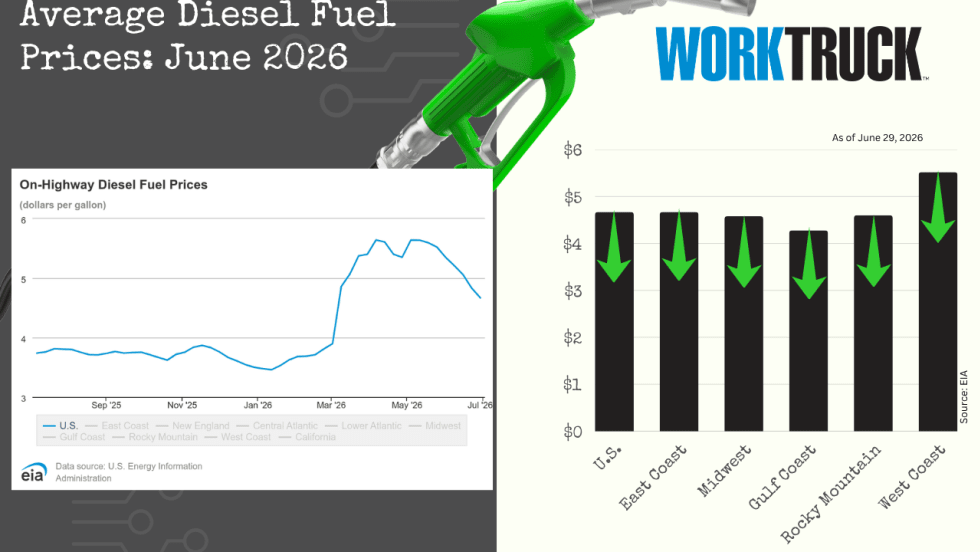
June Diesel Trends Update
The national average price of a gallon of diesel has dropped again, this week by more than 16 cents. All five regions reported lower average prices, ranging from almost 13 cents to more than 28 cents cheaper than a week ago.
Read More →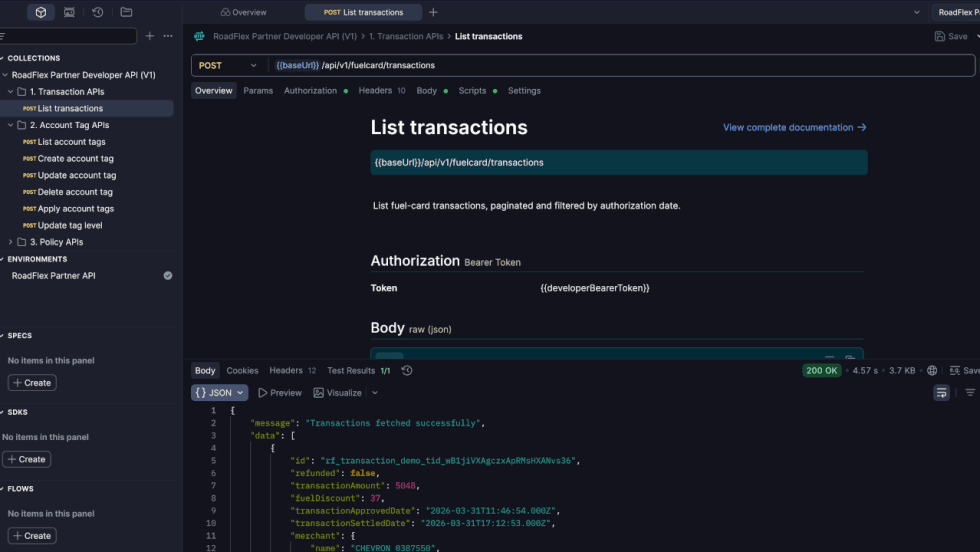
RoadFlex Launches RoadFlex Direct Open API Platform
RoadFlex Direct connects fuel cards, controls, and data to the telematics and fleet management systems fleets already run, from Geotab and Samsara to Fleetio and RTA, with no separate dashboard or double data entry.
Read More →
The Key to Fuel Efficiency Sits in the Cab
Learn how driver behavior, telematics, coaching, and fuel data can help fleets improve fuel efficiency, lower costs, and reduce emissions.
Read More →