




Ford Pushes Vehicles to the Limit in Cold Weather Testing
Ford vehicles of all sizes – from Focus to F-Series Super Duty – annually submit to subzero testing in the U.S. military’s all-weather laboratory designed to recreate nearly every weather condition on earth.
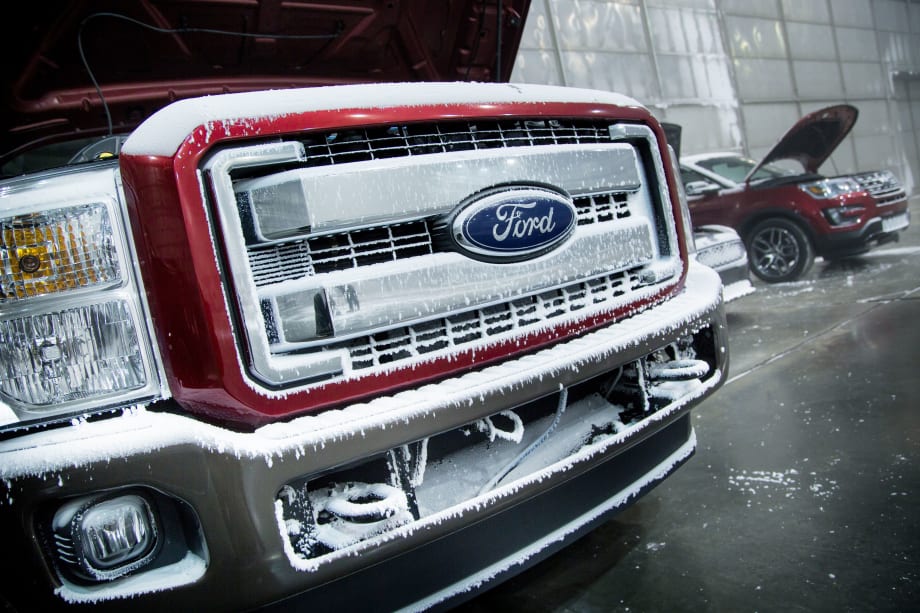
Photo courtesy of Ford.
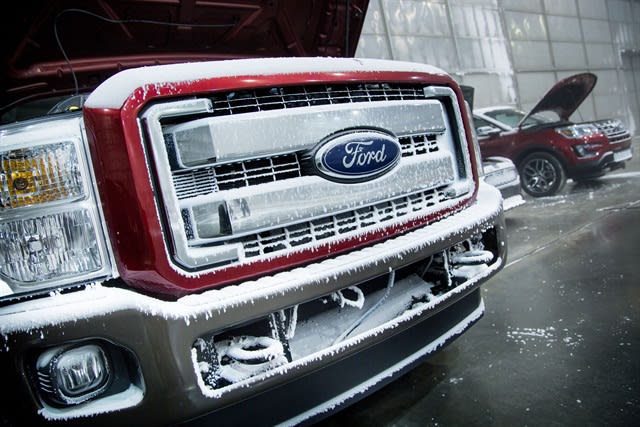
Photo courtesy of Ford.
Each year, Ford brings global prototype vehicles and a team of engineers to the world’s largest climatic test facility at McKinley Climatic Laboratory at Eglin Air Force Base in the Florida panhandle to push the limits of extreme cold-weather testing.
Ford engineers test vehicles ranging from the F-Series Super Duty to the Focus in a laboratory with temperatures as low as minus-40 degrees Fahrenheit over 10 hours. The hot, humid climate of northwest Florida in August has no impact on conditions inside the lab, which makes it ideal for simulating winter in Alaska’s Prudhoe Bay or Canada’s Yellowknife region, according to the automaker.
The opportunity to accommodate 75 global prototype vehicles of all sizes for rigorous testing creates efficiency in the company’s product development cycle that helps Ford learn in just three weeks what could take twice as long in a smaller facility. Collecting multiple data sets, analyzing results, and comparing and contrasting enables Ford engineers to quickly implement changes that enhance vehicle quality and ultimately benefit the customer, according to the automaker.
Engineers test the vehicles for specific situations.
In the oil fields of Alaska’s Prudhoe Bay, Ford F-Series trucks are not only a mode of transportation, but also a safety device for workers who need a warm cabin to retreat to on-site to prevent cold-weather injury on the job. Ford engineers conduct idle tests at the lab by running the engine week after week as temperature fluctuates from 40 degrees to minus-40 degrees, and examining the exhaust as it heats up then cools back down.
For those customers who depend on their vehicles for work commutes and to transport their families around town, Ford testing at the lab ultimately seeks to provide them with the assurance that their vehicles are designed to start and run in the bitter cold. As temperatures in the lab drop to minus-22 degrees, Ford engineers examine the volatility of 13 different types of fuel commonly used by customers across the globe to calibrate the cold start.
When running tests at such low temperatures inside McKinley Climatic Lab, engineers make changes daily to help ensure engine start and vehicle driveability. Learnings from these cold-weather tests helped Ford engineers perfect the 6.7-liter engine that powers the current F-Series Super Duty.
Engineers found that replacing metallic plugs with ceramic gold plugs enabled the engine to heat up more quickly, for a more robust start, according to the automaker.
Originally posted on Automotive Fleet
More Operations

Family Ties Inside the Fleet Families Building Careers Across Generations
Three fleet families share what it really takes to work together, learn across generations, and keep business from following them home.
Read More →
Shades of Fleet Call for Voices: Fleet's Hidden Heroes
Fleet’s hidden heroes are often the ones keeping everything moving behind the scenes. September’s Shades of Fleet is looking for dispatchers, coordinators, parts specialists, and other support pros to share their stories.
Read More →
Truck Centers, Inc. Celebrates National Truck Driver Appreciation Week with $1,000 Fuel Card Giveaways
During National Truck Driver Appreciation Week, Truck Centers, Inc. is offering customers a chance to fuel up for free. Customers at all Truck Centers locations can enter to win one of four $1,000 fuel cards from Sept. 14 - 18.
Read More →From Our Partners



Fleet Guides, AI Time-Savers, Truck Tariffs & Fuel Strategy Lead the News
This week’s Truck Chat Cheat Sheet covers new fleet vehicle guides, practical AI use cases, U.S.-Canada truck production, mixed-energy strategy, and more.
Read More →
What Fleet Employers Are Missing When Hiring Veterans
What if some of the strongest candidates for fleet are already out there, but their experience is written in a language our industry does not always recognize?
Read More →
Automotive Fleet Opens 2026 Personal Use Survey for Commercial Fleet Managers
Less than two weeks left! Commercial and corporate fleet managers are invited to share how their organizations handle company vehicle personal-use policies, charges, and driver eligibility.
Read More →
What Resilient Fleets Do Differently When Conditions Change
Fleet resilience is about more than reacting to disruption. Lauren Fletcher talks with AP Fleet’s Alex Coveney about flexibility, planning, scaling, and what helps fleets adapt when business conditions shift.
Read More →
If We Want the Next Generation in Automotive, We Have to Give Them a Reason to Care
The automotive industry talks constantly about its workforce shortage. But before we can recruit the next generation, we may need to do a better job giving kids a reason to care about automotive in the first place.
Read More →
Ram ProMaster City Under $40K, Truck Tariffs, and AI Maintenance Lead the News
A sub-$40K commercial van, tariff questions, AI-powered maintenance, and a new EV production strategy headline this week’s Truck Chat Cheat Sheet.
Read More →
Bob Adamsky Shares the Fleet Lessons You Usually Learn the Hard Way
After more than 30 years in fleet, Arrow International’s Bob Adamsky has learned that the job is about far more than vehicles. He shares the lessons he wishes every fleet manager could learn a little earlier.
Read More →