




EPA Finalizes Volumes for Biofuel Blending
The U.S Environmental Protection Agency has finalized the volume requirements under its Renewable Fuel Standard (RFS) for blending with the nation's fuel supply that includes increases from existing levels but falls short of expectations from producers.
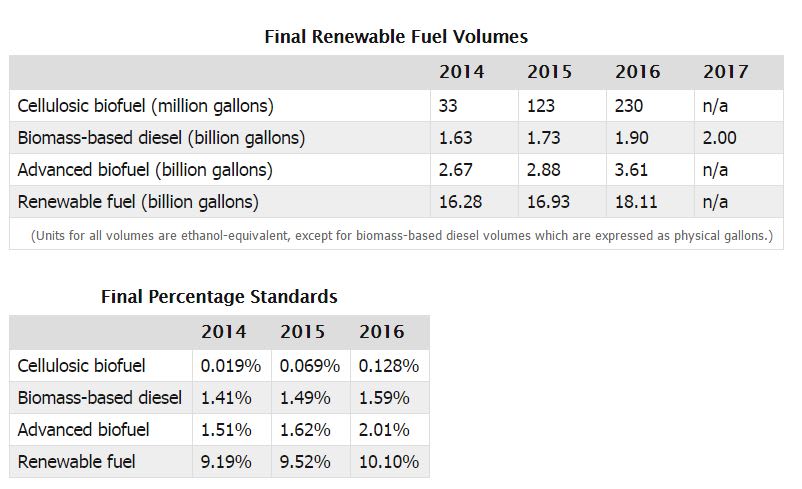
Charts courtesy of USEPA.
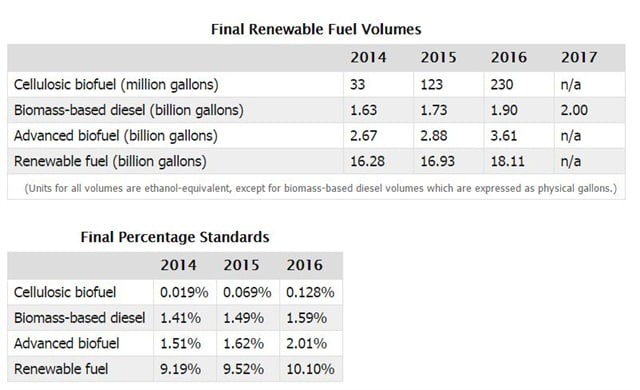
Charts courtesy of USEPA.
The U.S Environmental Protection Agency has finalized the volume requirements under its Renewable Fuel Standard (RFS) for blending with the nation's fuel supply that includes increases from existing levels but falls short of expectations from producers.
The agency finalized manadates for cellulosic biofuel, including ethanol for 2016, as well as final volume requirements for biomass-based diesel for 2016 and 2017.
“This rule finalizes higher volumes of renewable fuel than the levels EPA proposed in June, boosting renewable production and providing support for robust, achievable growth of the biofuels industry,” the agency said in a press release.
The final 2016 standard for the fuel with the lowest carbon emissions — cellulosic biofuel — is nearly 200 million gallons, or seven times more, than what the market produced in 2014.
The final 2016 standard for advanced biofuel is nearly 1 billion gallons, or 35%, higher than the actual 2014 volumes. The total renewable standard requires growth from 2014 to 2016 of more than 1.8 billion gallons of biofuel, which is 11% higher than 2014 actual volumes. Biodiesel standards grow steadily over the next several years, increasing every year to reach 2 billion gallons by 2017.
The National Biodiesel Board seemed to be fairly happy with the RFS rule, while backers of cellulosic ethanol expressed disappointment.
“It is a good rule," said Joe Jobe, CEO of the National Biodiesel Board. "It may not be all we had hoped for but it will go a long way toward getting the U.S. biodiesel industry growing again and reducing our dangerous dependence on fossil fuels.”
The Renewable Fuels Association president and CEO Bob Dinneen, on the other hand, said that the ruling, “turns our nation’s most successful energy policy on its head,” and fears that it “will deepen uncertainty in the marketplace and thus chill investment in second-generation biofuels.”
The final rule considered more than 670,000 public comments, and relied on the latest, most accurate data available, according to the EPA’s press release.
The agency finalized 2014 and 2015 standards at levels that reflect the actual amount of domestic biofuel used in those years, and standards for 2016 (and 2017 for biodiesel) that represent significant growth over historical levels.
Originally posted on Automotive Fleet
More Operations

Family Ties Inside the Fleet Families Building Careers Across Generations
Three fleet families share what it really takes to work together, learn across generations, and keep business from following them home.
Read More →
Shades of Fleet Call for Voices: Fleet's Hidden Heroes
Fleet’s hidden heroes are often the ones keeping everything moving behind the scenes. September’s Shades of Fleet is looking for dispatchers, coordinators, parts specialists, and other support pros to share their stories.
Read More →
Truck Centers, Inc. Celebrates National Truck Driver Appreciation Week with $1,000 Fuel Card Giveaways
During National Truck Driver Appreciation Week, Truck Centers, Inc. is offering customers a chance to fuel up for free. Customers at all Truck Centers locations can enter to win one of four $1,000 fuel cards from Sept. 14 - 18.
Read More →
Fleet Guides, AI Time-Savers, Truck Tariffs & Fuel Strategy Lead the News
This week’s Truck Chat Cheat Sheet covers new fleet vehicle guides, practical AI use cases, U.S.-Canada truck production, mixed-energy strategy, and more.
Read More →
What Fleet Employers Are Missing When Hiring Veterans
What if some of the strongest candidates for fleet are already out there, but their experience is written in a language our industry does not always recognize?
Read More →
Automotive Fleet Opens 2026 Personal Use Survey for Commercial Fleet Managers
Less than two weeks left! Commercial and corporate fleet managers are invited to share how their organizations handle company vehicle personal-use policies, charges, and driver eligibility.
Read More →
What Resilient Fleets Do Differently When Conditions Change
Fleet resilience is about more than reacting to disruption. Lauren Fletcher talks with AP Fleet’s Alex Coveney about flexibility, planning, scaling, and what helps fleets adapt when business conditions shift.
Read More →
If We Want the Next Generation in Automotive, We Have to Give Them a Reason to Care
The automotive industry talks constantly about its workforce shortage. But before we can recruit the next generation, we may need to do a better job giving kids a reason to care about automotive in the first place.
Read More →
Ram ProMaster City Under $40K, Truck Tariffs, and AI Maintenance Lead the News
A sub-$40K commercial van, tariff questions, AI-powered maintenance, and a new EV production strategy headline this week’s Truck Chat Cheat Sheet.
Read More →
Bob Adamsky Shares the Fleet Lessons You Usually Learn the Hard Way
After more than 30 years in fleet, Arrow International’s Bob Adamsky has learned that the job is about far more than vehicles. He shares the lessons he wishes every fleet manager could learn a little earlier.
Read More →