





TPMS: Driving Safety, Efficiency, and Cost-Savings for Fleets
Underinflation: A Sure Sign Fall Has Arrived
When the temperature drops, so do tire pressures. NHTSA outlined the dangers of driving with underinflated tires in the final rule that mandated TPMS in light-duty vehicles in 2005, and experts say underinflation is a leading cause of tire blowouts.
October 2, 2026
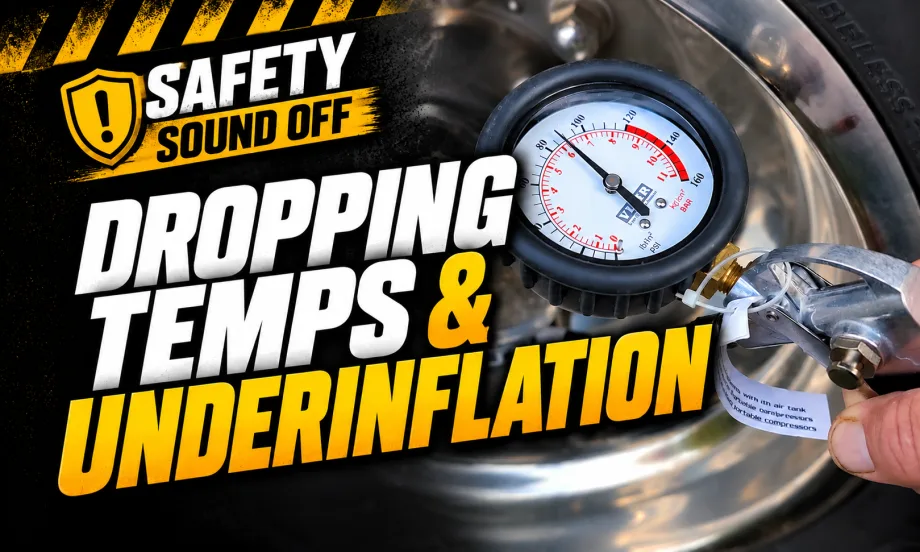
When temperatures drop, so will your tire pressures. Keep that in mind as fall arrives and winter approaches, and make sure your fleet drivers check their tires and keep them properly inflated.
Credit:
Wayne Parham | Edited with OpenAI
3 min to read
- Tire pressures decrease as temperatures drop, indicating the onset of fall.
- The NHTSA highlighted the risks of driving with underinflated tires when it mandated TPMS in 2005.
- Experts identify underinflation as a major factor contributing to tire blowouts.
*Summarized by AI
Well, down here in the Southeast, many would argue that fall arrives with the start of high school and college football, or a myriad of other cooler-season traditions. Actually, football now starts way early, in the heat of August. But, to me, fall truly arrives when tire pressures drop.
Over the past weekend, fall arrived. Or so I will proclaim. We had a 30°F temperature drop, and Saturday morning, as I headed out for my pre-daylight walk, all four tires had TPMS alerts.
Why must I notice? Well, if my family were a fleet, 50% of its drivers would never notice. My wife would say, “Isn’t that your job?” or, “You’re the one who works at a truck publication.”
My answer to that – yes, and yes. So, I started the weekend firing up the air compressor and getting each tire spot on, exactly to the proper PSI, even the spare tire on the back of my Jeep Wrangler. Yep, check the PSI on your spare. Mine was extremely low.
In the consumer automotive space, it is all too easy for people to see a TPMS low-pressure alert and simply think, “Oh, I’ll take care of that later; I’m not going that far.”
Well, I don’t think any fleet managers would look at it that way, and hopefully neither would their drivers.
I think back to a TPMS article I wrote back in April and the tire experts who took the time to be interviewed and share their knowledge. As I recall, each one stressed the problems that result from underinflation.
With that, let’s transition from talking about TPMS and underinflation to talking about how that relates to safety.
For that TPMS article, I asked the experts a simple question: ‘Which is more problematic, under- or over-inflation, when it comes to blowouts?’
“Underinflation is the leading cause of tire blowouts,” answered Jason R. Hendrix, manager of training – TPMS, Autel North America.
Jon Darab, director of operations and outreach for the Global Center for Automotive Performance Simulation within Virginia Tech Transportation Institute, also pointed out that typically underinflation is more likely to cause blowouts than overinflation.
NHTSA’s Viewpoint on Underinflation
The National Highway Traffic Safety Administration’s final rule (49 CFR Parts 571 and 585) that mandated installation of TPMS in light-duty vehicles states: “This final rule requires installation in all new light vehicles of a TPMS capable of detecting when one or more of the vehicle’s tires, up to all four tires, is 25% or more below the manufacturer’s recommended inflation pressure (placard pressure) or a minimum activation pressure specified in the standard, whichever is higher.”
That TPMS requirement became effective April 8, 2005. Safety-related data drove the requirement.
According to the NHTSA, as stated in the final rule, under-inflation of tires increases the likelihood of many different types of crashes, including those involving:
- Skidding and/or loss of control of the vehicle
- Hydroplaning
- Increases in stopping distance
- Flat tires and blowouts
- Overloading of the vehicle
So, TPMS was added to light-duty vehicles, but the intent behind that mandate matters to fleets with heavier, larger vehicles.
Basically, make sure your drivers watch for tire alerts on their TPMS or, better yet, make sure they periodically check tires to make sure they are properly inflated at the start of the day.
Subscribe to Our Newsletter
More Blog Posts
Truckers’ Strike: Don’t Go Chasing Rumors
While the rumor of a truckers’ strike on Oct. 1 is probably unfounded and driven by social media, how would it affect work truck fleets if it did happen?
Read More →
Safety-Inspired Gift Ideas for Father's Day
When it comes time to choose gifts, why not consider safety? Here are some gift ideas for Father’s Day. The five main suggestions are items I own and use regularly, but I also included some additional ideas.
Read More →
Diminished Visibility & Cognitive Demand
I learned firsthand two simple tricks to improve driver visibility in inclement weather and at night, reducing the cognitive challenges of driving in the dark and stormy conditions.
Read More →
7 Safety-Inspired Gift Ideas for Every Truck Owner
Do you know what to get that truck owner in your life as a gift this holiday season? Here are seven gift ideas that might help keep them safer on the road.
Read More →
Safety Sound Off: How Tire-Related Downtime is Like Shoelaces
Your fleet’s drivers not paying attention to their tires before they hit the road would be like not tying your shoelaces before walking a 5k. Both can lead to problems, downtime, and even injury.
Read More →
Witnessing the Devastation When Fleet Safety Fails
When fleet safety fails, the anguish and loss is very powerful. Many times a spouse arrives at the crash scene and learns their significant other is gone. If you ever witness that outpouring of grief, you understand fleet safety is far more than just terminology.
Read More →