





Transportation & Construction Are in the Top 10 Paying Industries for Graduates
Fleet Manager Salaries Continue to Rise as Responsibilities Expand
Fleet manager salaries are rising as roles expand. See 2026 trends in pay, experience, fleet size, and regional differences across U.S. operations.
May 7, 2026
Fleet manager overlooking a lot of work trucks at sunrise, representing rising pay and growing demand for fleet leadership roles.
Credit:
This is an AI-generated image. Refer to our Terms of Use.
6 min to read
- Fleet manager salaries are rising due to increased job responsibilities.
- Expansion of responsibilities includes managing new technology and sustainability initiatives.
- The role's growing complexity reflects the evolving demands of the transportation sector.
*Summarized by AI
Fleet manager salaries are rising as the role evolves into a more strategic leadership position across organizations, and the latest Work Truck Salary Survey reflects that shift. Responses from a sampling of verified fleet professionals across the U.S. point to steady compensation growth, expanding operational responsibilities, and the continued importance of experienced leadership overseeing increasingly complex fleets.
Fleet managers today are balancing far more than vehicles. They are managing data, vendor ecosystems, compliance requirements, and emerging technologies, often with lean internal teams. That expanding scope is reshaping how organizations view the role, elevating it from a primarily operational function to a key driver of business strategy.
Compensation Trends Show Continued Growth
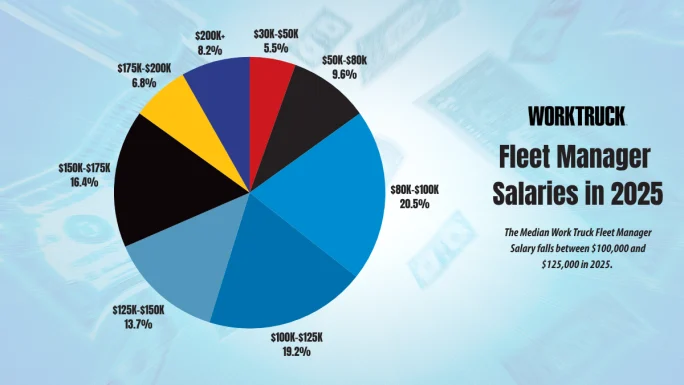
Most salaries cluster between $80K and $150K, with the largest share landing in the $80K–$125K range, reinforcing where the market’s current “middle” really sits.
Salary levels among respondents span a wide range, but most fleet managers fall solidly within six-figure compensation brackets. The largest group of respondents reported salaries between $80,000 and $125,000, with the median falling between $100,000 and $125,000.
Higher compensation levels were also common among respondents who managed larger fleets or held senior roles. One-third of respondents reported earning more than $150,000 annually, and nearly 9% reported earning more than $200,000 annually.
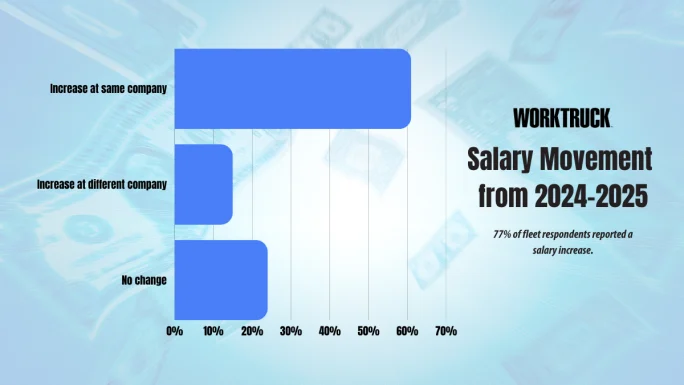
Raises were the norm this year, with the majority of respondents reporting increases at their current company, pointing to ongoing retention pressure and competitive hiring conditions.
Credit:
Work Truck
Year-over-year changes reinforce the strength of the profession. More than three-quarters of respondents reported receiving a salary increase between 2024 and 2025, and most of those raises occurred while staying with the same employer rather than changing jobs.
The size of those increases generally fell within typical annual ranges. Roughly 40% reported raises of 1–3%, while a similar share reported increases of 4-6%. About one in five respondents received raises of 7% or more.
Regional Pay Differences
Hover over the regions above to see the average salary!
Regional salary patterns show noticeable differences across the country. Based on approximate IP geolocation of survey responses, fleet managers in the Pacific region reported the highest average salaries, followed closely by respondents in the Southwest and Northeast.
The Pacific region stands out as the highest-paying market in the survey, with respondents averaging roughly $146,000 annually, while respondents in the Southwest and Northeast reported averages of around $140,000 and $138,000, respectively. Midwest respondents averaged about $124,000, while the Southeast reported the lowest regional average at approximately $118,000.
These variations likely reflect differences in cost of living, concentration of large enterprise fleets, and regional industry distribution. Markets with higher operating costs and large logistics hubs often support higher compensation levels..
Experience Remains a Defining Factor
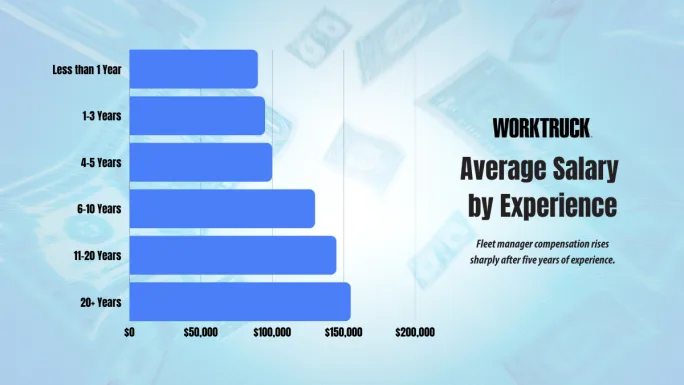
Pay growth isn’t linear early on, but it accelerates fast after five years, with the biggest jumps showing up as fleet managers move into mid-career roles and take on broader operational responsibility.
Credit:
Work Truck
Fleet management remains a profession built on experience. Nearly 60% of respondents reported more than 10 years in the role, including 30% with more than two decades of fleet management experience.
Only a small share reported fewer than five years in the profession, highlighting how fleet leadership roles are typically filled by professionals who have spent significant time building operational expertise.
That experience is reflected in the scale of fleets that many respondents oversee.
Large Fleets, Lean Teams
A significant portion of survey participants manage very large fleets. Nearly half reported overseeing fleets of more than 1,000 vehicles, while another 16% manage fleets of 501 to 1,000 units.
Despite this scale, fleet departments often remain lean. One-third of respondents reported supervising no staff, and nearly two-thirds manage teams of two or fewer.
This combination of large asset portfolios and small internal teams underscores the operational efficiency required of today’s fleet leaders.
Fleet Size Has a Direct Impact on Compensation
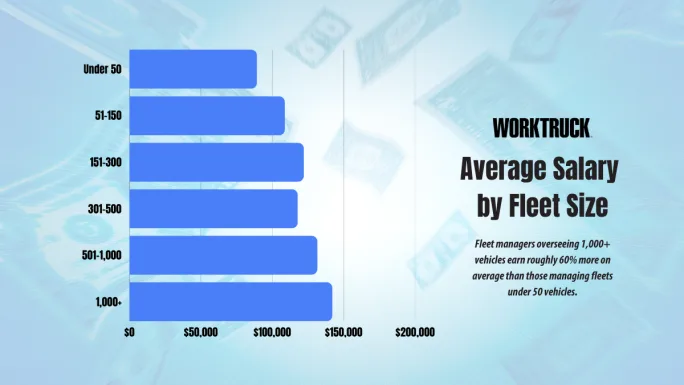
Bigger fleets continue to mean bigger paychecks, with managers overseeing 1,000+ vehicles earning significantly more than those running smaller operations.
Credit:
Work Truck
Fleet size appears to play a clear role in compensation levels across respondents.
Managers overseeing smaller fleets reported lower average salaries, with those managing fewer than 50 vehicles averaging just under $90,000 annually. Compensation increases steadily as fleet size grows, with managers of fleets between 51 and 150 vehicles averaging more than $100,000.
The trend continues into larger operations. Respondents managing fleets of 501 to 1,000 vehicles reported average salaries exceeding $130,000, while those overseeing fleets larger than 1,000 units averaged approximately $142,000.
The data suggests that compensation rises alongside operational complexity. Larger fleets typically require greater oversight of procurement, maintenance networks, technology systems, and vendor relationships, all of which contribute to higher salary levels.
Fleet Management Is Often a Full-Time Role
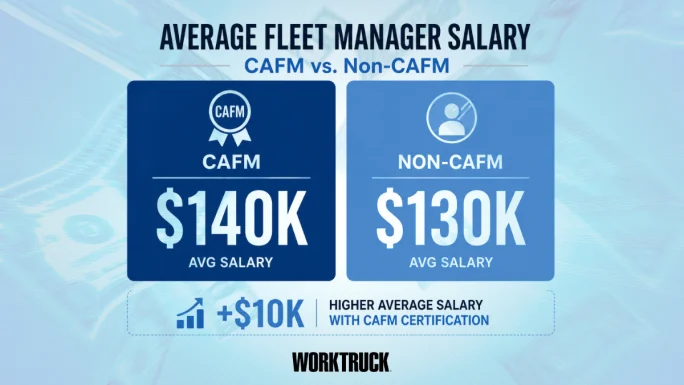
Certification continues to carry weight, with CAFM holders earning about $10K more on average, reinforcing the value of formal training and professional development in fleet leadership.
Credit:
Credit: This is an AI-generated image. Refer to our Terms of Use.
For most respondents, fleet management represents their primary professional responsibility. More than half reported spending 76%-100% of their time on fleet operations, while another 29% devote the majority of their work time to fleet management duties.
However, many fleet managers continue to handle adjacent responsibilities, including facilities management, travel programs, mobility services, and operational planning.
Professional certification also plays a role in compensation. Respondents who reported holding a Certified Automotive Fleet Manager (CAFM) designation earned higher average salaries than their non-certified peers, with a gap of roughly $10,000 annually. The data reinforces the value of continued professional development, particularly as fleet management responsibilities expand and organizations look for leaders with both operational and strategic expertise.
Outsourcing Remains a Strategic Tool for Fleet Operations
Third-party support continues to play a role in many fleet operations, though most organizations appear to use outsourcing selectively rather than relying on it entirely.
Nearly 9 out of 10 respondents reported outsourcing at least some of their fleet responsibilities. However, the data suggests that outsourcing is typically limited to specific functions rather than the entire fleet program.
The largest group of respondents reported outsourcing 1% to 20% of their fleet responsibilities, while another significant share reported outsourcing between 21% and 60% of operations. Together, these groups represent the majority of fleets in the survey and point to a common hybrid model in which internal teams maintain overall oversight while leveraging outside partners for specialized services.
Only a small number of respondents reported outsourcing the majority of their fleet responsibilities, and just one respondent indicated that their fleet operations are fully outsourced.
This approach reflects how many organizations balance internal fleet expertise with external support for services such as maintenance networks, technology platforms, vehicle acquisition, and other operational functions.
Combined with the earlier findings showing that many fleet managers oversee large fleets with relatively small teams, the outsourcing data reinforces how third-party partnerships can help extend internal capabilities while allowing fleet leaders to maintain strategic control of their operations.
Sustainability Incentives Still Rare
Although electrification and sustainability initiatives are increasingly part of fleet operations, financial incentives tied to those goals remain relatively uncommon.
Only 7% of respondents reported receiving compensation tied to sustainability milestones, emissions reductions, or electric vehicle adoption targets.
As electrification strategies expand, compensation structures tied to environmental performance may become more common.
A Profession Defined by Experience and Responsibility
Taken together, the survey results highlight a profession defined by deep experience and increasing operational complexity.
Fleet managers are overseeing larger fleets, managing vendor networks, implementing emerging technologies, and navigating evolving mobility strategies. Compensation trends suggest organizations recognize the value of that responsibility, with most respondents reporting steady salary growth.
As fleets become more data-driven and technologically advanced, the role of the fleet manager will likely continue to expand, both in responsibility and opportunity.
Quick Answers
Fleet manager salaries are on the rise due to the expanding responsibilities and complexities involved in managing modern fleets, including advancements in technology, regulatory compliance, and sustainability initiatives.
*Summarized by AI
Subscribe to Our Newsletter
More Operations
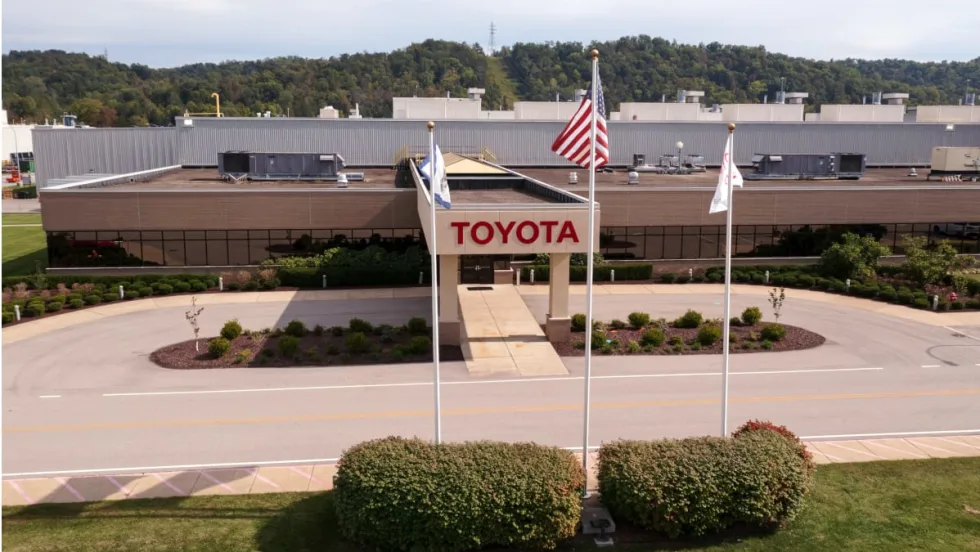
Toyota West Virginia Celebrates Three Decades of Manufacturing in the Mountain State
Toyota West Virginia celebrated 30 years of manufacturing. Toyota assembles both engines and drivetrain components in West Virginia to support its North American operations.
Read More →
The Hidden Cost of Idling
A low-mileage truck can still be one of the fleet’s hardest-working and most worn assets. Engine hours, idle time, and duty cycle reveal what the odometer misses.
Read More →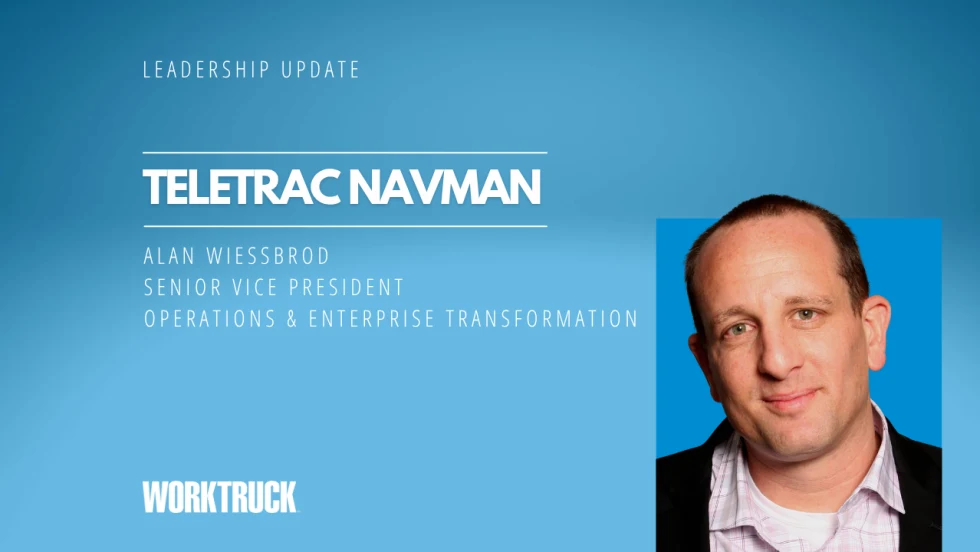
Teletrac Navman Hires SVP of Operations & Enterprise Transformation
Teletrac Navman has appointed Alan Wiessbrod to its senior leadership team as senior vice president, operations and enterprise transformation. The company said he has a strong track record of delivering profitable growth and operational excellence.
Read More →From Our Partners
Basic Tracking vs Next Generation Fleet Technology
Sponsored by AT&T Business

5 Facts Every Fleet Manager Should Know About Embedded Telematics
Sponsored by Stellantis/Mobilisights
How AI Video Telematics Boosts Driver Safety and Helps to Avoid Unnecessary Costs
Sponsored by Verizon Connect

Charting the 8 Bottom-Line Benefits of Workforce Optimization
Sponsored by Verizon Connect

2027 GM Trucks, Technician Retention, and Fleet Lessons Lead This Week’s News
New GM pickups, technician retention, fleet leadership lessons, winter equipment, and more headline this week’s Truck Chat Weekly Cheat Sheet.
Read More →
Family Ties Inside the Fleet Families Building Careers Across Generations
Three fleet families share what it really takes to work together, learn across generations, and keep business from following them home.
Read More →
Shades of Fleet Call for Voices: Fleet's Hidden Heroes
Fleet’s hidden heroes are often the ones keeping everything moving behind the scenes. September’s Shades of Fleet is looking for dispatchers, coordinators, parts specialists, and other support pros to share their stories.
Read More →
Truck Centers, Inc. Celebrates National Truck Driver Appreciation Week with $1,000 Fuel Card Giveaways
During National Truck Driver Appreciation Week, Truck Centers, Inc. is offering customers a chance to fuel up for free. Customers at all Truck Centers locations can enter to win one of four $1,000 fuel cards from Sept. 14 - 18.
Read More →
Fleet Guides, AI Time-Savers, Truck Tariffs & Fuel Strategy Lead the News
This week’s Truck Chat Cheat Sheet covers new fleet vehicle guides, practical AI use cases, U.S.-Canada truck production, mixed-energy strategy, and more.
Read More →
What Fleet Employers Are Missing When Hiring Veterans
What if some of the strongest candidates for fleet are already out there, but their experience is written in a language our industry does not always recognize?
Read More →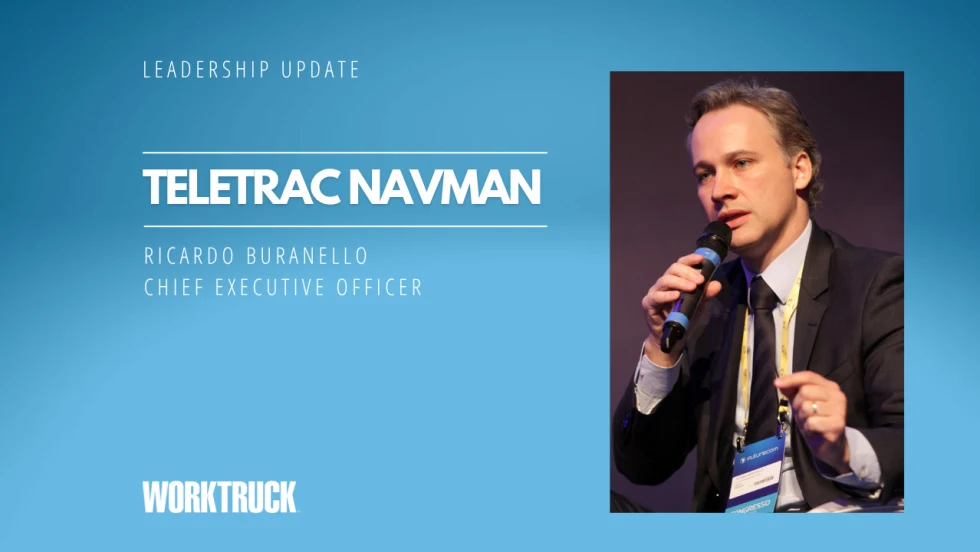
Teletrac Navman Promotes New CEO from Within
Teletrac Navman’s next CEO, Ricardo Buranello, has served as the company’s chief financial and operating officer. He brings deep financial and operational expertise, a strong strategic orientation, and an intimate knowledge of the business to his new role.
Read More →