




How to Defuse Driver Resistance to GPS
A GPS system can be a useful fleet management tool. However, the system must be properly introduced to employees to promote their acceptance and cooperation.
The days of equating GPS use in fleets to management playing "Big Brother" may soon be over, provided fleet managers use caution when approaching the issue with their drivers.
The strategy should avoid invoking paranoia by saying you’ll be monitoring each driver’s every move 24/7. Instead, explain to drivers the benefits of a fleet GPS program, how it can work to their advantage and ultimately make them more money.
For the past seven years, Larry Gemma, owner of Gem Plumbing in Lincoln, R.I., has been using @Road in his fleet of 180 GM and Ford trucks and vans to monitor mileage, location, speed, and to provide employee routing and maintenance alerts.
Admittedly, he initially decided to implement a GPS system to track employees.
"We found out very shortly that employees didn’t like it and it creates a lot of conflict," said Gemma. "The drivers we ended up having a problem with were the same drivers we already knew we had a problem with. GPS just verified the fact that we were right."
He said the system quickly lost its value because employees felt management no longer trusted them. "The way we had originally implemented GPS was the wrong way, and we learned our lessons the hard way. Now we have a whole different philosophy that our employees accept."
Gemma’s "win-win-win" philosophy is part of a comprehensive incentive program to help employees make more money. As long as the company can prove cost savings to the bottom line, revenue is passed on to employees. "Win-win-win means the customer wins first, the employee wins second, and the company wins third," Gemma says. "If everybody’s doing the right things, then everybody wins."
The incentive program is designed to better the experience for customers and reward employees through pay increases. But, Gemma cautions that GPS must be accepted by employees before it can be utilized properly.
Since implementing @Road, Gemma has experienced improved efficiency and reduced fleet costs by lowering vehicle mileage and maintenance, which reduces employee downtime and extends vehicle longevity. More money is then available to invest in new equipment and for bonuses and healthcare.
According to Gemma, GPS data has been used for stolen vehicle recovery and to vindicate drivers against customer complaints about time issues and bogus accident claims. "We immediately tell the employee about that benefit and what would have happened in that situation had we not had GPS."
[PAGEBREAK]
Gemma advises other fleet managers to get their employees involved in the GPS conversion. Explain what’s in it for them and stick by the rules so drivers won’t be tempted to challenge the limits.
"It’s an uncomfortable conversation to have initially with your employees, so make sure you do your homework and you have all the benefits of GPS and provide examples of companies that use GPS positively," he says.
Joe Christianson, president of Plumbing Plus and Remodel Works Bath & Kitchen in Poway, Calif., has a fleet of 30 service vans and pickups. He uses the Nextel phone GPS system, which also works as an employee timecard. It automatically collects location data, so all drivers have to do is put in the job number and code for the type of work they’re doing.
"Our drivers do multiple tasks because we do kitchen and bathroom remodeling. If they’re doing demolition, they put one code into the phone and if they start doing plumbing, it’s a different code," Christianson says. "They used to have to keep track of that and now they don’t."
Management then captures the GPS location, converts it for payroll, and downloads the data into the computer, so all the job costing and data collection for Workers’ Compensation is done. GPS assists in back-office functions by eliminating paperwork, and since drivers don’t have to bring in a timecard, they can go directly to the job site and be more productive.
The fleet also uses Xora software to route drivers to jobs closer to their homes. The GPS system installed in vehicles keeps track of maintenance and informs drivers when it’s time for an oil change.
Generally, drivers accept the concept of a fleet GPS program. However, "We’ve had drivers make a fuss and I told them, ‘Don’t let the door hit you on your way out.’ It’s just the way we operate. I don’t care how good he was; I don’t put up with that. If I lost 25 percent of my workforce for this reason, see you later, because then you’ve got something to be angry about," says Christianson.
He uses GPS as a tool to manage his business and thinks of it as similar to using a computer. "It helps me be more competitive and know exactly what I’m doing with my vehicles, especially with gas prices the way they are. I can eliminate problem employees because drivers know up-front we have GPS. It’s protection for us because honest people aren’t going to have a problem with it; they understand it’s a tool for us to help our business," Christianson says.
"Employees are a little more in tune to GPS, and now with high gas prices, you have to wring every bit of efficiency out of your routes. Now I can tell them this saves me money so I can afford to pay you better."
[PAGEBREAK]
The company offers a retirement program, 100-percent paid health and dental, and allows vehicles to be taken home at night. "Most of our competitors don’t. We can do those things and still pay top dollar because we are able to manage our business," says Christianson.
Another advantage offered by a GPS program is as a means to prove an employee was at a location on time. Christianson says a client may dispute the bill and say the employee was only there for a short period of time. "I can verify this and turn around and say he was there for two hours and 15 minutes. This allows us to be on the same side as our guy now because we have proof."
When introducing a fleet GPS program to employees, Christianson suggests that fleet managers bring it out with excitement. Tell them it’s a new tool to help the fleet become more efficient, so drivers know where the problem areas are and management knows whether one of the trucks isn’t operating correctly or is being abused or driven too fast. He says a bad company representative affects everyone, not only the person driving the vehicle.
David Hartman, president of EasyTurf, based in Escondido, Calif., uses NetworkCar in his fleet of 15 Chevrolet pickup trucks and has been with the provider for the past three years. One of the main selling points of the Web-based program was that the fleet could avoid regular California smog checks because NetworkCar constantly checks vehicle emissions levels. Another benefit Hartman notes are regular maintenance alerts sent to the company’s operations manager.
"The biggest reason we use GPS is as a deterrent because our crew leaders take the vehicles home with them in the evenings and on weekends. NetworkCar will let us know if the vehicle is used outside of certain time parameters," says Hartman. "Generally, our crews go out and stay in the same place all day, so we’re not using it to reroute them during the course of the day. But, if they’re late showing up to a job, we can look online and figure out where they are."
Employees are aware of the GPS system and are not allowed personal use of company vehicles. "We didn’t do this in a stealthy way. We let everyone know that if they disconnect the system, they’ll be in worse trouble than if they actually drove on the weekend," said Hartman.
Hartman suggests that other fleet managers considering implementing a GPS program be forthright and inform drivers it’s necessary to keep track of their equipment, and that insurance companies are increasingly mandating GPS systems.
"The last thing I would do is try to sneak it on them and not tell them about it. I know some companies that have done that and it doesn’t work very well," said Hartman.
[PAGEBREAK]
Mike Lanning, president of Desert Services, located in Scottsdale, Ariz., has been using GPS Insight for the past 2½ years because of the integration, customization, and service level provided. He says the GPS provider is on the cutting edge and one of the first companies to integrate with Google Earth.
With 38 vehicles consisting of water trucks, street sweepers, and roll-off trucks for temporary fencing, Lanning initially was interested in monitoring maintenance and mileage. He also can track location in real-time, route drivers to a specific job, and prove an employee was at a particular job on time or used the truck after hours.
"Just from that tracking, the system pays for itself. It prevents fraud from the customer and the driver side; you can’t dispute the evidence," says Lanning. "For the most part, 90 percent of our drivers are all doing the right things and they don’t care. The ones who complain are up to something and they’re the ones you need to watch anyway."
The system helps save money in a number of ways, including fuel. Drivers are efficiently routed to jobs closest to them and the number of trips is minimized.
Josh Zimmet, executive administrator for BLS Trucking, Inc., based in Dayton, Ohio, was initially looking to cut fuel costs and save money. He started using NetworkCar in February 2007 because it offered diagnostic information.
"Having the diagnostic data, which reads the truck’s information directly from its computer, sold us on NetworkCar," says Zimmet. We knew our trucks were being used for more than their intended use at night and on weekends. We knew tracking our trucks and knowing where they were at all times would eliminate unauthorized use. The savings so far show that we are going to be at or ahead of our predicted return on investment in less than one year."
Management tracks speed, idle time, odd-hour usage and locations, and fuel mpg. The system also offers truck computer alerts, which helps minimize costly breakdowns, particularly in difficult to access locations.
The fleet currently consists of 210 trucks, and drivers are mostly responsible for short-haul of lumber and building materials, as well as appliance delivery. For the most part, GPS use was generally accepted, according to Zimmet.
"We did have some drivers who were a little apprehensive. After we explained it was best for the company to have GPS and it actually protected the drivers against false claims, it was accepted," he says.
Among the benefits of NetworkCar, Zimmet says data is available 24/7 on a real-time basis. He knows where all 210 trucks are at any given time and where they have been. He can determine whether they are running and how fast they are traveling.
"We’ve had drivers who, because of the GPS data provided, have not been ticketed at the scene of an accident," says Zimmet.
"This year, we’ve had many claims that our trucks have caused damage at a particular location, and by having the GPS data with time stamps, we proved we were nowhere near the location where we had been accused of causing damage. These savings are not calculated into our ‘savings studies’ and are considered ‘hidden’ savings, but they definitely are evident," adds Zimmets. "Ultimately, at least with our company, what is good for the company, as far as savings are concerned, ends up being good for our employees. When introducing GPS, fleet managers should be honest with their employees."
Originally posted on Automotive Fleet
More Operations

ATRI Names Next President and CEO
Page Siplon, a longtime transportation and logistics industry executive, has been chosen as the next president and CEO of the American Transportation Research Institute (ATRI).
Read More →
Coltrain Onsite Fleet Care Sponsors 2026 Cure Bowl to Support Cancer Research
The mobile fleet maintenance provider is supporting the annual college football bowl game, which has helped raise $6.83 million for cancer research since 2015.
Read More →
Racing Lessons, Electric Fleet Growth, and Ghostbusters Lead This Week's Work Truck News
Racing lessons for fleets, Republic Services' electric truck expansion, 40 years of fleet wisdom, truck trivia, autonomous yard trucks, and more headline this week's Truck Chat Cheat Sheet.
Read More →From Our Partners
Basic Tracking vs Next Generation Fleet Technology
Sponsored by AT&T Business
5 Facts Every Fleet Manager Should Know About Embedded Telematics
Sponsored by Stellantis/Mobilisights
How AI Video Telematics Boosts Driver Safety and Helps to Avoid Unnecessary Costs
Sponsored by Verizon Connect
Charting the 8 Bottom-Line Benefits of Workforce Optimization
Sponsored by Verizon Connect

A buyer's guide to fleet management software in 2027
Buying fleet management software in 2027 means looking beyond features and price. As fleet operations, technology and expectations evolve, this guide explores what today’s fleet professionals should consider when choosing a system that can deliver value now and adapt to what comes next.
Read More →
How to Build a Lasting Fleet Career by Staying Curious and Connected
Tina Kourakos never planned on a career in fleet. More than 30 years later, she says curiosity, strong relationships, and a willingness to keep learning helped turn an unexpected assignment into a career spanning fleet management and OEM leadership.
Read More →
Think You Know Trucks? Take Our 19-Question Fleet Trivia Challenge
From chicken lights to diesel engines and trucking history, test your knowledge with 19 questions from the 2026 Work Truck Exchange and Heavy Duty Trucking Exchange.
Read More →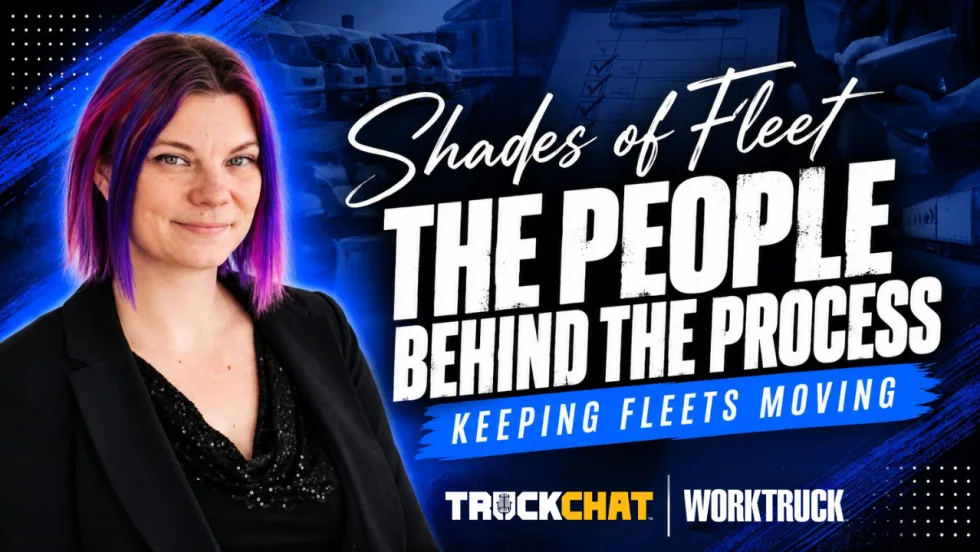
Where’s My Truck: Inside the Fleet Logistics Work Nobody Sees
Shades of Fleet video thumbnail featuring Lauren Fletcher beside the text “The People Behind the Process, Keeping Fleets Moving,” with fleet vehicles and logistics imagery in the background.
Read More →
Work Truck Seeks Fleet and Industry Insights on 2026 Trends and 2027 Forecasts
Work Truck is seeking insights from fleet leaders and industry partners on the trends that shaped 2026 and what commercial fleets should prepare for in 2027. Participate today!
Read More →
It's 10 p.m... Do You Know Who Has Access to Your Fleet?
Preventing cargo theft requires investment in technology, operational processes, and employee training. In an industry with tight margins, it can be difficult to justify investments whose value is measured by incidents that might never occur.
Read More →
GeoFencing Adds to Your Truck Security Arsenal
Geofencing is a familiar fleet tool today, but its early adoption marked a major shift in vehicle tracking, route monitoring, and the debate over employee privacy.
Read More →