




Learn More: Making the Case for Renewable Fuels in Trucking
Davidson Environmental Turns Waste into Revenue
The company uses the food refuse it collects to generate electricity, adding to a sustainability-first business model.
by Lexi Tucker, with additional reporting by Doug Siefkes
February 2, 2022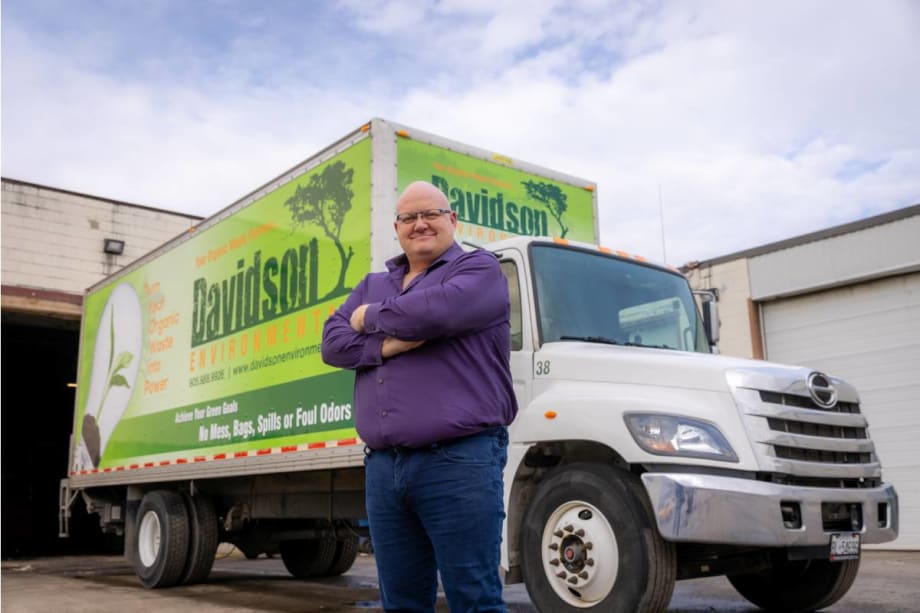
James Davidson purchased a used garbage truck from the City of Toronto and started Davidson Environmental with that and six bins.
Photo: Davidson Environmental
4 min to read
James Davidson, CEO of Davidson Environmental, got his start in the waste industry 30 years ago working for Waste Management. After the company lost its residential contract in the town where he worked, he decided to strike out on his own and start Davidson Environmental. He went out and purchased a used garbage truck from the City of Toronto and started with that and six bins. This year, his company has done $4M in business and has 14 trucks on the road 24/7.
Finding a Specialty
The organic recycling company’s niche lies in its cart exchange program. It doesn’t just show up to a customer, dump waste into its trucks, and move on. Instead, it takes the whole cart away and switches it for a fresh, clean one. This eliminates smell and dirty carts or bins.
“This works well for places that place a high value on cleanliness like food factories, hospitals, and homes for the elderly,” he said.
They company also has a food waste de-packaging machine that can separate food waste from its packaging, from old cans of ravioli to glass jars of pickles and ketchup packets. There was a time when people used to do this by hand, but with the current labor shortage, grocery stores are lucky to get people to show up and stock shelves. This simplifies the process and saves time.
Breaking it Down
The company uses full-size Hino trucks as its customer service vehicles that pick up carts from customers because they're “bulletproof…maintenance wise, they don't break down,” according to Davidson.
“I have several units that have a million-plus miles on them and are still going strong. I can't wait until they produce the hydrogen electric ones they are touting,” he mentioned.
End-use wise, once the product comes to homebase and gets de-packaged and ready to go, the company uses Kenworth truck trailer units to deliver loads to the anaerobic digester (a process through which bacteria break down organic matter—such as animal manure, wastewater biosolids, and food wastes—in the absence of oxygen) companies they work with.
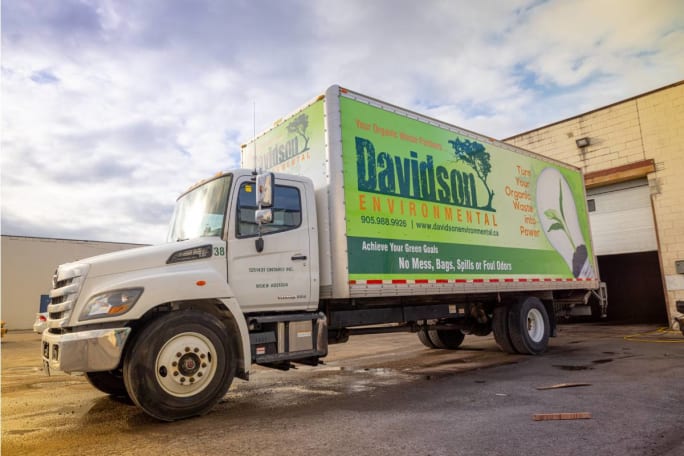
The company uses full-size Hino trucks as its customer service vehicles that pick up carts from customers because they're “bulletproof…maintenance wise, they don't break down,” according to Davidson.
Photo: Davidson Environmental
Generating Electricity (and Revenue)
Davidson Environmental uses food waste to generate electricity through the gases it emits. The company lets the food waste rot and then captures the natural gas that comes off it.
“The natural gas in your furnace has been cleaned through a process to about 94% cleanness, whereas landfill gas is about 65%. The other percentage of what you're smelling is nitrogen, methane, and ammonia. We take that gas, put it into a specially designed internal combustion engine, and push that electricity right back into the grid and get paid for it,” he explained.
According to Davidson, it costs about the same amount of money to clean natural gas to a state where you can put it right back into the grid and houses use it as it does to buy the engine and hook it up to the electrical grid.
The company also just agreed to start using a truck that runs off of the compressed natural gas it generates. It can put it right back into the truck, making Davidson Environmental even more self-sustaining.
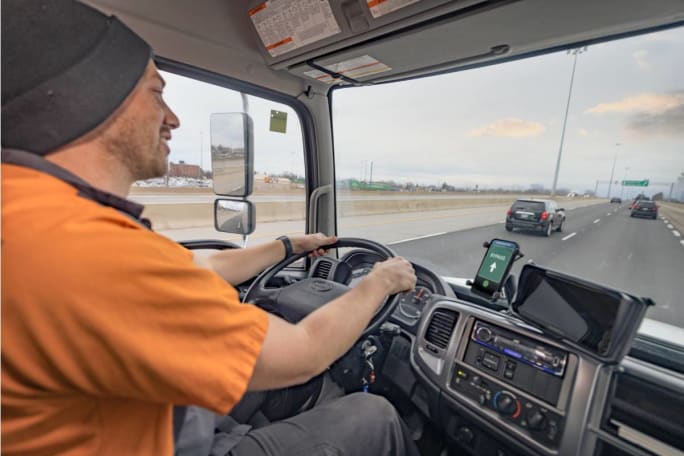
Davidson Environmental uses Geotab in its Hino vehicles, including Drivewyze PreClear, a weigh station bypass service.
Photo: Davidson Environmental
Tapping into Tech
Davidson Environmental uses Geotab in its Hino vehicles, including Drivewyze PreClear, a weigh station bypass service. Drivewyze offers the service throughout the U.S., but also has an Ontario‐only bypass subscription.
According to Davidson, there are six weigh stations that dot the logistics map where Davidson trucks run in Ontario (Drivewyze offers bypass opportunities at 44 weigh stations in Ontario).
“One is located 15 minutes away, near Niagara Falls,” he said. “Before Drivewyze, we were following all the other trucks into weigh stations, which meant a seven- or eight-minute delay at the inspection site. But, if the inspector decided he or she wanted to conduct a Level 1 inspection, it would trigger up to a 1‐1/2 hour stop. That made things tough on our longer runs where we run around 12 hours. Throw in bad weather, and our hours got awfully tight.”
As a former driver himself, Davidson immediately saw the benefit of using his company’s good safety record in the form of weigh station bypasses, which has meant up to 26 bypasses in one month for one of Davidson’s drivers.
“We have a bypass rate upwards of 95%,” he said. “While the bypasses our drivers receive help save us time and money and keep us moving, the biggest benefit to me is helping our driver retention. Drivers like to drive and not knowing the detention time when entering a weigh station can be unsettling.”
“It’s a big benefit, no doubt,” said James MacEachern, who has been driving for Davidson Environmental for the past 3‐plus years. “Drivers appreciate the company providing the service – it makes our job easier. This last Saturday, for example, I drove for 13‐1/2 hours and bypassed three weigh stations in London (twice – eastbound and westbound) and Vineland. In the old days, I would have had to pull in automatically if the weigh station was open. That would have cut my day close to exceeding my 14 hours. Drivewyze really helps out, especially on our longer runs.”
Wise Words
His advice for other truckers looking to maybe start their own business is simple: Under promise and over deliver; be honest and accountable; and don't be afraid to charge for the service you provide.
Subscribe to Our Newsletter
More Operations
Sponsored•October 14, 2026
A buyer's guide to fleet management software in 2027
Buying fleet management software in 2027 means looking beyond features and price. As fleet operations, technology and expectations evolve, this guide explores what today’s fleet professionals should consider when choosing a system that can deliver value now and adapt to what comes next.
Read More →
How to Build a Lasting Fleet Career by Staying Curious and Connected
Tina Kourakos never planned on a career in fleet. More than 30 years later, she says curiosity, strong relationships, and a willingness to keep learning helped turn an unexpected assignment into a career spanning fleet management and OEM leadership.
Read More →
Think You Know Trucks? Take Our 19-Question Fleet Trivia Challenge
From chicken lights to diesel engines and trucking history, test your knowledge with 19 questions from the 2026 Work Truck Exchange and Heavy Duty Trucking Exchange.
Read More →From Our Partners
Basic Tracking vs Next Generation Fleet Technology
Sponsored by AT&T Business

5 Facts Every Fleet Manager Should Know About Embedded Telematics
Sponsored by Stellantis/Mobilisights
How AI Video Telematics Boosts Driver Safety and Helps to Avoid Unnecessary Costs
Sponsored by Verizon Connect

Charting the 8 Bottom-Line Benefits of Workforce Optimization
Sponsored by Verizon Connect

Where’s My Truck: Inside the Fleet Logistics Work Nobody Sees
Shades of Fleet video thumbnail featuring Lauren Fletcher beside the text “The People Behind the Process, Keeping Fleets Moving,” with fleet vehicles and logistics imagery in the background.
Read More →
Work Truck Seeks Fleet and Industry Insights on 2026 Trends and 2027 Forecasts
Work Truck is seeking insights from fleet leaders and industry partners on the trends that shaped 2026 and what commercial fleets should prepare for in 2027. Participate today!
Read More →
It's 10 p.m... Do You Know Who Has Access to Your Fleet?
Preventing cargo theft requires investment in technology, operational processes, and employee training. In an industry with tight margins, it can be difficult to justify investments whose value is measured by incidents that might never occur.
Read More →
GeoFencing Adds to Your Truck Security Arsenal
Geofencing is a familiar fleet tool today, but its early adoption marked a major shift in vehicle tracking, route monitoring, and the debate over employee privacy.
Read More →
Truckers’ Strike Rumors, New GM Engines, and Hidden Idling Costs Lead This Week’s News
Truckers’ strike rumors, GM’s new 2027 engines, hidden idling costs, racing lessons, IRP rules, and more headline this week’s Truck Chat Weekly Cheat Sheet.
Read More →
Shades of Fleet Wants to Hear From You About Building a Culture of Care
Fleet leaders, we want to hear from you. Share how empathy, trust, and creating space for people can strengthen your team, improve performance, and support retention.
Read More →
What Racing Can Teach Work Truck Fleets About the Work Nobody Sees
Race car driver and mechanical engineer Isaac Johnson shares practical lessons on preparation, relationships, setbacks, and building teams that perform when it counts.
Read More →