





Learn More: 3 Strategies to Avoid Distracted Driving
Top States With the Worst Distracted Drivers
A study by Assurance reveals the top states with the worst distracted drivers.
August 4, 2023
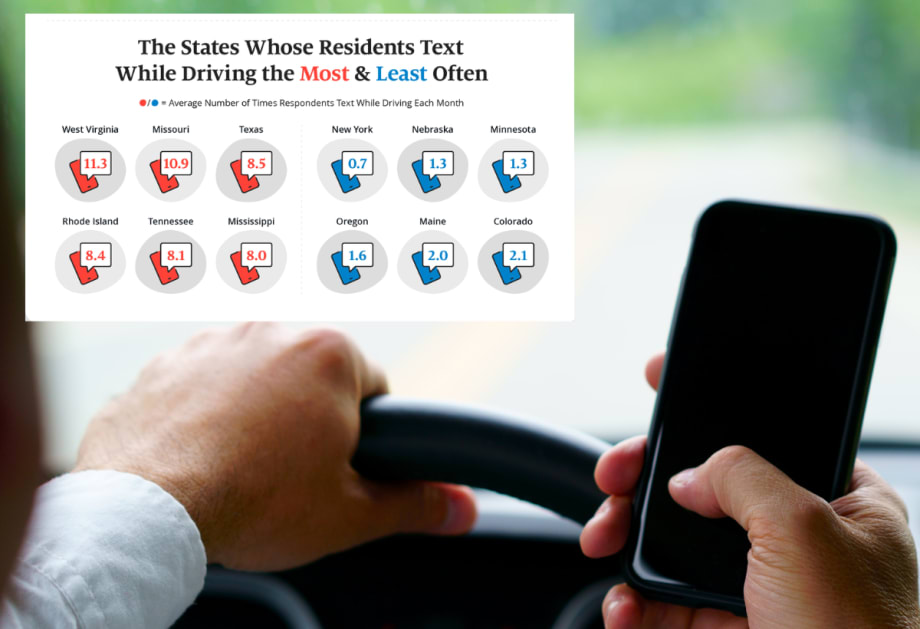
West Virginia and Missori drivers reported texting while driving the most.
Photo: Assurance/Work Truck
4 min to read
In 2023, distracted driving remains a critical concern, leading to an alarming rate of nine fatalities daily.
To gauge the prevalence of distracted driving on today's roads, Assurance conducted survey among more than 3,200 U.S. drivers.
It inquired about their distracted driving habits, encompassing texting, checking their phones, applying makeup, and changing music.
Additionally, it identifys which states had the highest rates of distracted drivers based on the frequency of residents texting while driving.
Distracted Driving Persists in 2023
The study revealed that 37% of U.S. drivers admitted to texting while driving within the past month.
When examining each state's data, it became evident that certain states engage in riskier behaviors than others.
Mississippi and New Hampshire topped the list, with 50% of drivers in both states admitting to texting while driving in the past 30 days. Following closely behind were Missouri (49%), Alabama (48.1%), and Louisiana (48.1%), with three out of the five states located in the Deep South.
On the contrary, some states exhibited more responsible behavior. New York, Pennsylvania, Oregon, and New Jersey reported the lowest percentage of residents who texted while driving last month.
Moreover, when analyzing the frequency of texting while driving among states, drivers in West Virginia, Missouri, Texas, Rhode Island, and Tennessee emerged as the most frequent texters behind the wheel.
On average, West Virginia drivers texted while driving 11.3 times a month, while Missouri drivers reported 10.9 times, and Texas drivers confessed to texting 8.5 times a month. By comparison, the average American driver texts while driving around 4.8 times a month.
Conversely, New York, Nebraska, Minnesota, Oregon, and Maine drivers demonstrated the least texting while driving each month, boasting the lowest average frequencies.
Survey Reveals Top Distracted Driving Behaviors
Driving while distracted poses a significant risk to everyone on the road, making improving safety behind the wheel crucial.
Raising awareness about the most common distracted driving behaviors is essential to address this concern. Based on survey results, here are the prevalent distractions among drivers:
Selecting Music: A staggering 68.9% of drivers admit to choosing music while driving, which can lead to accidents when adjusting audio settings or searching for playlists.
Checking the GPS: Over half (56.1%) of drivers confess to checking GPS devices while driving, which can impair focus on the road and increase the risk of accidents.
Interacting with Adults in the Car: Approximately 54.8% of drivers engage in conversations or interactions with adults, potentially compromising situational awareness.
Eating Food: Approximately 37.5% of drivers admit to eating while driving, which diverts attention and poses a dangerous distraction.
Interacting with Children in the Car: About 21.1% of drivers report being distracted by their children while driving, which can increase accident risks.
Texting and Emailing: Despite known risks, 19.2% of drivers still text while driving, significantly increasing the chances of collisions.
Making a Phone Call: Approximately 18.1% of drivers admit to making phone calls without using hands-free devices, leading to distracted driving and decreased reaction times.
Grooming and Applying Makeup: Approximately 11.9% of drivers look at themselves in the mirror while driving, diverting attention from the road.
Checking Social Media: Approximately 7.4% of drivers browse social media feeds while driving, impairing their ability to anticipate and respond to traffic situations.
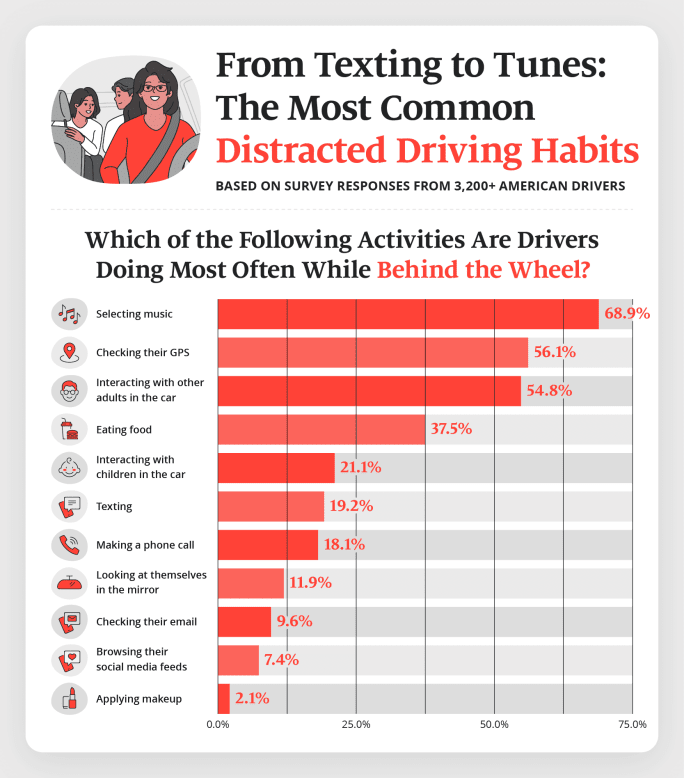
Chart on the results of the most distracted driving habits.
Photo: Assurance
Reducing Risks Associated With Distracted Driving
Understanding these common distractions is the first step toward fostering safer driving habits and reducing the risks associated with distracted driving.
Distracted driving presents a serious safety risk, encompassing various behaviors that divert a driver's attention from the road. One particularly concerning phenomenon is "highway hypnosis" or "white line fever," where drivers enter a trance-like state, mentally detached from their driving environment.
This state often occurs during long and monotonous journeys on highways or freeways, causing drivers to lose awareness of time, distance, and potential hazards. Our survey found that 54% of drivers have experienced highway hypnosis at some point while driving.
In addition to highway hypnosis, our investigation uncovered other troubling insights regarding distracted driving:
37% of U.S. drivers regularly ignore no-texting laws while driving, yet only 2.9% have been pulled over for doing so.
20% of drivers are unaware if their state has a law banning texting while driving.
Despite 86% of Americans feeling unsafe with a texting driver, only 47% feel unsafe when they are the ones texting while driving.
26% of drivers have driven with AirPods or earphones in their ears.
46% of drivers have honked their horns at another driver who was texting while driving.
These findings highlight the importance of addressing distracted driving and raising awareness about its dangers to ensure safer roads for everyone.
More Safety
When Work Trucks Under 26,001 Pounds Need IRP Registration
Think trucks under 26,001 pounds are automatically in the clear when it comes to IRP? Not always. Learn where lighter vehicles can still run into trip permit, apportioned registration, and IFTA compliance requirements when crossing state or provincial lines.
Read More →
Volvo Trucks Releases New Safety Recommendations for Traveling with Pets
One of the most important recommendations for professional drivers traveling with pets is to ensure pets are properly restrained while the truck is moving. Other tips are available in the new guide from Volvo Trucks North America and Center for Pet Safety.
Read More →
API Issues Refueling Safety Guidelines
The American Petroleum Institute offers a list of safe vehicle refueling guidelines, including ways to avoid potential problems with static electricity discharges in fall, winter, and early spring.
Read More →
Winter Fleet Prep: Expert Tips to Keep Vehicles Running Smoothly
Cold weather can expose weak batteries, tires, fuel systems, and maintenance gaps fast. Use this winter fleet checklist to prepare trucks and drivers before temperatures drop.
Read More →
When a Work Truck Breaks Down, the Job Can Stop, Too
A work truck breakdown can stop more than the vehicle. Discover how payloads, jobsites, and specialty equipment change the roadside response.
Read More →
What Stronger Long-Term Fleet Service Partnerships Actually Require
Fleet service partnerships rarely fall apart all at once. Learn the three warning signs that trust is eroding and what fleets and providers can do before downtime, frustration, and lost revenue follow.
Read More →
Applause & TRUCE Software Partner to Improve Driver Safety Through AI-Powered Telematics & Employee Performance Management
Applause has integrated TRUCE driving metrics directly into its employee-first performance and safety platform that transforms mobile devices into AI-powered telematics.
Read More →
How Detroit Assurance with Active Brake Assist Works
Do you want to see what it is like to experience Detroit Assurance’s Active Brake Assist? In this video, Work Truck will put you in the cab to see how it all works and then hear more details from DTNA’s Mike Young.
Read More →
Get Left of Loss: A 5-Step Workplace Violence Prevention Framework for Fleet Operators
Violence risks do not stop at the driver’s door. Learn five practical steps fleets can take to spot threats early and protect workers before loss occurs.
Read More →
Sponsored•July 17, 2026
How Better Visibility Cut Speeding Violations by 48%
Fleet leaders don't need more data, they need clearer visibility into what the data is saying. This case study explores how one utility replaced speeding-event counts with a single metric — miles driven in violation — to strengthen safety and significantly reduce speeding violations.
Read More →