





Learn More: Best Practices for Safe Driving in Light- and Medium-Duty Trucks
New York City Expands Safety Technologies Across Municipal Fleet
Mayor Zohran Mamdani’s Executive Order 19 requires added safety features on municipal vehicles and also calls for all existing city fleet trucks to be retrofitted with pedestrian alerts by June 30, 2029.
September 14, 2026
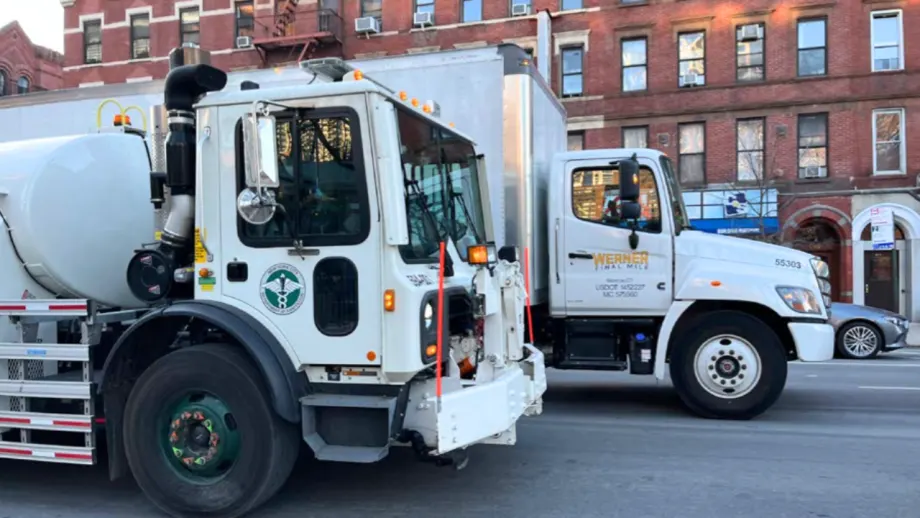
In July, New York Mayor Zohran Mamdani signed Executive Order 19, which mandates added safety features on municipal vehicles.
Credit:
Together for Safer Roads
2 min to read
- Mayor Zohran Mamdani has issued Executive Order 19 to enhance the safety features of municipal vehicles in New York City.
- The order mandates the retrofitting of all existing city fleet trucks with pedestrian alert systems.
- The deadline for implementing these safety upgrades is June 30, 2029.
*Summarized by AI
New York City’s Executive Order 19 requires Intelligent Speed Assistance (ISA) in contracts for the purchase or lease of new civilian city fleet vehicles and pedestrian alerts in contracts for the purchase or lease of city fleet trucks.
Together for Safer Roads said this provides a model for cities looking to protect lives by scaling fleet safety solutions.
“New York City’s decision to expand proven fleet safety technologies across its municipal fleet is an important example of how cities can move from testing and research to implementation at scale,” said Peter Goldwasser, executive director, Together for Safer Roads.
In July, Mayor Zohran Mamdani signed Executive Order 19, which also directs the New York City Department of Citywide Administrative Services (DCAS) to retrofit all existing city fleet trucks with pedestrian alerts by June 30, 2029.
Goldwasser said this action builds on years of testing and implementation by DCAS. The city has already equipped 1,000 vehicles across 23 vehicle types with ISA, and DCAS reports that the program has reduced dangerous speeding among equipped vehicles by 64%.
Pedestrian alerts, which warn pedestrians, bicyclists, and other road users when trucks are turning, have already been rolled out on 800 city trucks.
What is particularly significant is the progression from testing safety interventions, to measuring their performance, to incorporating them into how a major fleet purchases and operates vehicles. This is how proven safety solutions move from promising ideas to standard practice, explained Goldwasser.
“Together for Safer Roads has been proud to work with New York City and DCAS on fleet safety, including through our Truck of the Future program pilots and our broader efforts to advance safer vehicle design, direct vision, telematics, and technologies that can better protect drivers and vulnerable road users,” Goldwasser said. “New York City’s actions demonstrate what is possible not only for one municipal fleet, but for public and private fleets across the country. The challenge in fleet safety is increasingly not whether effective technologies and practices exist. It is how fleets can adopt them consistently, incorporate them into procurement and operations, measure their impact, and implement proven solutions at scale.”
“New York City is providing an important model for how that can be done for other cities across the nation,” he added.
More Safety

Volvo Trucks Releases New Safety Recommendations for Traveling with Pets
One of the most important recommendations for professional drivers traveling with pets is to ensure pets are properly restrained while the truck is moving. Other tips are available in the new guide from Volvo Trucks North America and Center for Pet Safety.
Read More →
API Issues Refueling Safety Guidelines
The American Petroleum Institute offers a list of safe vehicle refueling guidelines, including ways to avoid potential problems with static electricity discharges in fall, winter, and early spring.
Read More →
Winter Fleet Prep: Expert Tips to Keep Vehicles Running Smoothly
Cold weather can expose weak batteries, tires, fuel systems, and maintenance gaps fast. Use this winter fleet checklist to prepare trucks and drivers before temperatures drop.
Read More →
When a Work Truck Breaks Down, the Job Can Stop, Too
A work truck breakdown can stop more than the vehicle. Discover how payloads, jobsites, and specialty equipment change the roadside response.
Read More →
What Stronger Long-Term Fleet Service Partnerships Actually Require
Fleet service partnerships rarely fall apart all at once. Learn the three warning signs that trust is eroding and what fleets and providers can do before downtime, frustration, and lost revenue follow.
Read More →
Applause & TRUCE Software Partner to Improve Driver Safety Through AI-Powered Telematics & Employee Performance Management
Applause has integrated TRUCE driving metrics directly into its employee-first performance and safety platform that transforms mobile devices into AI-powered telematics.
Read More →
How Detroit Assurance with Active Brake Assist Works
Do you want to see what it is like to experience Detroit Assurance’s Active Brake Assist? In this video, Work Truck will put you in the cab to see how it all works and then hear more details from DTNA’s Mike Young.
Read More →
Get Left of Loss: A 5-Step Workplace Violence Prevention Framework for Fleet Operators
Violence risks do not stop at the driver’s door. Learn five practical steps fleets can take to spot threats early and protect workers before loss occurs.
Read More →
Sponsored•July 17, 2026
How Better Visibility Cut Speeding Violations by 48%
Fleet leaders don't need more data, they need clearer visibility into what the data is saying. This case study explores how one utility replaced speeding-event counts with a single metric — miles driven in violation — to strengthen safety and significantly reduce speeding violations.
Read More →
13 Safe Driving Tips for Commercial Vehicle Drivers
Make sure you are spending time on the road safely with these important tips.
Read More →