





IIHS Study Shows Pickups with AEB Have Far Fewer Rear-End Crashes
IIHS Shares Pickup Truck Side Crash Results
While five out of six of the small pickup trucks tested earned at least a good or acceptable rating, only three earned a "good" rating.
November 22, 2022
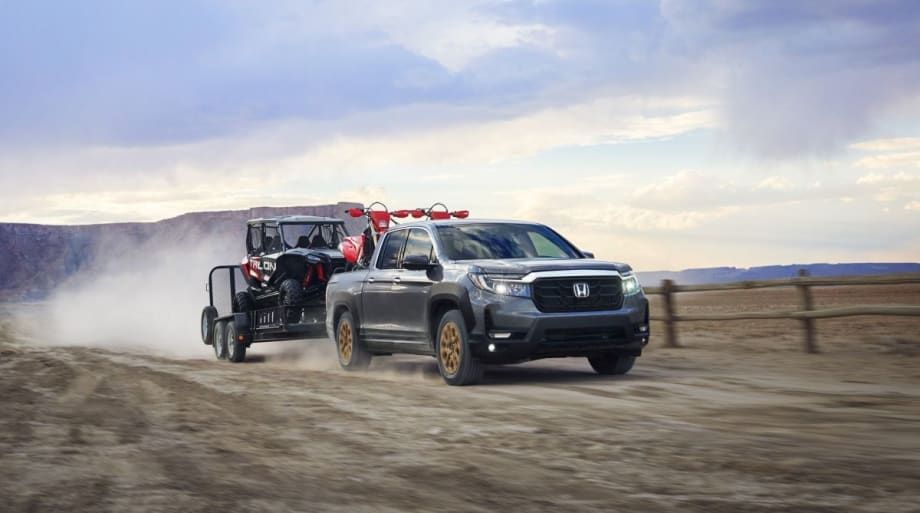
The Honda Ridgeline crew cab was one of the trucks to earn a Good rating by the IIHS in side-impact crash tests.
Photo: Honda
3 min to read
Five out of six small pickups tested earn good or acceptable ratings in the Insurance Institute for Highway Safety’s (IIHS) updated side crash test. Pickup and work truck fleet safety is top of mind for vocational fleet managers and knowing what trucks will keep you safe is essential.
IIHS side crash test ratings top results included:
Good rating:
Chevrolet Colorado crew cab
GMC Canyon crew cab
Honda Ridgeline crew cab
Acceptable Rating:
Nissan Frontier crew cab
Ford Ranger crew cab
Marginal Rating
Toyota Tacoma crew cab
“Overall, this was a solid performance from these vehicles,” said IIHS Senior Research Engineer Becky Mueller, whose work formed the foundation for the new evaluation. “Their high ride height means that the barrier we use to represent a striking vehicle hits the strong door sill structures directly. This likely prevented excessive intrusion into the occupant compartment, except in the case of the Tacoma.”
Standing Up to the Test
The structure and safety cages of the good-rated Colorado, Canyon and Ridgeline held up relatively well, contributing to a minimal risk of most injuries. However, injury measures taken from the dummies indicated a possibility of a pelvic fracture for the driver of the Colorado, the Canyon and especially the Ridgeline.
The Frontier’s structure held up the best out of all six vehicles, and the Ranger’s occupant compartment was also maintained relatively well, minimizing the risk of most injuries. However, the rear passenger dummies’ heads struck the C-pillar through the side curtain airbag in both acceptable-rated vehicles.
Though measurements indicated minimal risk of most injuries for the marginal-rated Tacoma, its structure and safety cage were not maintained well during the crash. The impact from the striking barrier crumpled the door sill and B-pillar, pushing the B-pillar to within a few inches of the center of the driver seat.
“That alone pushed the overall rating down to marginal,” Mueller said. “We weight structural performance very heavily because it is tied so closely with survivability.”
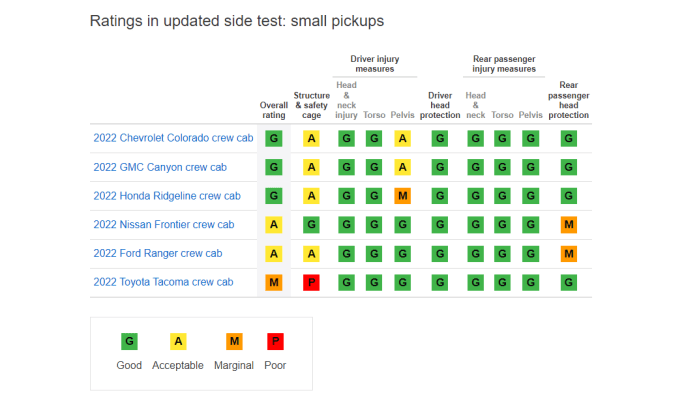
IIHS Ratings in the updated side crash test for small pickup trucks.
Photo: IIHS
Updating Crash Tests
IIHS developed the updated side crash test after research showed that many of the real-world side impacts that still account for nearly a quarter of passenger vehicle occupant fatalities are more severe than the original evaluation.
The updated side crash test uses a heavier barrier traveling at a higher speed to simulate the striking vehicle. The new barrier weighs 4,200 pounds — close to the weight of today’s midsize SUVs — and strikes the test vehicle at 37 mph, compared with a 3,300-pound barrier traveling at 31 mph in the original evaluation.
For now, the updated test is not included in the IIHS award criteria. However, starting in 2023, a good or acceptable rating will be required for the lower-tier TOP SAFETY PICK award and a good rating will be needed for the higher-tier TOP SAFETY PICK+.
All six vehicles earn good ratings in the original side test.
More Safety
When Work Trucks Under 26,001 Pounds Need IRP Registration
Think trucks under 26,001 pounds are automatically in the clear when it comes to IRP? Not always. Learn where lighter vehicles can still run into trip permit, apportioned registration, and IFTA compliance requirements when crossing state or provincial lines.
Read More →
Volvo Trucks Releases New Safety Recommendations for Traveling with Pets
One of the most important recommendations for professional drivers traveling with pets is to ensure pets are properly restrained while the truck is moving. Other tips are available in the new guide from Volvo Trucks North America and Center for Pet Safety.
Read More →
API Issues Refueling Safety Guidelines
The American Petroleum Institute offers a list of safe vehicle refueling guidelines, including ways to avoid potential problems with static electricity discharges in fall, winter, and early spring.
Read More →
Winter Fleet Prep: Expert Tips to Keep Vehicles Running Smoothly
Cold weather can expose weak batteries, tires, fuel systems, and maintenance gaps fast. Use this winter fleet checklist to prepare trucks and drivers before temperatures drop.
Read More →
When a Work Truck Breaks Down, the Job Can Stop, Too
A work truck breakdown can stop more than the vehicle. Discover how payloads, jobsites, and specialty equipment change the roadside response.
Read More →
What Stronger Long-Term Fleet Service Partnerships Actually Require
Fleet service partnerships rarely fall apart all at once. Learn the three warning signs that trust is eroding and what fleets and providers can do before downtime, frustration, and lost revenue follow.
Read More →
Applause & TRUCE Software Partner to Improve Driver Safety Through AI-Powered Telematics & Employee Performance Management
Applause has integrated TRUCE driving metrics directly into its employee-first performance and safety platform that transforms mobile devices into AI-powered telematics.
Read More →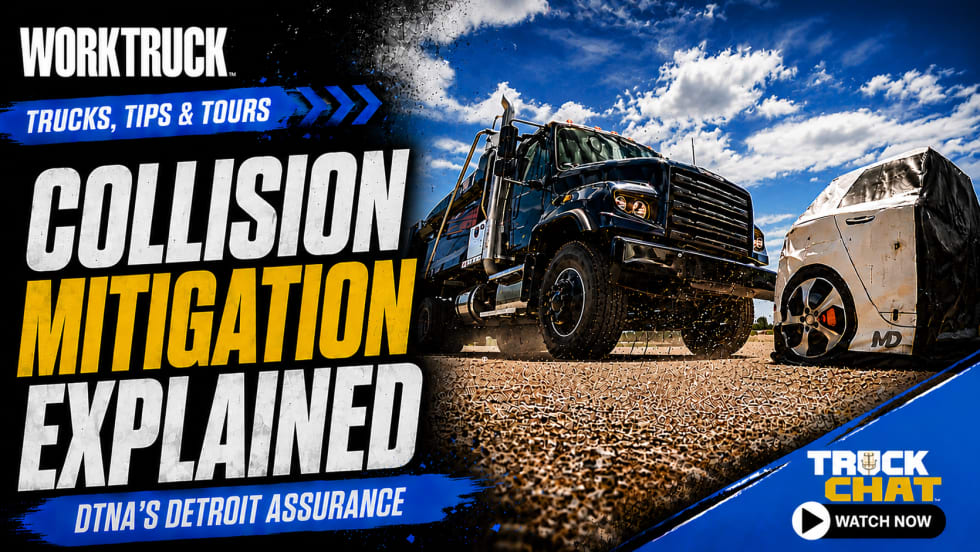
How Detroit Assurance with Active Brake Assist Works
Do you want to see what it is like to experience Detroit Assurance’s Active Brake Assist? In this video, Work Truck will put you in the cab to see how it all works and then hear more details from DTNA’s Mike Young.
Read More →
Get Left of Loss: A 5-Step Workplace Violence Prevention Framework for Fleet Operators
Violence risks do not stop at the driver’s door. Learn five practical steps fleets can take to spot threats early and protect workers before loss occurs.
Read More →
Sponsored•July 17, 2026
How Better Visibility Cut Speeding Violations by 48%
Fleet leaders don't need more data, they need clearer visibility into what the data is saying. This case study explores how one utility replaced speeding-event counts with a single metric — miles driven in violation — to strengthen safety and significantly reduce speeding violations.
Read More →