




Avoiding Collisions on Slick Winter Roads
Keep your heavy-duty vocational fleet drivers safer on the roads this winter through safe driving practices and the use of collision mitigation technology.

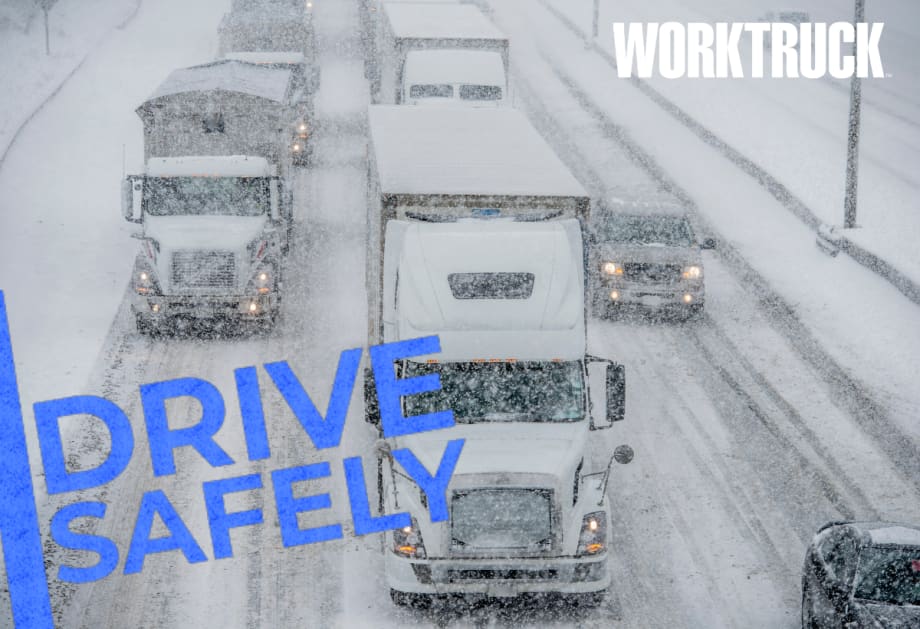
Winter roads provide an abundance of potential safety hazards. Keep drivers alert and prepared for anything.
Photo: Work Truck
In the United States, daylight hours are shortening and the temperatures are dropping. This means commercial vehicle drivers are far more likely to encounter slushy, snowy, and icy road conditions, according to Bendix Commercial Vehicle Systems.
With this in mind, Bendix is sharing insights on what drivers may expereince from today's collision mitigation technology that can help them stay safer on slick surfaces and winter roads.
“During our ride-and-drive safety technology demonstrations, two questions frequently pop up,” said Fred Andersky, Bendix director – Demos, Sales & Service Training. “The first is, ‘What can I expect from collision mitigation on a slick road?’ and the second is, ‘Could an automatic brake application cause me to lose control?’ Conveniently, the answers are found in the inclusion of full-stability technology as a building block of collision mitigation.”
What Are Collision Mitigation Technologies?
Systems such as Bendix Wingman Advanced and Wingman Fusion are built upon full-stability control, which has been required on most new heavy-duty Class 7 and 8 air-braked tractors in the U.S. since 2017. Full-stability technologies like Bendix ESP (Electronic Stability Program) – generally known in the industry as ESC (electronic stability control) – are designed to help drivers mitigate rollovers. But importantly, they’re also engineered to potentially help a driver in some loss-of-control, or some loss-of-vehicle-traction, conditions that can be experienced during wintry weather.
“Just like any safety technology, full stability is there to assist the driver – the driver is always in control of the vehicle at all times,” Andersky emphasized. “And it is important to remember that the system has limits: You can drive too fast and negate its benefit. But by building the collision mitigation technology on top of stability control – which is itself built on the antilock braking system (ABS) – we’re helping both drivers and the collision mitigation system keep control when brakes are applied.”
According to Bendix, Collision mitigation systems may help drivers mitigate forward crash situations by reducing the throttle and/or applying the brakes when the system detects a potentially threatening forward collision. The difference is that instead of a driver physically stepping on and off pedals to engage and disengage the brakes and throttle, a collision mitigation system may deliver the interventions using electronics in the braking system.
Using input gathered by radar, camera, and system sensors, a collision mitigation system’s electronic control unit (ECU) continuously assesses the vehicle’s situation. If the system determines a forward collision is imminent, then it sends signals to the brake controller, which may reduce the throttle and/or apply the brakes. Prior to cutting the throttle and braking, collision mitigation technology may deliver in-cab alerts as the gap between the truck and a forward vehicle closes. It may also provide an alert before intervening.
Note: Safety technologies complement safe driving practices. No commercial vehicle safety technology will ever replace a skiller, alert driver.
In terms of road conditions, collision mitigation systems are subject to the same laws of physics as a driver: What happens when you apply the brakes on a slick surface – a surface with the potential loss of vehicle traction? The vehicle slows and eventually stops. If skidding starts to occur, then the ABS and stability control systems may intervene to help the driver keep control in some situations.
The same is true for a collision mitigation system. The obvious difference is that when either the driver or the collision mitigation technology is braking on a slick surface instead of a dry surface, the vehicle requires more time and distance to come to a stop. Bendix noted this statement is worth repeating – time and distance are critical in terms of the system detecting the situation and braking on slick surfaces.
Checking Out Real-World Safety Examples
The Bendix team spends a good portion of every winter at the Keweenaw Research Center in Michigan’s Upper Peninsula, where there is no shortage of brutal winter conditions for putting vehicles and safety systems to the test. Joining the engineers and other personnel on site, Andersky – who holds a Class A CDL and regularly drives at Bendix demonstrations – had the opportunity to get behind the wheel to put a truck through normal demo maneuvers, but on a surface of slick, packed snow.
He drove a 6x4 tractor with a loaded trailer, air disc brakes, and a gross vehicle combination weight of 65,000 lbs., and performed tests involving both a stationary and slow-moving forward vehicle. (In this case, an inflatable “test car” was used for demonstrations.)
Andy Pilkington, Bendix product group director – ADAS/HAD, offered, “The first thing to understand is that the collision mitigation system must detect the situation ahead, then perform calculations to determine if or when alerts or automatic braking is needed. The faster the truck approaches the forward vehicle (whether it is stationary or moving), the more difficult it is to detect and the less time the system has to react. For demonstration purposes, Fred ran two common traffic scenarios to better illustrate system reaction.”
First, approaching a stationary car at a moderate speed, the vehicle’s collision mitigation system detected the situation and intervened as designed: By alerting the driver, cutting the throttle, and applying the brakes to assist. However, because of the approach speed and slick surface, the vehicle slid – just as if the driver had applied the brakes.
According to Pilkington, it’s important to note that multiple scenarios exist. He added, “Specifically, sometimes there is not enough time or friction with the road surface to provide any alert or sufficient braking force to mitigate impact with the forward vehicle. In other situations, the truck can partially decelerate and may still impact the forward vehicle with a lesser speed. And in yet another set of circumstances, there is sufficient friction with the road surface and time to detect the situation to prevent impact altogether. The situation matters!”
“That’s one of the reasons Bendix says the driver must stay alert and deal with potentially threatening situations themselves – the driver always has control of the vehicle and is responsible for its safe operation,” remarked Andersky. “These collision mitigation systems are driver assistance, NOT driver replacement.”
The next maneuver, at a higher speed, simulates the common situation of a slow-moving vehicle in a driver’s lane of travel, with the tractor-trailer coming up fast on a slower moving vehicle. As before, after the system detected the situation, it alerted and applied the brakes – and in both cases, while the vehicle slowed, the speed reduction alone did not avoid the forward vehicle: Andersky needed to swerve to prevent the collision.
Pilkington commented, “The same possibilities detailed in the first maneuver exist here as well. Sometimes only an alert is given or limited braking is applied, or in other situations, maximum braking occurs; the response is contingent on the exact situation, the closure rate with the forward vehicle, and how much time the system has to detect the situation and react.”
“In other words, the system reacted as it was designed and allowed me the opportunity to take action,” Andersky explained. “Not all that surprising. Whether the forward vehicle is moving or stationary, bringing a loaded tractor-trailer to a stop requires more time and distance on a slick surface.”
Science Behind Truck Safety
The coefficient of friction represents the amount of friction between two surfaces – the lower it is, the more easily the two surfaces will slide. Compared to a dry asphalt or concrete surface, the coefficient of friction of truck tires on hard-packed snow or ice is up to 87% less. Combine this situation with the mass and speed of a combination vehicle – 80,000 lbs. and 55 mph, for instance – and we can roughly compare the stopping distance on various surfaces, bringing the science into the real world.
Bendix testing shows that the truck that takes 335 feet to stop on dry pavement, for example, will likely take 466 feet to stop on a wet road, 965 feet to stop on packed snow, and 1,625 feet – more than a quarter mile – to stop on ice. Nearly triple the stopping distance between snow and dry road, and almost five times as long to stop on ice as a dry surface. This means both the driver and the system need to be aware of what is happening down the road to react in time.
“This is the perfect illustration of why driver alerts are so critical,” Pilkington said. “Giving the drivers time to react before a system intervenes helps capitalize on their abilities to see farther and also to steer – something most of today’s collision mitigation technologies don’t do.”
He added, “It also shows the value of the collision mitigation system on a slick surface: Beyond the interventions, depending on the situation, the alerts can help re-engage the driver to brake or take other action to avoid a hazard. And if the driver intervenes to steer around the situation, then full stability can possibly help them keep control of the vehicle.”
As to any potential loss of control caused by system-generated collision mitigation braking, it is no more of an issue than a driver applying brakes on the same surface, especially since the full-stability system is already integrated to help maintain control.
“Ultimately, safe, alert drivers are the single most important factor to help mitigate collisions on slick roads,” Andersky said. “They have advantages over technology – sight and steering – and they’re trained to recognize the crucial factors in increasing following distance to create reaction time when the weather gets bad.”
Are you worried about your electric vehicles (EVs) this winter? Check out these tips on how to prepare your EVs for the winter months and don't forget to protect yourself and your truck this winter!
More Safety
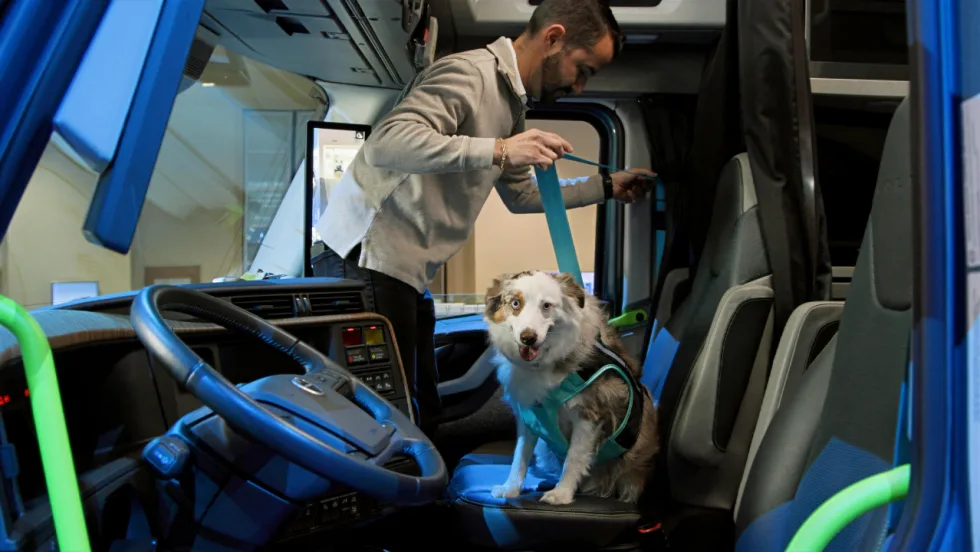
Volvo Trucks Releases New Safety Recommendations for Traveling with Pets
One of the most important recommendations for professional drivers traveling with pets is to ensure pets are properly restrained while the truck is moving. Other tips are available in the new guide from Volvo Trucks North America and Center for Pet Safety.
Read More →
API Issues Refueling Safety Guidelines
The American Petroleum Institute offers a list of safe vehicle refueling guidelines, including ways to avoid potential problems with static electricity discharges in fall, winter, and early spring.
Read More →
Winter Fleet Prep: Expert Tips to Keep Vehicles Running Smoothly
Cold weather can expose weak batteries, tires, fuel systems, and maintenance gaps fast. Use this winter fleet checklist to prepare trucks and drivers before temperatures drop.
Read More →
When a Work Truck Breaks Down, the Job Can Stop, Too
A work truck breakdown can stop more than the vehicle. Discover how payloads, jobsites, and specialty equipment change the roadside response.
Read More →
What Stronger Long-Term Fleet Service Partnerships Actually Require
Fleet service partnerships rarely fall apart all at once. Learn the three warning signs that trust is eroding and what fleets and providers can do before downtime, frustration, and lost revenue follow.
Read More →
Applause & TRUCE Software Partner to Improve Driver Safety Through AI-Powered Telematics & Employee Performance Management
Applause has integrated TRUCE driving metrics directly into its employee-first performance and safety platform that transforms mobile devices into AI-powered telematics.
Read More →
How Detroit Assurance with Active Brake Assist Works
Do you want to see what it is like to experience Detroit Assurance’s Active Brake Assist? In this video, Work Truck will put you in the cab to see how it all works and then hear more details from DTNA’s Mike Young.
Read More →
Get Left of Loss: A 5-Step Workplace Violence Prevention Framework for Fleet Operators
Violence risks do not stop at the driver’s door. Learn five practical steps fleets can take to spot threats early and protect workers before loss occurs.
Read More →
How Better Visibility Cut Speeding Violations by 48%
Fleet leaders don't need more data, they need clearer visibility into what the data is saying. This case study explores how one utility replaced speeding-event counts with a single metric — miles driven in violation — to strengthen safety and significantly reduce speeding violations.
Read More →
13 Safe Driving Tips for Commercial Vehicle Drivers
Make sure you are spending time on the road safely with these important tips.
Read More →