




Alaska Energy Fleet Airlifts Trucks Into Service
ASRC Energy Services has been using creative methods to transport its fleet vehicles to remote areas of the state, including replacing a vehicle's wheels with smaller ones so the vehicle fits into an airplane.
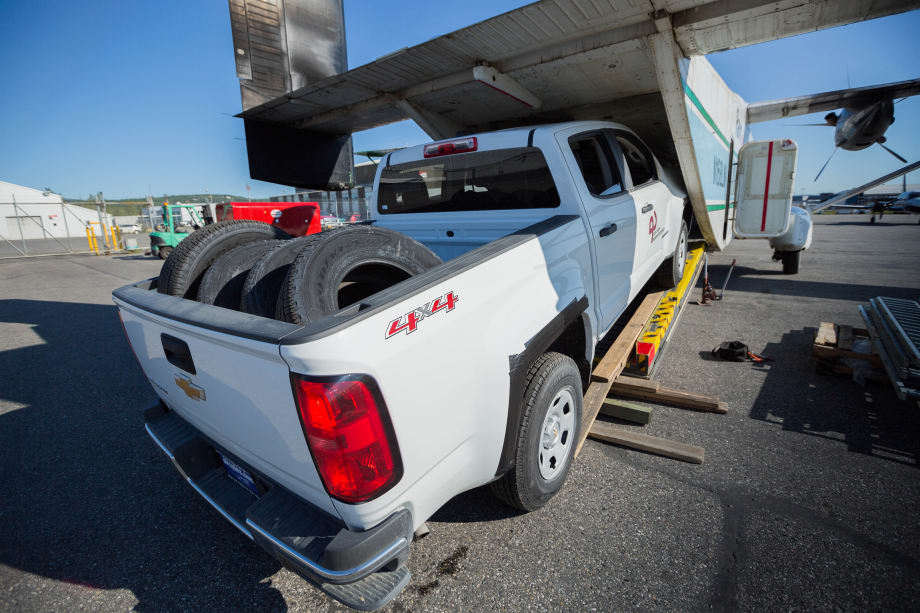
Photo of 2015 Chevrolet Colorado being loaded on to a Shorts 330 Sherpa aircraft for ASRC courtesy of GM.

Photo of 2015 Chevrolet Colorado being loaded on to a Shorts 330 Sherpa aircraft for ASRC courtesy of GM.
Arctic Slope Regional Corp. (ASRC) Energy Services, an Alaskan oilfield service partner, has been using creative methods to transport its fleet vehicles to remote areas of the state, including replacing a vehicle's wheels with smaller ones so the vehicle fits into an airplane.
The fleet has been adding 2015 Chevrolet Colorado mid-size pickups and air-lifting the trucks using a Shorts 330 Sherpa airplane. ASRC Energy Services has been experimenting with this shipping method when weather conditions permit and to meet delivery deadlines.
"Our fleet vehicles double as mobile offices for the majority of our employees, so we need to give them dependable vehicles in the remote areas where they work," said Chris Maynard, general manager of fleet operations for ASRC Energy Services. "These locations can vary from areas with no electricity to temporary roads built on top of the frozen tundra."
Their total fleet size ranges from 600 to 1,000 vehicles a year, and they purchase 100 to 200 vehicles annually as part of their rotation plan.
To fulfill its fleet's needs and ensure its employees can travel easily across Alaska, ASRC Energy Services uses Chevrolet's three-truck strategy: Chevrolet Colorado, Chevrolet Silverado 1500, and Chevrolet Silverado 2500HD and 3500HD.
The Silverado 1500, as a light-duty truck, helps ASRC's management team get to and from project sites and transport clients. The Colorado is able to meet those same needs with a smaller footprint. The Silverado HDs are a year-round, durable yet dependable truck that aids client operations in the oil and gas market, according to General Motors.
The Chevrolet trucks serve as towing vehicles, to bring trailers, mobile heaters and lights to construction zones. They also service heavy equipment.
The fleet uses “arctic upfits” to navigate the changing weather and terrain. These modifications include adding pan or transmission heaters, wind straps for the doors and -40 degree Fahrenheit fluids. Safety and rescue features are also added, including fire extinguishers, first-aid kits and flares. Most vehicles get reflective striping for detection during winter.
"We build our trucks with companies like Arctic Slope in mind," said John Schwegman, GM's director of commercial product. "Their employees don’t have time to worry about how the vehicle will operate when the weather is 40 degrees below zero. We ensure our vehicle's performance will stand up to the test so they can get their work done."
Originally posted on Automotive Fleet
More Operations
Family Ties Inside the Fleet Families Building Careers Across Generations
Three fleet families share what it really takes to work together, learn across generations, and keep business from following them home.
Read More →
Shades of Fleet Call for Voices: Fleet's Hidden Heroes
Fleet’s hidden heroes are often the ones keeping everything moving behind the scenes. September’s Shades of Fleet is looking for dispatchers, coordinators, parts specialists, and other support pros to share their stories.
Read More →
Truck Centers, Inc. Celebrates National Truck Driver Appreciation Week with $1,000 Fuel Card Giveaways
During National Truck Driver Appreciation Week, Truck Centers, Inc. is offering customers a chance to fuel up for free. Customers at all Truck Centers locations can enter to win one of four $1,000 fuel cards from Sept. 14 - 18.
Read More →
Fleet Guides, AI Time-Savers, Truck Tariffs & Fuel Strategy Lead the News
This week’s Truck Chat Cheat Sheet covers new fleet vehicle guides, practical AI use cases, U.S.-Canada truck production, mixed-energy strategy, and more.
Read More →
What Fleet Employers Are Missing When Hiring Veterans
What if some of the strongest candidates for fleet are already out there, but their experience is written in a language our industry does not always recognize?
Read More →
Automotive Fleet Opens 2026 Personal Use Survey for Commercial Fleet Managers
Less than two weeks left! Commercial and corporate fleet managers are invited to share how their organizations handle company vehicle personal-use policies, charges, and driver eligibility.
Read More →
What Resilient Fleets Do Differently When Conditions Change
Fleet resilience is about more than reacting to disruption. Lauren Fletcher talks with AP Fleet’s Alex Coveney about flexibility, planning, scaling, and what helps fleets adapt when business conditions shift.
Read More →
If We Want the Next Generation in Automotive, We Have to Give Them a Reason to Care
The automotive industry talks constantly about its workforce shortage. But before we can recruit the next generation, we may need to do a better job giving kids a reason to care about automotive in the first place.
Read More →
Ram ProMaster City Under $40K, Truck Tariffs, and AI Maintenance Lead the News
A sub-$40K commercial van, tariff questions, AI-powered maintenance, and a new EV production strategy headline this week’s Truck Chat Cheat Sheet.
Read More →
Bob Adamsky Shares the Fleet Lessons You Usually Learn the Hard Way
After more than 30 years in fleet, Arrow International’s Bob Adamsky has learned that the job is about far more than vehicles. He shares the lessons he wishes every fleet manager could learn a little earlier.
Read More →