




2015 Sprinter Gets Small Diesel, ‘Crosswind Assist'
A smaller and more economical diesel powertrain, new styling and safety features, and optional on-demand four-wheel drive are among features of 2015 Sprinter models.

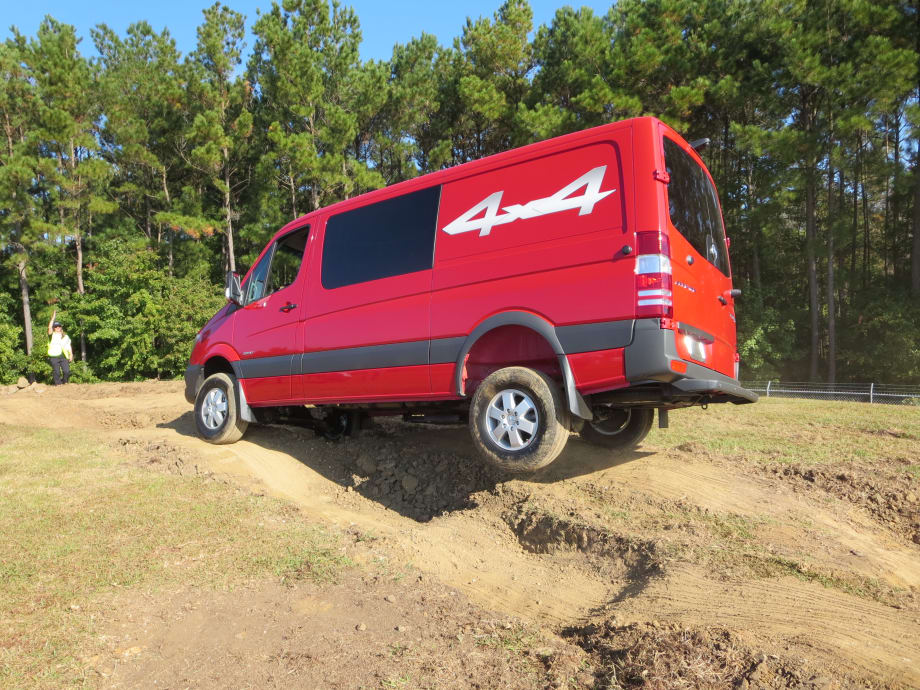
Electronic controls send power to three grounded wheels while the fourth hangs in the air. Photo: Tom Berg
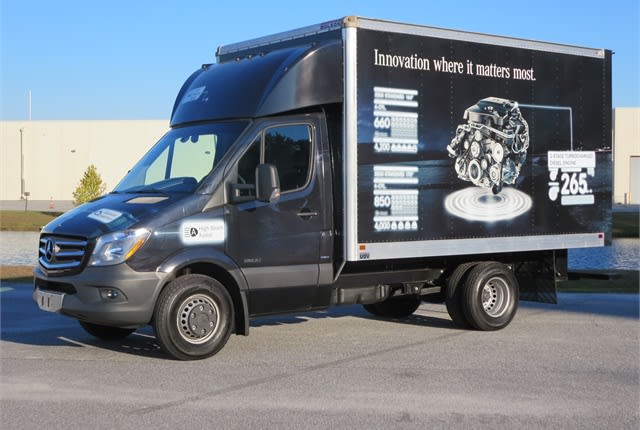
Cab-chassis with cargo delivery van sports graphics extolling a new high-tech I-4 diesel and other features.Photo: Tom Berg
A smaller and more economical diesel powertrain, new styling and safety features, and optional on-demand four-wheel drive are among features of 2015 Sprinter models, which are now being shipped to dealers from the Daimler company’s facilities in South Carolina.
In an event for reporters, Sprinter executives explained that the new-to-North-America third-generation Sprinter van, introduced in Europe as a 2014 model, replaces the second-generation Sprinter that sold more than 1 million around the globe.
The first-generation Sprinter entered the European market in 1994 and came to North America in 2001, said Mathias Geisen, product and marketing manager for Mercedes-Benz of North America. The second generation arrived in 2006.
As before, Sprinter cargo vans are assembled from German-produced kits near Charleston, S.C., to avoid a 25% import tax, while passenger vans and cab-chassis trucks come in already assembled, said Claus Tritt, general manager, Sprinter operations. He, Geisen and others spoke to reporters at an event at the assembly plant on Monday and Tuesday.
2015 Sprinters come in five models, three lengths and roof heights, and for cargo vans, three gross-vehicle weight ratings – 8,050, 9,990 and 11,030 pounds. Some are equipped for specialized vocations by four upfitters operating adjacent to the Sprinter assembly plant.
New I-4 Diesel
The new standard powertrain is a 2.1-liter inline 4-cylinder diesel running through a 7-speed automatic transmission, with the current 3-liter V-6 diesel and 5-speed automatic available as an option.
The high-tech I-4 has double overhead camshafts, twin counter-rotating balance shafts and a special flywheel that work together for smooth operation. Two-stage turbocharging boosts inlet air that’s cooled before entering the engine. The extra two ratios in the 7-speed allow the smaller engine to perform about as well as the larger diesel while delivering slightly better economy, Tritt said.
A short test drive by this reporter in an I-4-powered cab-chassis truck with a box-type body showed that to be true. The smaller engine is busy, spinning at an indicated 2,400 rpm at 65 mph and 2,600 at 70.
Tritt expects about half of all buyers to take the standard I-4, which makes 161 hp and 266 lb-ft. Those needing more cargo-carrying and towing ability will choose the 188-hp, 325-lb-ft V-6. Both use Blue Tec urea injection to reduce nitrogen oxides to meet current federal exhaust emissions limits. A Super Ultra-Low-Emission version of the I-4 is available for environmentally sensitive areas and “green” customers.
Exclusive 4x4
The 4x4 system is a segment exclusive, Tritt said, and “I fought for it for years” with Daimler officials in Germany. He believes it will find buyers in the construction trades and in cargo delivery and passenger conveyance in snowy and mountainous areas, and thus take about 5% of sales. It will find additional buyers among off-road enthusiasts, especially in the West.
Starting in early 2015, it will be available with a single-speed transfer case or with a 2-speed TC with a low range, with an upcharge of $6,400 and $6,800, respectively.
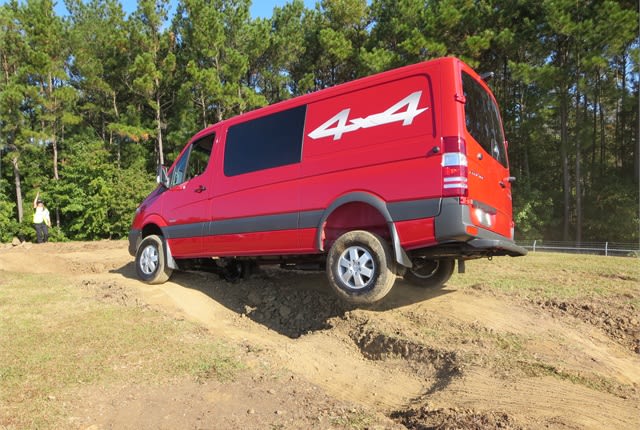
Electronic controls send power to three grounded wheels while the fourth hangs in the air.Photo: Tom Berg
The system is based on 4Matic mechanical and electronic equipment used in Mercedes cars, and automatically sends power to wheels with the best traction. However, while the auto version of 4Matic is full-time all-wheel drive, the Sprinter’s 4x4 is part-time and must be manually engaged with a dash-mounted switch at speeds of 6 mph or less. Another switch engages low range in the transfer case.
When 4x4 is engaged, torque is distributed at a ratio of 35:65 between the front and rear axle. At this point, the Electronic Traction System, or 4ETS, takes over, sending power to wheels that have a bite of ground.
Demonstrations on a short off-road course showed the system keeps the van moving over severe undulations that raised one wheel off the ground. A Sprinter 4x4 sits 4 inches higher than a 4x2 to provide extra ground clearance and fordability through streams. Most customers will never need all the capability the system has, Tritt said.
Countering Crosswinds
The perception of vans becoming sails in side winds is overstated, Sprinter people said, but Daimler engineered “cross-wind assist” to counter that notion and underscore the vehicles’ built-in safety.
The feature uses chassis instruments to sense sideways motion and applies brakes in wheels on the upwind side to compensate. The action is automatic and instantaneous, and a driver could take his hands off the wheel with the van staying in line, said a technician after a demonstration using three trailered air boats to generate a 90-mph wind perpendicular to a Sprinter’s travel direction.
Other safety features include Collision Prevention Assist, which applies brakes to avoid a collision with an object ahead if the driver doesn’t; Blind Spot Assist, which warns of vehicles alongside; Lane Keeping Assist, which warns of drifting in one’s lane; and Highbeam Assist, to switch to low beams for oncoming motorists.
Assertive Styling
The third-generation van’s new swept-back styling is concentrated in the nose with sculpturing extending through side panels. It gives the vans a more assertive and contemporary appearance. The nose is higher to lessen the severity of injuries if the van hits a pedestrian. Name badges front and rear and slightly different grilles separate Freightliner and Mercedes-Benz versions. The vehicles are otherwise identical, Tritt said.
Sprinters are sold by 57 Freightliner and about 200 Mercedes-Benz dealers. Sprinter will never try to achieve the volume anticipated for the new Ford Transit van or the Ram Promaster, he said. Instead, it will concentrate on quality of the product and service.
“We leveled the way for them,” Tritt said of the new competitors, because Sprinter pioneered the concept of larger but lighter full-size vans that use smaller and more economical powertrains in the U.S.
Analysts have said the new Euro-style vans’ fuel economy alone will save users millions of dollars a year, and, based on strong resale value of Sprinters, should have better residual value than traditional full-size American cargo vans.
Originally posted on Automotive Fleet
More Operations

Family Ties Inside the Fleet Families Building Careers Across Generations
Three fleet families share what it really takes to work together, learn across generations, and keep business from following them home.
Read More →
Shades of Fleet Call for Voices: Fleet's Hidden Heroes
Fleet’s hidden heroes are often the ones keeping everything moving behind the scenes. September’s Shades of Fleet is looking for dispatchers, coordinators, parts specialists, and other support pros to share their stories.
Read More →
Truck Centers, Inc. Celebrates National Truck Driver Appreciation Week with $1,000 Fuel Card Giveaways
During National Truck Driver Appreciation Week, Truck Centers, Inc. is offering customers a chance to fuel up for free. Customers at all Truck Centers locations can enter to win one of four $1,000 fuel cards from Sept. 14 - 18.
Read More →From Our Partners



Fleet Guides, AI Time-Savers, Truck Tariffs & Fuel Strategy Lead the News
This week’s Truck Chat Cheat Sheet covers new fleet vehicle guides, practical AI use cases, U.S.-Canada truck production, mixed-energy strategy, and more.
Read More →
What Fleet Employers Are Missing When Hiring Veterans
What if some of the strongest candidates for fleet are already out there, but their experience is written in a language our industry does not always recognize?
Read More →
Automotive Fleet Opens 2026 Personal Use Survey for Commercial Fleet Managers
Less than two weeks left! Commercial and corporate fleet managers are invited to share how their organizations handle company vehicle personal-use policies, charges, and driver eligibility.
Read More →
What Resilient Fleets Do Differently When Conditions Change
Fleet resilience is about more than reacting to disruption. Lauren Fletcher talks with AP Fleet’s Alex Coveney about flexibility, planning, scaling, and what helps fleets adapt when business conditions shift.
Read More →
If We Want the Next Generation in Automotive, We Have to Give Them a Reason to Care
The automotive industry talks constantly about its workforce shortage. But before we can recruit the next generation, we may need to do a better job giving kids a reason to care about automotive in the first place.
Read More →
Ram ProMaster City Under $40K, Truck Tariffs, and AI Maintenance Lead the News
A sub-$40K commercial van, tariff questions, AI-powered maintenance, and a new EV production strategy headline this week’s Truck Chat Cheat Sheet.
Read More →
Bob Adamsky Shares the Fleet Lessons You Usually Learn the Hard Way
After more than 30 years in fleet, Arrow International’s Bob Adamsky has learned that the job is about far more than vehicles. He shares the lessons he wishes every fleet manager could learn a little earlier.
Read More →