




When the Shop Is Gone, Preparing Technicians for Real-World Disaster Response
When disaster shuts down the shop, technicians must adapt. Learn how field expedient skills keep equipment running when it matters most.

The answer is never forcing the equipment beyond its limits. It may mean organizing a relay with multiple smaller vehicles, clearing a short access path to bring help closer, or moving patients in stages to a safer transfer point.
Credit: Envato
- Technicians must adapt swiftly when natural disasters close down regular repair facilities, utilizing innovative field skills.
- Mastering on-the-spot repair techniques is crucial for maintaining equipment functionality in disaster-stricken areas.
- Real-world disaster response requires technicians to apply practical knowledge and problem-solving skills effectively.
*Summarized by AI
When disaster strikes, the supply chain doesn’t pause for instructions. Parts don’t arrive overnight. Technical support may be unreachable. Shops may be inaccessible. And yet, equipment still needs to move, lift, transport, and support people.
For Ben Evridge, Owner, Pillar Creek Equipment, LLC, this scenario is not theoretical. Much of his career was spent working in remote environments where parts and outside support were often days away. The conditions may not have been labeled “disaster response,” but the operational realities were the same.
His message to fleet managers preparing for 2026 and beyond is straightforward: readiness begins with a mindset shift.
“Technicians need to shift from the equipment manufacturer's accepted procedures to what is known as ‘field expedient’ procedures,” Evridge said.
Field-expedient techniques are not casual shortcuts and should be used only in extreme situations by qualified, experienced technicians. Evridge noted that they are an established part of heavy construction, mining, commercial fishing, logging, and military disaster-response operations.

When disaster cuts off parts, tools, and outside support, technicians rely on experience, adaptability, and field expedient repairs to keep essential equipment working.
Credit: Envato
“Field expedient equipment techniques differ from ‘shade tree’ mechanics in three major ways,” he explained. “They are based on sound engineering principles. They are performed by trained, experienced techs to save lives or to permit mission completion. And they are temporary until better repairs can be made.”
That distinction is critical. Field expedient work is:
- Engineered
- Mission-driven
- Temporary
It is never reckless. It is never permanent. It exists to stabilize operations until proper repairs, parts, and support can be restored.
In disaster conditions, the goal is not perfection. The goal is safe continuity.
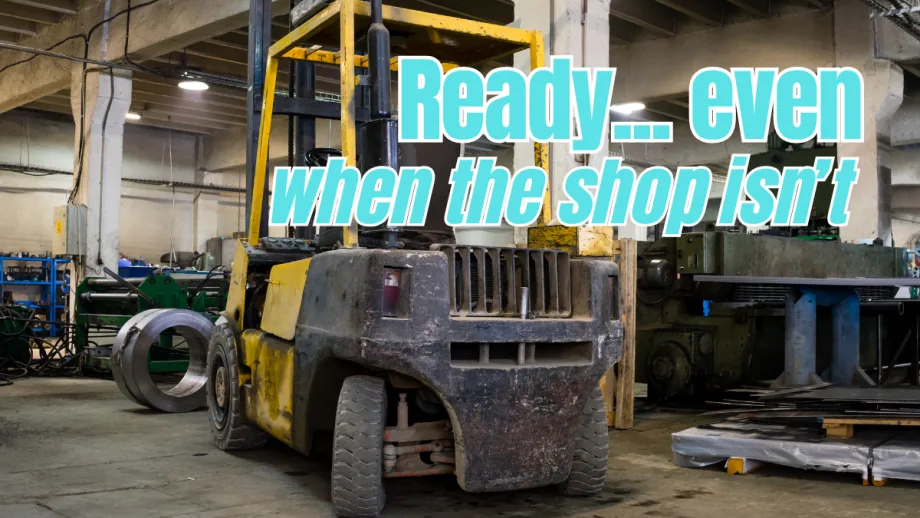
The Forklift That Couldn’t Wait
Evridge learned one big lesson early in his career. “On a job in Kotzebue, Alaska, in 1978, I was the mechanic for a construction company that built housing,” he recalled. “Summer (the very short building season) was only two months long, and the rest of the year was very cold.”
According to Evridge, there was just one large forklift in the village. It supported the efforts of a dozen carpenters, plumbers, and electricians. If it stopped, the project stopped.
“One morning, a wheel fell off the steering axle of the forklift, bringing the building project to a stop,” Evridge said. “The needed parts were in Anchorage. It would take three days to be delivered because the weather was too poor for commercial flights to come in.”
Three days during a two-month building season was not an option.
“I happened to recall that someone had told me of a way to keep a forklift going with only three wheels,” he said. “Cutting a stout wooden block, we raised the machine and inserted it as shown in the drawing here. Within an hour, the crew was back in business.”
The repair was temporary, but it restored stability and bought time until the proper parts arrived. The machine was operated cautiously and only for essential tasks until proper repairs were completed.
The Repairs That Buy Critical Time
In disaster environments, time is often the most limited resource. According to Evridge, many delays stem not only from unavailable parts but from limited tooling and adaptability.
“Often, delays result from poor tooling availability, as much as difficulty getting parts,” he noted. “I often must repair, fabricate, or modify a tool; otherwise, the job wouldn’t get done. In a case like this, anyone who has metalworking skills has a leg up.”
Metalworking, welding, and tool fabrication are not niche skills in disaster response. They are core competencies.
Beyond tooling, several repair categories consistently surface in emergency conditions.
“Another common field repair involves removing seized and broken fasteners that hold machines together,” Evridge said. “Repairing damage to fittings in the lubrication, hydraulic, and cooling systems is also very common.”
Leak management becomes relentless.
“Monitoring for leaks and stopping them is vitally important,” he added. “There aren’t many things on vehicles that can’t leak.”
Cold-weather operation introduces additional strain. “Knowing how to safely warm equipment in the cold and then start the engines will help any disaster response effort,” Evridge explained. Even seemingly minor maintenance tasks carry greater weight. “A simple thing like safely cleaning (with rubber gloves and a face shield) and tightening connections to equipment batteries is more important than it sounds.”
In extreme life-safety situations, experienced technicians may need to implement temporary stabilization measures to move equipment a short distance to a safer location. These decisions must be based on a clear understanding of mechanical systems, potential consequences, immediate risk to human life, and must remain within the scope of the technician’s training and organizational policy.
Any temporary measure must be followed by full inspection and proper repair before the equipment returns to service.
Training Crews to Think Under Pressure
Technical capability alone is not enough. Disaster response demands mental flexibility.
“Good training will help people respond well to the unexpected,” Evridge said. “Working through ‘what if’ scenarios stimulates creativity.”
He offers a practical exercise: imagine an earthquake has just occurred. Several people require transportation to a hospital five miles away. The only suitable vehicle has suffered mechanical damage that cannot be safely repaired on site.
“How to proceed?” Evridge asked.
The answer is not to force the equipment beyond its limits. It may mean organizing a relay with multiple smaller vehicles, clearing a short access path to bring help closer, or moving patients in stages to a safer transfer point.
Evridge encourages leaders to normalize this type of thinking during routine operations.
“At the end of service meetings, consider taking time to share a short story about the successful use of sound creativity,” he suggested. “Let your people know you value their ability to work with others in difficult situations. Invite techs to share recent successes they’ve had in working through challenges.”
Culture Determines Performance
Well-resourced fleets often assume access to tools and support guarantees performance. Evridge cautioned that culture ultimately determines outcomes.
“All disaster scenarios carry risk,” he said. “If the company culture promotes creative problem solving, well-trained technicians, drivers, and operators will know how to make informed, safety-focused decisions within their training and authority when time-sensitive situations arise.”
Calculated risk does not mean disregarding safety or compliance. It means acting on the basis of training, experience, and engineering understanding when time-sensitive decisions must be made.
“This won’t be as likely to happen in a fearful company culture,” Evridge added. “An atmosphere of fear can quickly permeate a group of people, under the guise of risk management (that is the risk of litigation), and hamper positive problem solving.”
In disaster conditions, hesitation can compound operational damage. Confidence built through training reduces that hesitation.
How Different Disasters Stress Equipment
Not all disasters affect equipment in the same way. Preparation requires understanding how failure patterns shift under environmental stress.
“Wildfires are hard on air filters and heat-sensitive rubber and plastic compounds,” Evridge explained. “This includes tires, drive belts, and hoses. Working near fires will often lead to severe overheating of engines, which leads to the loss of power or destruction of the engine.”
Winter storms introduce a different set of vulnerabilities. “Winter storms most often cause hard starting, plugged air filters, and loss of traction,” he said. “Poor traction results in trucks and machines colliding with others, and or getting stuck. Once stuck, vehicles are often damaged during the recovery process.”
Flooding presents some of the most complex repair challenges, according to Evridge.
“Flooding contaminates fuel and hydraulic systems, engines, transmissions, and gearboxes with water,” Evridge noted. “Submerging a machine also discharges batteries between the posts. Repairing flood-damaged equipment is very time-consuming and takes experienced technicians to pull it off.”
Each scenario reinforces the importance of preventive inspection and disciplined response.
Habits That Carry Over
Years of working in remote areas reshaped Evridge’s daily inspection habits.
“As a result of working in remote areas with poor supply availability, I’m now much more conscious of checking machines regularly for water in the fuel tank,” he said. “In addition to this, it’s important to include checking all fluid levels, tire inflation pressure, and watching for leaks all day, every day.”
Disaster response amplifies the importance of these fundamentals. When parts are scarce and downtime is costly, early detection becomes a strategic advantage.
The Skills That Matter Most
When asked which skills matter more than any specific tool, Evridge returned to fundamentals.
“In addition to the confidence that comes with experience, three very powerful skills will get us through most emergency situations,” he said.
“First, there is metalworking. Early in my career, I began learning welding and metalworking, which are among the most valuable skills during equipment challenges. An interest in metal working, heat treating, and tool making will make the difference in a pinch.”
He also emphasized equipment recovery.
“Many times, I have had to de-water machines that have been underwater,” he noted. “We never discussed this subject in trade school, or during my two-year Caterpillar apprenticeship, and yet, out on the job, unexpected things happen.”
Finally, disaster response requires awareness beyond machinery.
“For the techs out in these tough conditions, it is important to recognize when others are stressed or injured, suffering from shock, or even dehydrated,” Evridge said. “Right along with this is a good knowledge of First-Aid practices, and to know how to work with people who are badly injured or distressed.”
Building the Next Generation of Disaster-Ready Technicians
Proper preparation, ultimately, rests with fleet leadership.
“Fleet managers have the opportunity to train and build confidence in their people,” Evridge said. “Regular training is far better than a hit-or-miss effort. As mentioned above, remember to include ‘what if’ scenarios.”
Hiring philosophy also plays a role.
“Managers can also learn to give the ‘sleepers’ a chance; that is, people who might be socially awkward or have imperfect grammar,” he noted. “Maybe they are not highly educated. However, you will be pleasantly surprised by what they can do with good guidance and training.”
As people are hired, Evridge recommended starting them out working with experienced workers who are inclined to share their knowledge and experience.
“Soon these experienced people will age out and retire, and this is your opportunity to expose younger workers to the distilled knowledge that most often departs when workers retire,” he added.
As the industry faces workforce transitions and increasingly complex operating environments, preserving institutional knowledge may be one of the most important preparedness strategies.
When the shop is inaccessible and the parts are days away, equipment performance depends on disciplined creativity, practiced skill, and leadership that trusts its training.
“Mix strong company leadership, sprinkle in some mentorship between older and younger members, and add in appropriate training, and you have the ingredients for great morale that helps people do their best come rain or shine,” Evridge concluded.
Disaster readiness is not built during the event itself; It is built long before the first siren sounds.
Quick Answers
Technicians must adapt to limited resources and potentially hazardous conditions while ensuring that equipment essential for disaster response remains operational.
*Summarized by AI
More Disaster Response
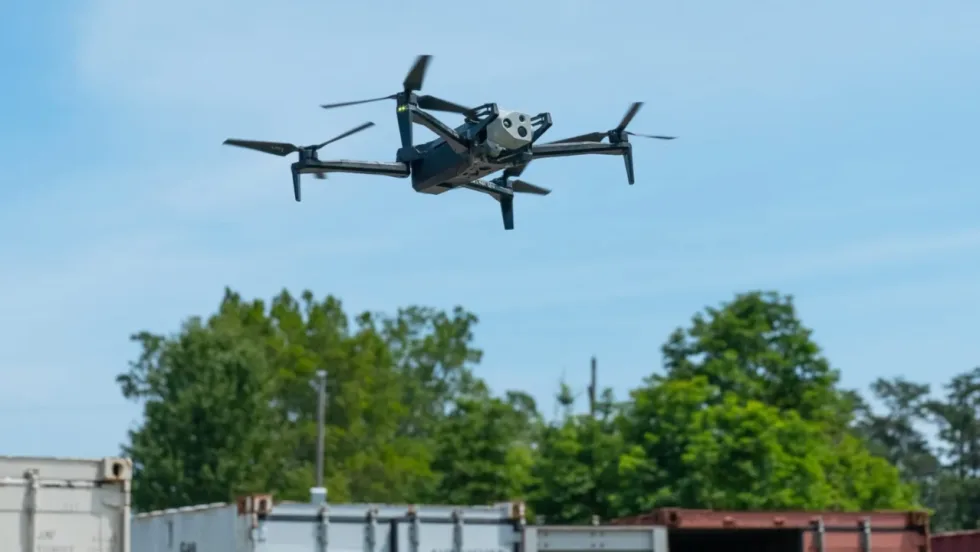
When Disaster Response Goes Mobile
Drones and robotic systems can give emergency teams a view of a disaster before crews ever reach the scene. But the real challenge is keeping those machines, vehicles, operators, and command centers connected when traditional infrastructure may already be compromised.
Read More →
Experts Forecast Broader Impact of Wildfires in 2026
This year’s wildfire season will likely be more intense than in 2025. The 2026 wildfire forecast from AccuWeather is for fewer fires, but even more acreage will be impacted this year.
Read More →
Farmers Insurance Backs Red Cross Disaster Response Efforts With $250,000 Commitment
Farmers Insurance joined the Red Cross Disaster Responder Program to help support emergency response and recovery during disasters nationwide.
Read More →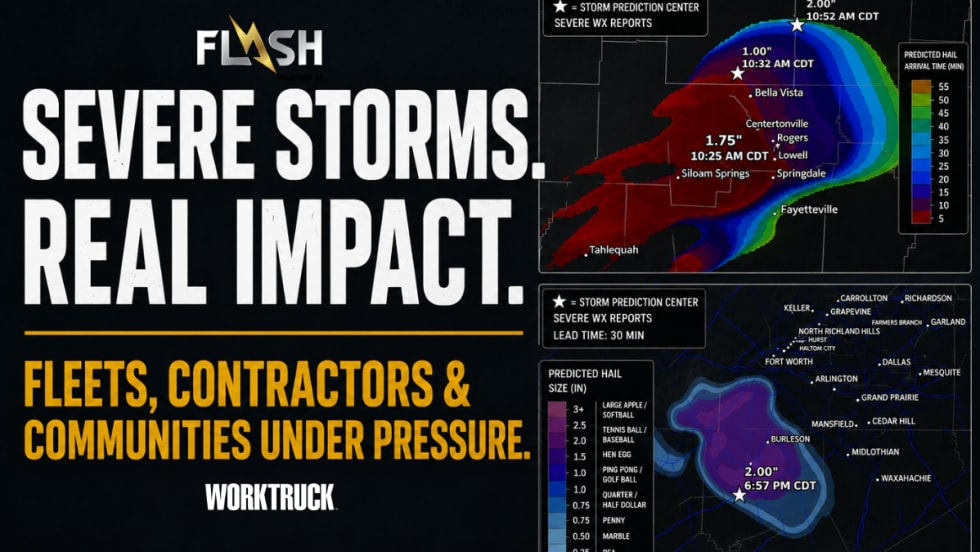
Severe Storms Are Reshaping Recovery Operations for Contractors and Work Truck Fleets
Hailstorms are creating costly new challenges for work truck fleets, from damaged onboard tech to longer recovery timelines and tactical storm planning.
Read More →
After the Storm Clears: Why Cargo Risk Spikes During Disaster Recovery
When the storm ends, cargo theft risk can spike. Here’s why the restart phase is the danger zone and what fleets can do to stay ahead.
Read More →
Your Suppliers Are Part of Your Disaster Plan
Your suppliers can make or break disaster response. Here’s how fleets can reduce vendor risk and keep critical parts flowing when storms hit.
Read More →
When the Process Breaks (Why Fleet Workflows Collapse During Disaster Response)
When disaster hits, fleet workflows don’t collapse all at once. They unravel quietly. Here’s where breakdowns start and how to build resilience before it’s too late.
Read More →
How Federal Disaster Declarations Work and Why Fleet Leaders Need to Know
How federal disaster declarations work and why fleet leaders should care about funding, reimbursements, infrastructure repairs, and recovery timelines.
Read More →
Disaster Readiness Is Not a Fleet Count, It’s a Stress Test of the Whole System
Fleet readiness isn’t about your vehicle count. It’s about condition, capacity, and whether your system can actually perform under stress.
Read More →
Disaster-Proofing Fleet Operations: How to Maintain Uptime When Conditions Are Anything but Normal
When disaster strikes, fleet uptime depends on prep, mobile maintenance, clear visibility, and disciplined execution before, during, and after the event.
Read More →