




Santa Monica Seafood Delivers
In the growing world of last-mile delivery, everything from restaurants to event venues and even theme parks depends on SMS to deliver food on time and at the right temperature.

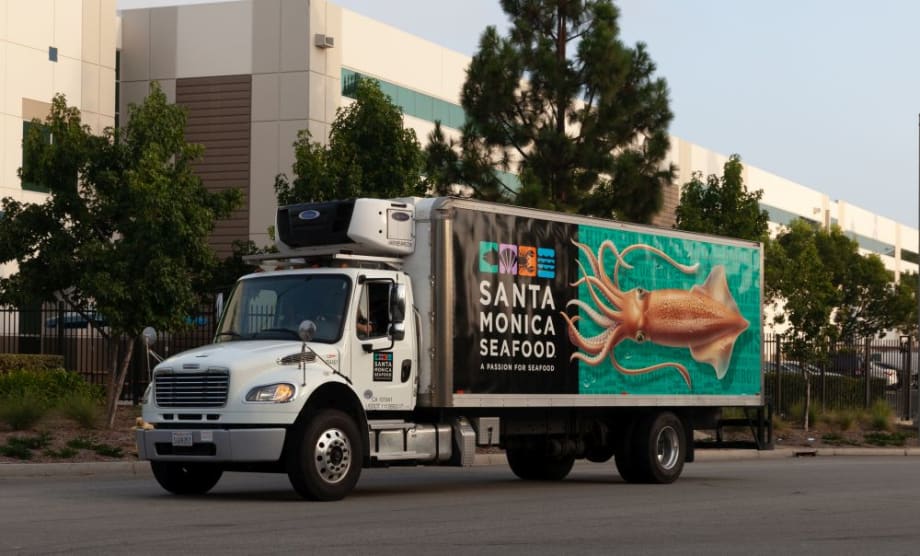
The delivery fleet recently redesigned its vehicle graphics as part of an overall company rebranding and redesign. Both local and national vendors were used for the project.
Photo: Santa Monica Seafood
Santa Monica Seafood (SMS) is the largest specialty distributor of fresh and frozen seafood in the Southwestern U.S.
A “passion for seafood” drives this fleet to deliver its products not only on time but at the proper cold temperatures, too.
The company operates a fleet of approximately 80 trucks across all locations. Most of the trucks (around 90%) are medium-duty, Class 3-6 box trucks. The fleet primarily operates Isuzu NPR, NQR, and NRR Series models, but has a few Peterbilt, Freightliner, and Kenworth models, typically with 16- to 26-foot boxes as well. SMS also operates Sprinter cargo vans. About 10% of the fleet consists of heavy-duty, Class 7-8 trucks, primarily 53-foot tractor-trailers.
Most trucks drive dense delivery routes (15-35 stops per route) for foodservice customers — restaurants, hotels, grocery stores, hospitals, event venues, casinos, country clubs, military bases, and theme parks (e.g., Disneyland).
“On these foodservice routes, we typically deliver five to 10 cases per order. By contrast, for large grocery accounts, we use tractor-trailers to deliver to customer distribution centers (DC) in Southern California and the Midwest,” said James Nissenberg, VP Logistics for SMS.
The SMS fleet also picks up supplier shipments, typically arriving via air freight or at cold storage facilities.
Nissenberg is no newcomer to the world of fleet.
“Previously, as a management consultant, I addressed fleet strategy and transportation as part of projects for companies such as CVS, Wegmans, Interline Brands (The Home Depot Pro), Serta Simmons, and Castellini. I also began my career in the airline industry working in route planning and revenue management,” Nissenberg explained.
All SMS Seafood trucks are refrigerated with Carrier Transicold or ThermoKing reefer units. Due to the areas these trucks operate, some specs, including turning radius and driver safety, are essential.
“On our box trucks, we find a tight turning radius, good engine acceleration, and compact size are important for driving and delivering in large metro areas. We also ‘over-engineered’ our bumpers in terms of ergonomics, so drivers have more options to climb in and out of the box,” he noted.
Founded in 1939, today SMS operates a 120,000 square foot corporate office and main processing facility in Rancho Dominguez, Calif., and additional satellite distribution and/or processing locations in San Diego, Phoenix, Las Vegas, Albuquerque, El Paso, Central and Northern California, and Hodgkins, Ill.SMS also owns and operates two retail stores and cafes in Santa Monica and Costa Mesa, Calif.
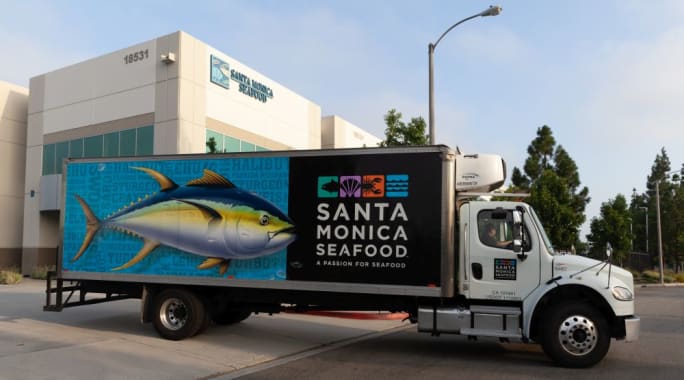
Most of Santa Monica Seafood’s fleet operates delivery routes of approximately 15-35 stops per route for foodservice customers.
Photo: Santa Monica Seafood
Facing Challenges Head-On
A top challenge SMS faces is the fact that medium-duty trucks are some of the last to get new technology integrations, denying these fleets of the added productivity benefits.
“We find many vendors focus on the heavy-duty truck market when developing new technologies and equipment. For example, our telematics vendor offers integration with trailer refrigeration units, but not for units commonly used on box trucks or cargo vans. It means we are not able to remotely control reefers or download historical temperature data even though these capabilities would improve our productivity,” Nissenberg said.
To combat these challenges, Nissenberg reminds vendors in the fleet industry how large the market is for local and regional delivery, including couriers, express logistics providers, and private fleets. And he displays the tenacity not to let it stop him.
“We have still made several ROI-positive investments in route dispatch software, telematics systems, and fleet management in the past few years that have cut costs, improved customer experience, and helped meet our sustainability goals,” Nissenberg shared.
As an added challenge, SMS serves several restaurant groups and lounges at airports such as Los Angeles International Airport (LAX).
“As a condition of driving our vehicles on-airfield, we comply with Los Angeles World Airports (LAWA) emissions requirements utilizing our Sprinter cargo vans,” Nissenberg said.
The COVID-19 pandemic has also had its impact over the past year.
“Due to the temporary reduction in foodservice business, we have been more focused on rationalizing assets and using them for new revenue opportunities. For example, we expanded our service to a very large grocery customer now delivering to stores up to three times a week. This has helped improve sales and product freshness while meeting the increased demand for groceries during the pandemic,” Nissenberg said.
The fleet also recently redesigned its vehicle graphics as part of an overall company re-branding and redesign. After the process, Nissenberg had some advice for others:
“Shop carefully. You can go with a local shop that does graphics and installation or a national one that usually does graphics and ships to a local installer. The former is usually more expensive but has fewer problems. We’ve had mixed results with the national brand and local installers — it can work but do your homework,” Nissenberg recommended.

James Nissenberg, VP Logistics for SMS
Photo: Santa Monica Seafood
The Bottom Line
Looking forward, Nissenberg is optimistic about the future of fleet in general.
“I think we can look to the future and be very excited. The push toward electric trucks is accelerating, which is great for the environment, and the acquisition cost should come down in the next few years while charging infrastructure develops. Also, fleet and driver safety have improved remarkably through tools such as driver backup assist, dashcam video, and safe driving alerts enabled via telematics systems,” Nissenberg noted.
He closed with the following advice for the industry:
“I think we need to consider fleets as part of a larger supply chain workflow and not necessarily as ends in themselves. The fleet enables us to serve customers and implement our business strategy. In the end, they are a tool like many other assets that serve a greater purpose,” Nissenberg said.
More Operations
Family Ties Inside the Fleet Families Building Careers Across Generations
Three fleet families share what it really takes to work together, learn across generations, and keep business from following them home.
Read More →
Shades of Fleet Call for Voices: Fleet's Hidden Heroes
Fleet’s hidden heroes are often the ones keeping everything moving behind the scenes. September’s Shades of Fleet is looking for dispatchers, coordinators, parts specialists, and other support pros to share their stories.
Read More →
Truck Centers, Inc. Celebrates National Truck Driver Appreciation Week with $1,000 Fuel Card Giveaways
During National Truck Driver Appreciation Week, Truck Centers, Inc. is offering customers a chance to fuel up for free. Customers at all Truck Centers locations can enter to win one of four $1,000 fuel cards from Sept. 14 - 18.
Read More →
Fleet Guides, AI Time-Savers, Truck Tariffs & Fuel Strategy Lead the News
This week’s Truck Chat Cheat Sheet covers new fleet vehicle guides, practical AI use cases, U.S.-Canada truck production, mixed-energy strategy, and more.
Read More →
What Fleet Employers Are Missing When Hiring Veterans
What if some of the strongest candidates for fleet are already out there, but their experience is written in a language our industry does not always recognize?
Read More →
Automotive Fleet Opens 2026 Personal Use Survey for Commercial Fleet Managers
Less than two weeks left! Commercial and corporate fleet managers are invited to share how their organizations handle company vehicle personal-use policies, charges, and driver eligibility.
Read More →
What Resilient Fleets Do Differently When Conditions Change
Fleet resilience is about more than reacting to disruption. Lauren Fletcher talks with AP Fleet’s Alex Coveney about flexibility, planning, scaling, and what helps fleets adapt when business conditions shift.
Read More →
If We Want the Next Generation in Automotive, We Have to Give Them a Reason to Care
The automotive industry talks constantly about its workforce shortage. But before we can recruit the next generation, we may need to do a better job giving kids a reason to care about automotive in the first place.
Read More →
Ram ProMaster City Under $40K, Truck Tariffs, and AI Maintenance Lead the News
A sub-$40K commercial van, tariff questions, AI-powered maintenance, and a new EV production strategy headline this week’s Truck Chat Cheat Sheet.
Read More →
Bob Adamsky Shares the Fleet Lessons You Usually Learn the Hard Way
After more than 30 years in fleet, Arrow International’s Bob Adamsky has learned that the job is about far more than vehicles. He shares the lessons he wishes every fleet manager could learn a little earlier.
Read More →