New motor oils are coming to truck engines and lubricant marketers near you this December; here's what you need to know.
Fleet managers, public and private nationwide, have become conditioned by constant changes in software, diagnostics, powertrain, emissions controls, service tools, and vehicle aerodynamics, so it only seems right that motor oil has been called out for change, too.
That’s right: New motor oil is on the near horizon. Actually, there are two, and although they have been in the works for four years, don’t be discouraged if you aren’t aware. A recent study showed that 92% of fleets are equally unaware. The new oils are coming to truck engines and lubricant marketers near you this December; here’s what you need to know:
Why New Oils?
Diesel engines beginning in 2007, and especially in 2010 with SCR equipment added, run much hotter than previous engines. The increases in engine temperatures place a burden on current oils, compromising oil performance and jeopardizing engine integrity. Further, and as government fleet managers have seen in gasoline engines for years, lowering oil viscosity results in improved miles per gallon.
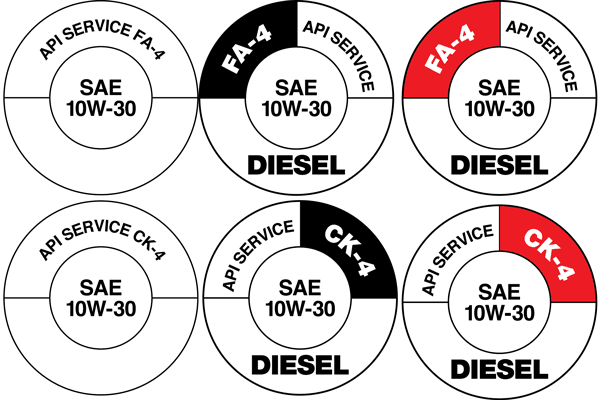
The new oil classification, CK-4 (supersedes CJ-4) was developed by the American Petroleum Institute (API) to address these two specific issues, improving oil performance/longevity by dissipating heat and improving miles per gallon. In addition to CK-4, an added classification, FA-4, is also being introduced (but more about that later).
The new classifications will be introduced to the market beginning this December.
Will We Need to Inventory Yet Another Oil?
No, CK-4 will be fully backward compatible and can be used in any engine currently using CJ-4, including off-highway equipment. It can be mixed with CJ-4 both in vehicles and in bulk storage facilities with no adverse effect provided the same viscosity is retained in both. Because government fleets retain vehicles and equipment longer than the industry as a whole, government fleets should take care to assure OEM viscosity requirements are met (e.g. 10W-30, 15W-40) in those older engines.
Similar to CJ-4, CK-4 will be available in multiple viscosity grades, SAE 15W-40, Synblend 15W-40, 10W-30, and full synthetic SAE 5W40 and 5W-30 grades.
Will Maintenance Programs Change?
Not initially. However, because the new oil formulation includes a different additive package to improve wear and engine performance, fleets may come to reevaluate their drain intervals for both on and off-highway equipment as extending them may be possible. Fleets currently on extended drain intervals and fleets utilizing oil analysis routinely should submit a fresh sample of CK-4 to their analysis supplier to establish “baselines” reflective of the new additive package.
Oil filtration media may change in the future as the effects of the new oil become more widespread but no change in filters is currently anticipated.
According to lubricant manufacturers, in addition to added engine protection from additional wear and oxidation resistance, CK-4 may have emission system benefits for diesel particulate filter (DPF) equipped vehicles by helping to maximize their service life.
What about Natural Gas (NG) Engines?
Engine oil specifications for NG engines are different. Nothing changes here; Neither CK-4 nor FA-4 oils are formulated for spark ignition engines.
What about Biodiesel-Fueled Engines?
Unlike NG engines with different oil requirements, oil requirements for bio-fueled engines are the same for engines fueled by diesel exclusively, so CK-4 is okay.
What about Heavy Equipment?
In the formulation of CK-4, two additional tests (Volvo T13 oxidation and COAT, or Caterpillar Oil Aeration Test) were added to the standard API testing protocol. Field use of CK-4 specifically in heavy equipment indicates a strong possibility that drain intervals could be increased significantly. As the automotive adage goes, “Your mileage may differ,” so it’s important, as the migration to CK-4 progresses in a fleet, to use the various tools available, such as oil analysis, to ascertain a fleet’s results. The risks and benefits of extending drain intervals on heavy equipment are huge. If the use of CK-4 in heavy equipment validates current test results, the potential cost advantages could be significant.
Will CK-4 Cost More?
Lubricant manufacturers are understandably quiet about the cost. As financially and realistically savvy fleet managers, expect the new oil to cost slightly more. As a commodity, oil is very competitively priced in the marketplace. Fortunately, we are enjoying the benefits of lower petroleum commodity prices, which is clearly having a beneficial impact on motor oil prices. This author has always treated motor oil as cheap insurance; I concentrated less on price and more on quality.
Hopefully, the fleet has a close relationship with a lubricant supplier(s); lean on them to ease the transition.
What About the New Classification — FA-4?
FA-4 is being introduced in a limited application and designed specifically for 2017 and later diesel engines. This is an important distinction. Although FA-4 will feature the same next-generation additive package as CK-4, it will be offered in lower viscosity grades designed to correlate closely with new engine technology. This formulation is designed specifically to reduce GHG emissions while optimizing fuel economy. FA-4 is different from CK-4; they should not be used interchangeably.
Because 2017 and later engines will feature more advanced technology exploiting the benefits of the lower viscosity FA-4, check with the engine OEM to assure biodiesel fuel and FA-4 oil will operate cooperatively with this new engine technology if the fleet currently uses or plans to use biodiesel.
Although many fleets currently utilize CJ-4 interchangeably in gasoline and diesel engines for simplicity purposes, FA-4 is not formulated for gasoline engines and definitely should not be used in them.
How Will This Affect 2017 Diesel Vehicles?
In January, truck and engine OEMs will release their Phase I federal greenhouse gas emission-compliant engines for which FA-4 is specifically designed. Some new engines could be delivered with FA-4 as the factory fill although this may vary by OEM and is currently expected to be very limited.
Nevertheless, fleets not willing to add yet another oil to their inventory should check with their engine or chassis OEM to determine which oil comes standard with their new trucks.
Even if FA-4 is the factory fill, use of CK-4 in those engines is okay. Replacing FA-4 with CK-4 in 2017 and later engines at the first oil change is perfectly fine but, as always, get assurance from an OEM to maintain the integrity of the warranty and engine life long term.
As the fleet population of new engines (2017 and later) increases in succeeding years, consider adding FA-4 to the oil inventory to gain the benefits afforded by using the motor oil for which those engines were designed. Fleet managers should be aware, however, that a future switch from CK-4 to FA-4 may require cleaning their bulk oil storage tanks.
In summary, these new classifications are in the pipeline and coming to lubricant suppliers soon.
Fortunately, preparation for such will be minimal. Be aware (the objective of this article) it’s coming and consider these few minor preparations in advance:
Viscosity Integrity: As fleets transition to CK-4, double check to assure OEM viscosity recommendations are being adhered to, especially for older engine families.
Oil Analysis Baselines: If oil analysis is part of fleet’s maintenance strategy, take the necessary steps to assure analysis baselines are updated to reflect CK-4.
2017 Diesel Vehicle Acquisitions: Check with engine and chassis OEMs to determine if FA-4 is the factory fill for those units and modify your strategy accordingly.
Cost Considerations: Be prepared for slightly higher oil costs. While it may not happen, it’s always good to prepare for the worst. If extended drain intervals and improved miles per gallon both prove out, the cost-benefit equation from using CK-4 will definitely be in your fleet’s favor.
Vendor Considerations: OEM dealers will maintain inventories of both new classifications. In that vein, fleets choosing to standardize on CK-4 may consider labeling engine motor oil intake spouts “CK-4 Only,” especially on new vehicles, if they rely on vendors for warranty or other repairs.
Editor's note: Reliance on lubricant experts and vehicle OEM representatives is key. They are the best source for advice and assistance. Thanks to Paul Cigala, ExxonMobil; Paul Whitacre, Chevron; and Doug Sacket, Total Petroleum for their assistance.
About the Author: Bob Stanton, CPM, CPFP, is an independent fleet consultant and retired public sector fleet manager with 39 years of experience. He can be reached at victorybob@gmail.com.