





Do You Know: Where's My Truck Body?
Looking Toward the Future of Truck Bodies
Innovative, new technologies and advances in engineering are creating lighter, stronger, and more fuel-efficient truck bodies than ever before.
March 12, 2014
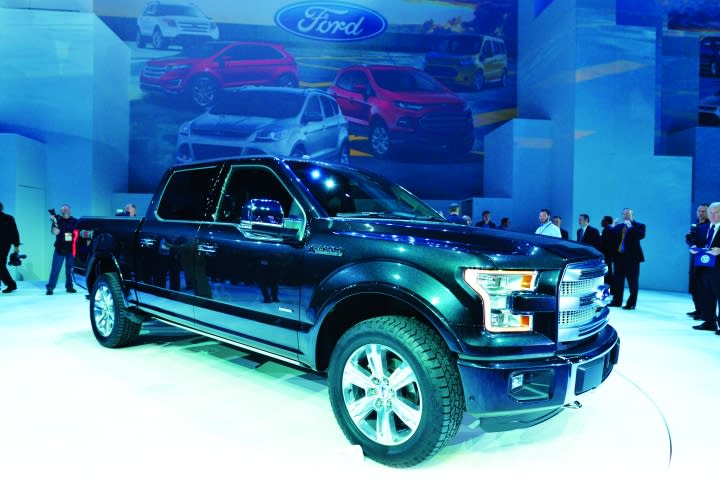
Ford introduced the 2015 Ford F-150 at the Detroit Auto Show, noting that it will utilize an all-new, high-strength, military-grade, aluminum alloy body and will weigh 700-pounds less than previous models.
Photo: Ford
7 min to read
What will the commercial truck bodies of tomorrow look like? What will be different? What design innovations can we expect to see?
For clues on what the future holds in the commercial truck body market, one starting point is to look at what the automakers are doing, said Ray Chess, president of R.J. Chess Consulting LLC, an automotive industry advisory firm based in Oxford, Mich. Chess is a former commercial truck vehicle line executive for General Motors.
“OEMs are a leading indicator. To me, that’s your road map for seeing what will happen in the commercial truck and equipment sector,” Chess said. “The truck body manufacturers do not need to create a lot of new invention here because they don’t have to. They can piggyback off what the OEMs are doing. And, when OEMs get involved, they help lower the cost.”
Take, for example, the 2015 Ford F-150 pickup, which is 700-pounds lighter than the outgoing model by replacing traditional steel with a military-grade aluminum alloy throughout 95 percent of its body. According to Ford, the aluminum alloys, already used in the aerospace and other industries, not only make the new truck’s body lighter, but also stronger and more resistant to dents.
“The things we see getting utilized in light-duty vehicles — if and when it becomes cost effective — tend to migrate into bigger trucks and bigger truck bodies,” said Doyle Sumrall, managing director for the National Truck Equipment Association (NTEA), the association for the work truck industry. “I think we’ve already seen a transition in the last decade where, as truck chassis become more aerodynamic and use more modern materials, I think we’ll see that same sort of trend being adopted in the body industry over time.”
Bob Johnson, the NTEA’s director of fleet relations, agreed. “OEMs are developing the advanced material technologies and increasing their use, which means as the availability of these materials increase, driving down the price,” he said. “As the OEMs use more and more of these advanced material technologies, they are going to refine the technology and build the service and repair infrastructure to make the material more available and affordable.”
Utilizing Advanced Material Hybridization
If the automakers are a leading indicator for what to expect in the truck body market, then it’s not likely one advanced material — whether aluminum, fiberglass composite, plastic composite, high-strength steel, or carbon fiber — will be declared the sole winner in the foreseeable future.
The MY-2015 Ford F-150 incorporates other advanced materials beyond aluminum, such as high-strength steel that’s used in design of the truck’s fully boxed ladder frame to make it stronger yet lighter.
Johnson of the NTEA forecasts a similar trend with truck bodies, where one material does not fit all fleet applications or duty cycles.
“Moving forward, I think we will see more hybrid bodies. We’re going to see a lot of innovation in design in the area of moving away from an all-steel or all-aluminum or all-fiberglass bodies and start mixing and matching the materials and technologies to get the best features of all of them into one body — for weight reduction, corrosion resistance, reparability, and lifecycle considerations,” Johnson said.
Additionally, the increased cost of the advanced materials currently comes into consideration, and increased usage may drive these costs down.
Johnson added: “I can’t say the OEMs are leading the body companies because the body companies are really doing more in the area of fiberglass, plastics, and aluminum right now than the OEMs are. But, that being said, as OEMs get involved with it they achieve much higher volume, which drives availability and cost and knowledge of how to repair it.”
Creating High-Strength Bonds Without Welds
The increased use of lighter-weight materials in truck bodies may increase the use of high-strength adhesives versus conventional riveting and welding techniques to ensure an optimal bond. Used extensively in aerospace applications, these adhesives are ideal in joining dissimilar materials where welding may not be possible.
In the right applications, these adhesives provide greater bonding flexibility to achieve more aerodynamic body designs and reduce the number of welds to increase manufacturing efficiency.
“Once the adhesive technology matures, I think you’ll see more use of the adhesives in the truck body market, especially when you get into the advanced materials like the carbon fibers, plastics, and things of that nature,” said Johnson of the NTEA. “You can weld plastic, but it takes special equipment and skills, so why not bond it?”
Increasing Aerodynamics
In September 2012, Daimler Corp., unveiled its futuristic “Aerodynamics Truck and Trailer” concept with a combination tractor and box trailer, built with smooth walls and rounded edges, reducing air resistance by 18 percent and fuel consumption by 4.5 percent.
Some of the innovations include:
A spoiler on the bulkhead of the trailer reduces the distance to the tractor unit, which, itself, lowers air resistance by 1 percent.
The plastic side-trim panels, slightly drawn-in at the front and characterized by an opening at the rear, on the trailer contribute an 8-percent improvement to the air resistance.
A “boat tail” rear taper measuring up to 400 mm in length, which improves the air resistance of the entire tractor unit by a full 7 percent.
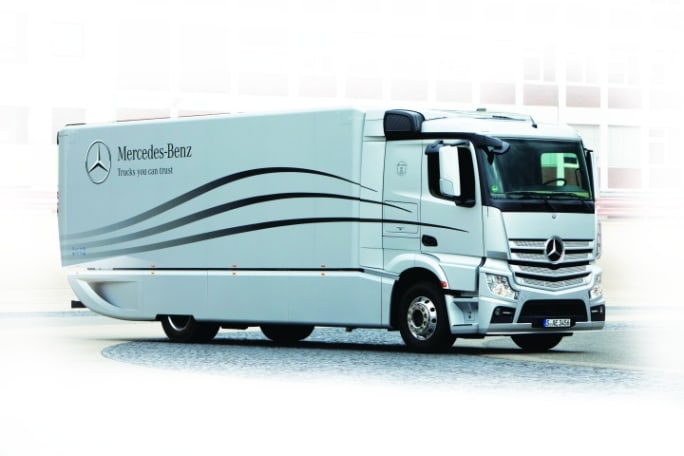
Unveiled in 2012,
Daimler Corp.’s “Aerodynamics Truck and Trailer” concept was part of an initiative by engineers to reduce fuel consumption in truck/semitrailer
combinations.
Photo: Daimler
Sumrall with the NTEA is familiar with the Daimler tractor-trailer concept, and noted: “With the very short wing tails on the back of the trailer and side skirts and a lot of those other aerodynamic innovations, the drag coefficient for that entire semi rig is beginning to approach that of a Corvette.”
Could similar designs be seen in the future of truck bodies for light- and medium-duty trucks?
“I think we’re already seeing this starting to happen, with rounded corners, streamlined bodies, and add-on components being added to trailers,” Sumrall said. “So, as the focus on aerodynamic design becomes more prevalent, that stuff is going to get integrated in the body.”
Developing Vehicle Standardization & Modularity
Fleets are realizing that the more customization is required, the more expensive it is to build the body. Johnson with the NTEA envisions that one solution to drive down costs (particularly with increased use of lightweight materials) is a trend toward building more standard bodies, while offering modular components to allow for greater customization at the end-user level — to give fleets the best of both worlds.
“I think we’re going to see a growing number of companies developing more standardized bodies with a handful of options for door-size openings, for example. There would be something similar to a low-body spec, medium-height body, and a high-body, with a certain number of available sizes of horizontal and vertical doors,” Johnson envisioned. “Then, you would plug in a rack of shelves, hooks or drawers or whatever the component, all of which could be adjusted according to the driver’s or fleet manager’s preference.”
Johnson sees a modular body having a large place in the future, and noted that a trend toward body standardization could potentially reduce both production and repair expenses because doors and other components could be manufactured at higher volumes, driving down cost per unit.
Using Computer Modeling & Simulation Technology
Imagine if engineers could develop a virtual prototype of a truck body or component and test it under every conceivable condition, without first having to invest a ton of money in developing a prototype? That’s the promise of computer modeling technology and it’s becoming more prevalent in the automotive market today.
For example, truck manufacturer Navistar reported significant improvements in airflow to its vehicles. This wasn’t accomplished by using expensive wind tunnel testing, but through modeling and simulation software to make improvements for a fraction of traditional research costs.
The implication here is that body companies will adopt computer modeling technology, on a wider scale, to test the impact (in terms of weight, aerodynamics, potential fuel economy savings, etc.) of changes in body materials and design before investing in the next step of production. This could spur major innovation in body design, without the traditional financial risk.
“With the simulation tools available today, we can take operational data from an existing truck fleet, make changes to specs like adding low rolling resistance tires to determine how much fuel that will save in that specific application. Or, we can drop the weight of that truck by 500 pounds with advanced materials, and see what the impact will be. We’re not very far away of being able to do this on a bigger scale,” Sumrall said.
The Bottom Line
What does the future hold for truck bodies 10 to 15 years down the road?
While no one knows for sure, it’s clear that truck bodies are trending toward being lighter weight, more aerodynamic, more durable, and more corrosion resistant than today’s bodies. And, innovative engineering and manufacturing processes are expected to achieve significant efficiencies and cost-savings so that the “high-tech” truck body of tomorrow will also make financial sense for tomorrow’s fleets.
What does the impact of electrification have on truck bodies? How are truck bodies and upfits evolving to meet the changing needs of EVs? JB Poindexter & Co. shares some updates.
Subscribe to Our Newsletter
More Operations

Family Ties Inside the Fleet Families Building Careers Across Generations
Three fleet families share what it really takes to work together, learn across generations, and keep business from following them home.
Read More →
Shades of Fleet Call for Voices: Fleet's Hidden Heroes
Fleet’s hidden heroes are often the ones keeping everything moving behind the scenes. September’s Shades of Fleet is looking for dispatchers, coordinators, parts specialists, and other support pros to share their stories.
Read More →
Truck Centers, Inc. Celebrates National Truck Driver Appreciation Week with $1,000 Fuel Card Giveaways
During National Truck Driver Appreciation Week, Truck Centers, Inc. is offering customers a chance to fuel up for free. Customers at all Truck Centers locations can enter to win one of four $1,000 fuel cards from Sept. 14 - 18.
Read More →
Fleet Guides, AI Time-Savers, Truck Tariffs & Fuel Strategy Lead the News
This week’s Truck Chat Cheat Sheet covers new fleet vehicle guides, practical AI use cases, U.S.-Canada truck production, mixed-energy strategy, and more.
Read More →
What Fleet Employers Are Missing When Hiring Veterans
What if some of the strongest candidates for fleet are already out there, but their experience is written in a language our industry does not always recognize?
Read More →
Automotive Fleet Opens 2026 Personal Use Survey for Commercial Fleet Managers
Less than two weeks left! Commercial and corporate fleet managers are invited to share how their organizations handle company vehicle personal-use policies, charges, and driver eligibility.
Read More →
What Resilient Fleets Do Differently When Conditions Change
Fleet resilience is about more than reacting to disruption. Lauren Fletcher talks with AP Fleet’s Alex Coveney about flexibility, planning, scaling, and what helps fleets adapt when business conditions shift.
Read More →
If We Want the Next Generation in Automotive, We Have to Give Them a Reason to Care
The automotive industry talks constantly about its workforce shortage. But before we can recruit the next generation, we may need to do a better job giving kids a reason to care about automotive in the first place.
Read More →
Ram ProMaster City Under $40K, Truck Tariffs, and AI Maintenance Lead the News
A sub-$40K commercial van, tariff questions, AI-powered maintenance, and a new EV production strategy headline this week’s Truck Chat Cheat Sheet.
Read More →
Bob Adamsky Shares the Fleet Lessons You Usually Learn the Hard Way
After more than 30 years in fleet, Arrow International’s Bob Adamsky has learned that the job is about far more than vehicles. He shares the lessons he wishes every fleet manager could learn a little earlier.
Read More →