




Latest Trends in Medium-Duty Truck Maintenance
How current and future challenges are affecting medium-duty fleets.
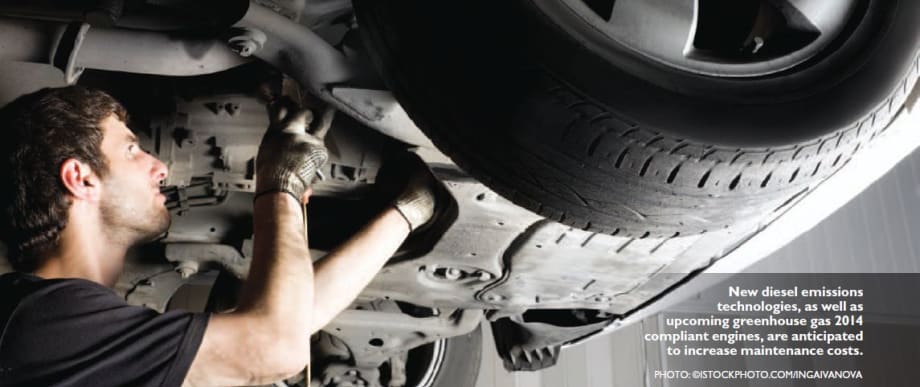
A lot has happened since 2007 to impact medium-duty truck maintenance costs and protocols — for better and for worse.
First, there was the introduction of expensive diesel emissions technologies, such as diesel particulate filters (DPFs), selective catalytic reduction (SCR) systems, and diesel exhaust fluid (DEF).
Now, medium-duty fleets are anticipating new greenhouse gas (GHG) regulations in 2014, which could lead to new technologies being developed for engines, tires, transmissions, and fluids — all of which will likely affect truck maintenance.
With so many changes in the medium-duty truck world in recent years and more on the horizon, what should fleet managers expect when it comes to keeping their trucks in optimal condition?
Work Truck, Business Fleet’s sister magazine, spoke with subject matter experts from fleet management companies ARI and PHH Arval to get their outlook on these current and upcoming challenges. They shared these seven trends to help fleet managers navigate the current and future truck maintenance landscape.
1. New diesel emissions technologies are driving higher maintenance costs, and more downtime in certain applications.
One key issue is drivers not allowing for full regeneration (burning off of soot) of the DPF in urban applications, where there are as many as 30 to 40 stops per day, according to Don Scare, regional fleet services manager for PHH Arval, a fleet management services provider in the U.S. and Canada.
“If drivers don’t get the truck up to highway speed long enough to allow for a full regeneration cycle, what will eventually happen is that the DPF filter will clog. Then you have to remove that filter for maintenance, which is very expensive,” he said, adding that the cost for DPF removal and cleaning is roughly $3,000 to $5,000.
Tony Piscopo, director, global fleet management and product management for ARI, agreed, but said that the increased costs related to new emissions technologies have begun to level off as fleets and drivers have become more familiar with the trucks.
“When first introduced, these [new emissions] systems caused a great deal of new expense and downtime to clients’ fleets,” Piscopo said. “Parts and fluid availability, as well as driver and technician training, were lacking. Worse, fleets were responsible for bearing the expense.”
Over the past few years, these maintenance costs have flattened and decreased somewhat, because of better training and technology.
“Trained drivers, in-cab warning systems, an increase in the number of trained technicians, better equipped facilities, and the increased availability and price-competitiveness of parts have kept prices down,” Piscopo noted.
2. Drivers are increasingly more responsible for proper
maintenance protocols.
“It’s key for drivers to understand the type of trucks they’re operating,” Scare said. “When it comes to filling the DEF tank, you have to use the right solution. In a lot of cases, we have found with the introduction of DEF that drivers are putting the wrong product in the wrong tank. Of course, that adds to maintenance cost because you have to go back to clean the system. It all boils down to proper driver instruction on their maintenance responsibilities when operating the vehicle.”
This hasn’t always been the case. Scare remembered a time when drivers could jump in the truck in the morning, drive it all day, then bring it back and just drop off the keys.
“The maintenance garage would take care of the oil change intervals and whatever else that may go wrong with the vehicle on a given day,” Scare said. “But now with the new emissions technologies, drivers need to be more engaged and aware of what they are to do for DPF regeneration, refilling the DEF tanks and so forth.”
[PAGEBREAK]
3. While tire costs are increasing, new technology offers improved fuel economy and lower operational costs.
Piscopo noted that fluctuations in the cost of raw materials used in the production of tires have led to increased prices for replacements. He attributed the fluctuations in cost to an increased global demand for raw materials.
Said Scare of PHH, “Rolling resistance of tires is going to continue to play a big role into the future. Tire manufacturers are looking for ways to improve their product — to lessen that resistance, to increase fuel economy and also to meet a lot of the new environmental and EPA requirements.”
4. More OEMs are offering disc brakes, increasing replacement intervals over drums.
With more OEMs offering disc brakes in the medium- to heavy-duty class vehicles, Scare sees the advantages for medium-duty fleet vehicles.
“The airflow onto the brake components on a disc brake operation versus drum is considerably better, which reduces heat during braking, resulting in longer replacement intervals for disc brakes,” Scare said.
5. Enhanced synthetic lubricants increase PM intervals.
“One of the most interesting maintenance trends that we are seeing is the increased use and acceptance of synthetic lubricants,” Piscopo said. “As the cost of synthetics has continued to decrease and availability has continued to increase, the majority of our clients are using synthetics in certain applications.”
Said Scare, “The synthetic oils reduce resistance within the moving parts of the engine, creating less engine sludge and longer drain intervals, driving lower costs in the long-run.”
6. New greenhouse gas 2014 (GHG14)–compliant engines are expected to increase maintenance costs.
“In most cases, changes to engine technology or calibrations affect maintenance costs, usually causing expenses to rise for a period,” Piscopo said.
“Repair costs [and/or downtime] often rise as the change is implemented and perfected. These costs are usually related to decreased availability of parts and fewer trained technicians. While we do not believe that the GHG14 requirements will have as significant an impact as other recent emissions changes, we do believe there will be an uptick in the cost to maintain these units.”
7. Improved vehicle quality will eventually drive lower maintenance costs.
The upside with diesel emissions changes is that OEMs have built a better vehicle, said Scare. “The quality of the vehicles is much better, which has lowered the cost of operating in areas that traditionally companies spend a lot of money,” he noted.
Said Piscopo for ARI, “We believe there will continue to be an increased focus by OEMs and component manufacturers to use technology to produce higher quality components, with the end goal being to lengthen maintenance intervals and increase vehicle uptime. Higher quality and longer life tires, brakes and fluids — while costing more in the near-term — will lead to lessened downtime and ultimately lower overall maintenance costs.”
More Small Fleet


Developing Budget-Friendly Driver Safety Programs
From driver training and safety meetings to one-on-one coaching and incentive programs, several small fleets share how they have developed a safety culture with their drivers using low- to no-cost resources.
Read More →
Boosting Last-Mile Fleet Uptime, Safety, and Value with AI Vehicle Inspections
AI-powered inspections are transforming last-mile fleets by replacing manual checks with highly accurate automated scans that detect defects in seconds. By giving fleet operations visibility into the daily condition of their vehicles, you can identify trends over the vehicle’s lifecycle that enable improved procurement decisions, route management, driver training and accountability.
Read More →
Five Ways Seat Belts Help Prevent Injuries
There are five ways seat belts protect occupants from injuries, according to the Tennessee Department of Safety and Homeland Security.
Read More →
It’s here: The 2026 Fleet Technology Trends Report
What does AI mean for fleets? Get the answer — and learn other top tech trends.
Read More →
Small Fleets, Big Impact: How Independent Drivers Power Wreaths Across America
Check out how small fleets and independent drivers power Wreaths Across America each December and why their impact matters more than ever.
Read More →
VMS Survey Finds 65% of Small Fleet Managers Run Operations Alone
A new VMS survey shows small fleet managers are stretched thin, with most handling operations solo and eager to adopt digital tools for relief.
Read More →
Tips for Driving Safely on Halloween Night
This video features a reminder from the Connecticut Department of Transportation (DOT) and the Connecticut Police Chiefs Association, urging drivers to prioritize safety this Halloween.
Read More →
AI, Access, and Uptime: VMS’s Next Chapter with David Prusinski
VMS’s new Co-CEO, David Prusinski, shares how an AI-first approach will give small fleets and repair shops the tools to compete like big players.
Read More →
Fleet Managers Share Winter Prep Tips: It's Never Too Early!
Three fleets share best practices to prep vehicles for winter and prevent downtime when the cold sets in.
Read More →