





Related Content: A 34-Hour Restart for the Federal Motor Carrier Safety Administration
How Will the Hours-of-Service Revisions Affect Your Fleet?
Industry experts believe the FMCSA provisions will fundamentally change the way many fleets do business. Main points of the revised ruling are highlighted.
December 18, 2012
The FMCSA’s hours-of-service final ruling has arrived.
Photo" Work Truck
6 min to read
On Dec. 27, 2011, the Federal Motor Carrier Safety Administration (FMCSA) issued its final ruling on revisions to the hours-of-service (HOS) rules, which regulate driving and work-time of commercial vehicle operators (10,001-lb. GVWR and larger) to “help prevent fatigue-related truck crashes and save lives.”
Despite legal challenges by trucking groups, including the American Trucking Associations (ATA), arguing that the HOS changes would be too burdensome and expensive for fleets and may actually undermine the government’s intent to improve driver safety, the new HOS rules are still on track to go into effect July 1, 2013.
Reviewing Changes to HOS
The first step is to understand exactly what changes to expect. Here are highlights of the FMCSA’s hours-of-service final ruling. (Details are available online at www.fmcsa.dot.gov/rules-regulations/topics/hos/index.htm.)
Eleven-hour daily driving limit retained. Although safety organizations and labor groups pressed the FMSCA to reduce the driving limit from 11 hours to 10, the agency kept the current 11-hour limit with the caveat that it will “continue to conduct data analysis and research to further examine any risks associated with the 11 hours of driving time.”
Maximum weekly work hours. Under the old rule, truck drivers could work up to 82 hours within a seven-day period. The new HOS final rule limits a driver’s workweek to a maximum 70 hours.
Mandatory 30-minute break. Truck drivers cannot drive after working eight hours without first taking a break of at least 30 minutes. Drivers can take the 30-minute break anytime during the eight-hour window.
Thirty-four-hour restart. Drivers who maximize their weekly work hours must take at least 34 consecutive hours off, including two consecutive periods between 1 a.m. and 5 a.m. The final rule allows drivers to use the restart provision only once during a 168-hour (seven-day) period. Under the previous rule, drivers could take their 34-hour restart more than once a week, without the 1 a.m. to 5 a.m. requirement.
Egregious violations. The previous rule did not clearly define maximum penalties for non-compliance. Under the new rule, trucking companies that allow drivers to exceed the 11-hour driving limit by three or more hours could be fined $11,000 per offense, and the drivers themselves could face civil penalties of up to $2,750 for each offense.
According to the FMCSA, drivers most likely to be affected by the final ruling are long-haul truckload drivers who work more than 70 hours per week on a continuing basis. Local drivers and less-than-truckload drivers who rarely work more than five days per week are not likely to be affected.
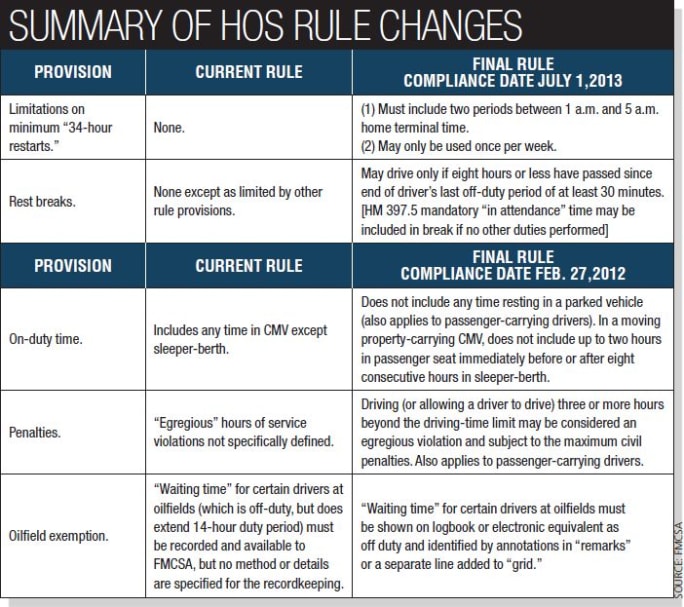
The chart above summarizes changes to the 2011 hours-of-service rule provisions.
Photo: fmcsa
Analyzing the Impact
How will the new HOS rules impact business for fleets (and drivers)?
According to Dixie Burbank, vice president with ITS Compliance Inc., a transportation industry compliance and risk management consulting company, the 34-hour restart concerns her clients the most.
“When FMSCA first came out with the 34-hour restart [in 2003], drivers could, theoretically, work 70 hours in four days, take a 34-hour restart, and be back on the road,” Burbank said. “Now, they’ve got to cut back [on hours].”
The impact? “Night deliveries and night operations, especially for the long-haul truckers, will really have to revamp their schedule,” Burbank said.
“Since most deliveries in corporate areas are done at night, drivers could use daytime hours for the 34-hour restart. But, now that the provision requires two four-hour periods between 1 a.m. and 5 a.m., it will cause these fleets to have to drastically readjust their dispatch.”
John Vosters, vice president of business development, also with ITS, agreed. “A big fallout from this change is delivery time frame,” Vosters said. “Under the new rules, those nighttime deliveries might no longer be available, which will cause a downstream effect on scheduling at the shipper’s location. And, it will more than likely require more dispatch resources and additional drivers.”
But, not all drivers and/or fleets that operate commercial vehicles (above 10,000-lbs. GVWR) will be affected by the 34-hour restart.
“With most private carriers, their drivers only work five days per week and have two full days off anyway,” Burbank said. “It’s the long-haul, coast-to-coast fleets that will have to change the way they do business.”
While the 30-minute mandatory break isn’t expected to create any major changes to fleet operations, it will require more driver education to ensure drivers log their break every day. “In the past, they never had to log [breaks] because they never ran up against the 70-hour limit,” Burbank explained. “It’s going to take a bit more education to make sure drivers understand their requirements when they’re logging, so there’s a learning curve.”
Preparing for July 1, 2013
What can affected fleets do to prepare?
“We examine our clients’ current patterns and historical data of their hours they are operating under with the current rules. Then we’ll apply those hours to the new rules to see where the gaps are,” said Vosters with ITS. “We’ll then be able to determine whether there’s, for example, a 3-percent variance or a 10-percent variance of what may be affected in their operation. Say you have a 100-driver fleet. If there’s a 3-percent gap, you may need to add two or three more drivers. In a 10-
percent scenario, then you may need to find 10-percent more drivers to add to your fleet.”
Mike Butsch, director global fleet operations for Joy Global, which manufactures and services heavy machinery used in underground and surface mining sites worldwide, agreed.
“Some companies must operate regulated vehicles all the time, while other companies, like us, can work around [the regulations] from jobsite perspective. We have a little more creative flexibility from a service side. From a commuting standpoint, one of the things we do with our trucks to help reduce the impact of [the new HOS rules] is to put a [regulated] service truck at the worksite and then we’ll use a non-regulated vehicle for transport to and from the hotel,” Butsch said. “This way, if the drivers are out of the hours of service, they are not violating that regulation. If we have to, we’ll send out a driver that has hours available to bring the truck back.”
Mark Rousseau, director of transportation operations with Frito-Lay Inc., said his company has begun adapting its operations to comply with the regulations in a way that minimizes impact on the business.
“We’re considering changing our network to include more relays to avoid layovers, modifying delivery windows to improve optimization of runs, and possibly adding more team runs,” he said.
Rousseau’s advice to other fleet managers: “Analyze current runs that are more than 13 hours to see if there will be any impact to your business. Also, review how many drivers utilize the current restart provisions to determine the potential impact if nothing else changes. Then, after understanding the possible impact to your network, review mitigation ideas to determine where they apply. You must also consider the impact on any common carriers currently used.”
According to Vosters with ITS, now is the time to plan and respond. “Once the new regs hit July 1, you no longer have the opportunity to be proactive — you’ll be reactive. That’s going to affect your shipper relations and other things that will impact your time. Run what-if scenarios so you’ll have the opportunity to deal with it — and not be caught by surprise,” he recommended.
Subscribe to Our Newsletter
More Safety

When Work Trucks Under 26,001 Pounds Need IRP Registration
Think trucks under 26,001 pounds are automatically in the clear when it comes to IRP? Not always. Learn where lighter vehicles can still run into trip permit, apportioned registration, and IFTA compliance requirements when crossing state or provincial lines.
Read More →
Volvo Trucks Releases New Safety Recommendations for Traveling with Pets
One of the most important recommendations for professional drivers traveling with pets is to ensure pets are properly restrained while the truck is moving. Other tips are available in the new guide from Volvo Trucks North America and Center for Pet Safety.
Read More →
API Issues Refueling Safety Guidelines
The American Petroleum Institute offers a list of safe vehicle refueling guidelines, including ways to avoid potential problems with static electricity discharges in fall, winter, and early spring.
Read More →
Winter Fleet Prep: Expert Tips to Keep Vehicles Running Smoothly
Cold weather can expose weak batteries, tires, fuel systems, and maintenance gaps fast. Use this winter fleet checklist to prepare trucks and drivers before temperatures drop.
Read More →
When a Work Truck Breaks Down, the Job Can Stop, Too
A work truck breakdown can stop more than the vehicle. Discover how payloads, jobsites, and specialty equipment change the roadside response.
Read More →
What Stronger Long-Term Fleet Service Partnerships Actually Require
Fleet service partnerships rarely fall apart all at once. Learn the three warning signs that trust is eroding and what fleets and providers can do before downtime, frustration, and lost revenue follow.
Read More →
Applause & TRUCE Software Partner to Improve Driver Safety Through AI-Powered Telematics & Employee Performance Management
Applause has integrated TRUCE driving metrics directly into its employee-first performance and safety platform that transforms mobile devices into AI-powered telematics.
Read More →
How Detroit Assurance with Active Brake Assist Works
Do you want to see what it is like to experience Detroit Assurance’s Active Brake Assist? In this video, Work Truck will put you in the cab to see how it all works and then hear more details from DTNA’s Mike Young.
Read More →
Get Left of Loss: A 5-Step Workplace Violence Prevention Framework for Fleet Operators
Violence risks do not stop at the driver’s door. Learn five practical steps fleets can take to spot threats early and protect workers before loss occurs.
Read More →
Sponsored•July 17, 2026
How Better Visibility Cut Speeding Violations by 48%
Fleet leaders don't need more data, they need clearer visibility into what the data is saying. This case study explores how one utility replaced speeding-event counts with a single metric — miles driven in violation — to strengthen safety and significantly reduce speeding violations.
Read More →