





Learn How to Reduce Work Truck Fleet Costs & Increase Uptime
Digging into Work Truck Fleet Costs
Defining fixed and variable costs, opportunity costs, cost-per-mile vs. engine hours, the total cost of ownership, and remarketing costs.
July 5, 2022

In addition to the costs associated with a truck while it’s in service, fleets should also consider the costs of remarketing it once it’s reached its lifecycle.
Photo: Ritchie Bros. Auctioneers
9 min to read
Costs are always tough to manage and fleet costs, from operating costs to lifeycle costs, are no different. Looking at a fleet budget can be daunting. All those dollars may seem like a lot to manage with line items for everything from fuel to permits.
Fortunately, fleet budgets can be parsed in different ways to make controlling the budget a little easier while also helping fleets run more efficiently.
Fixed Costs, Variable Costs & the Difference Between the Two
Just as the term sounds, fixed costs are the expenses that stay the same from month to month. These could be such items as taxes, insurance payments, license fees, permit costs, and loan and lease payments.
“Fixed costs are incurred whether a truck is driven or not. You can think of these as the costs associated with owning a vehicle,” said Dain Giesie, assistant vice president for Enterprise Fleet Management. “Your fleet management service provider would also be a fixed cost, as it’s typically paid monthly or yearly.”
Unlike fixed costs, variable costs can change from month to month and include such operating costs as fuel, tires, wages, maintenance, tolls, and parking.
“Variable costs are directly related to a vehicle’s activity level and fluctuate with mileage, such as fuel, maintenance, and tires,” said Steven Berube, sr. business dev manager - off-road, vocational and assets for Geotab. “Often, these costs are also driven by changes in market prices.”
The key difference between fixed and variable costs is “opportunity cost” — where the choices fleets make about how they operate can yield gains, or conversely, where a missed opportunity might lead to losses.
“While variable costs are not predictable like fixed costs, their fluctuating nature can create an opportunity to reduce overall expenses,” Giesie explained. “Fuel and maintenance are some of the biggest variable costs for a fleet, and both can be reduced by replacing older vehicles with newer, more fuel-efficient models whenever possible.”
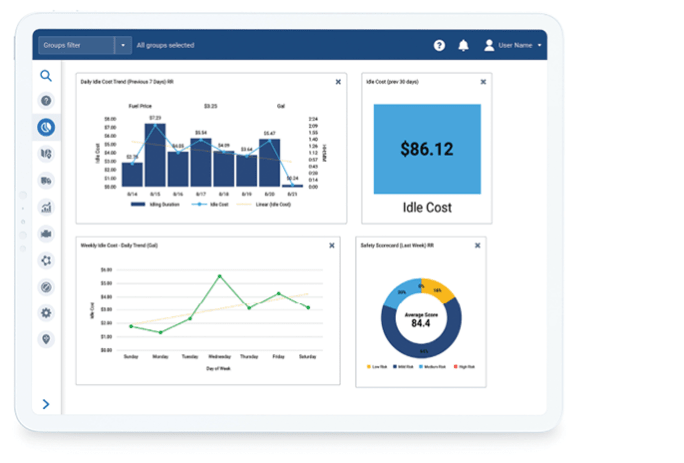
Understanding your costs — from fixed to operating — is essential to effective fleet management.
Photo: Geotab
Opportunity Cost Examples
Examples of opportunity costs will fall within the operating expenses bucket (i.e., variable costs), allowing fleets to reduce costs related to fuel, downtime, and truck lifecycles.
1. Fuel Costs for Work Truck Fleets
While there are many approaches fleets can take to reduce fuel costs, one common opportunity is to reduce idling.
“The total amount of idling might be different each month due to traffic or basic human error (like forgetting to turn the vehicle off), which can significantly impact the cost of fuel,” Geotab’s Berube said.
Telematics is one way to seize the opportunity to reduce idling and thereby reduce fuel consumption.
“By employing telematics, fleet managers can optimize route planning to help avoid heavy traffic or send in-cabin alerts to drivers when their vehicles have been idle for too long,” Berube explained. “While idle time still may vary month-to-month, measuring and monitoring fleet idling allows the manager to have more control over its fuel costs.”
2. Lifecycle Costs for Work Truck Fleets
Determining the ideal time to replace a truck can also allow fleets to reduce operating costs.
“Vehicles lose value over time and incur additional maintenance expenses over their lifecycle,” said Giesie of Enterprise Fleet Management. “Replacing older units with newer, fuel-efficient vehicles can avoid costly maintenance repairs and reduce total fuel spend as older vehicles usually offer lower mpg.”
3. Downtime Costs for Work Truck Fleets
Reducing unplanned downtime presents fleet managers with yet another opportunity to reduce costs.
“When your vehicle is unexpectedly in the shop rather than out on the road, that results in profit loss,” Geotab’s Berube said. “Developing a comprehensive maintenance program can enable fleets to monitor the health of their vehicles to help avoid unplanned downtime and keep their vehicles operating efficiently.”
Training an eye on variable costs gives fleets the opportunity to control costs and maximize profits.
“By measuring and monitoring operations associated with the variable costs, fleet managers can identify strategies to improve their operational efficiency, which translates to dollars saved,” Geotab’s Berube said.

While there are many approaches fleets can take to reduce fuel costs, one common opportunity is to reduce idling.
Photo: Shell
Cost-Per-Mile vs. Engine Hours
Digging deeper into variable costs, fleets typically have two ways to determine how much it costs to operate a truck: calculating the cost per mile or cost per hour (or engine hour).
There is a big difference between the two, so fleets must choose the one that best fits the truck’s application, or the data may prompt actions that negatively impact costs instead of saving them.
For example, a delivery truck traveling more than 100 miles a day operates much differently than a boom crane truck that operates solely at a job site. Using cost-per-mile is appropriate for the delivery truck, and the cost per engine hour makes far more sense for the boom crane truck.
“Cost-per-mile is typically an effective measurement for long-haul trucks,” Enterprise’s Giesie said. “For trucks with significant daily idle time, engine hours can offer a clearer picture of wear and tear.”
Geotab’s Berube said idling is one measure fleet managers often consider in determining whether to use vehicle hours or miles.
“Many work truck applications will have higher idling times than your typical over-the-road truck. Vehicles with consistent periods of idling, or operating at lower speeds, would be better suited for tracking vehicle hours,” he said. “Engines on vocational vehicles, such as waste management trucks, utility vehicles, and cement mixers, run for a greater amount of time despite what the reading on the odometer reflects. Only calculating miles driven will not tell the full story of engine activity for these applications.”
Ross Ingham, senior fleet consulting manager at Wheels Donlen, said the choice fleets make between hours and miles can have a ripple effect on truck maintenance.
“It’s imperative to use whichever metric is best, cost per mile vs. engine hours, to drive your preventative maintenance schedules,” he said. “Too often, we’ve seen fleets that use miles as the driving metric for preventative maintenance on equipment with extremely high idle/PTO times. In these cases, we find that their vehicles are not receiving the preventative maintenance they should and have unnecessary major component failures.”
Total Cost of Ownership
Another way of looking at fleet costs is the total cost of ownership (TCO) of a vehicle. Enterprise’s Giesie said fuel, maintenance, and depreciation make the largest impact on TCO. He underscored the importance of considering depreciation.
“It’s easy to simply focus on the costs of acquisition, or, in turn, to relentlessly squeeze as much utility as possible out of each vehicle, beyond its useful life,” he said. “The best way to ensure the fleet is operating at the lowest total cost of ownership is to identify the optimum cycle point. By doing so, companies can minimize depreciation by taking advantage of higher resale gains, avoid costly downtime and maintenance repairs, and reduce fuel spend by implementing newer, more fuel-efficient vehicles.”
Improperly spec’ing a truck can also affect how much it costs to operate it over its lifetime.
“The differences in operating costs that we typically see are driven by poor truck design. For example, if you have an undersized truck that is constantly hauling its max payload, you can rest assured that vehicle will have a high cost per mile than a properly spec’d unit,” Wheels Donlen’s Ingham said. “Conversely, if you have a PTO installed on a vehicle that does not properly match the depth, pitch, and helix angle of the transmission gear, you will not only damage the transmission of the truck and most likely the equipment it is powering as well.”
Jim Perkins, director of sales and marketing at Shell Fleet Solutions, said outside factors can also increase TCO.
“We have seen supply chain challenges and price increases likely impacting parts availability, making vehicles more expensive for fleet managers,” he said. “Labor shortages also affect every segment of the fleet industry, especially fleet operations with in-house maintenance facilities. Fleets have had to increase spending to retain and recruit technicians. We have seen limited options in finding a qualified workforce and an increased volume of available positions, posing some challenges to fleets’ overall costs and operations.”
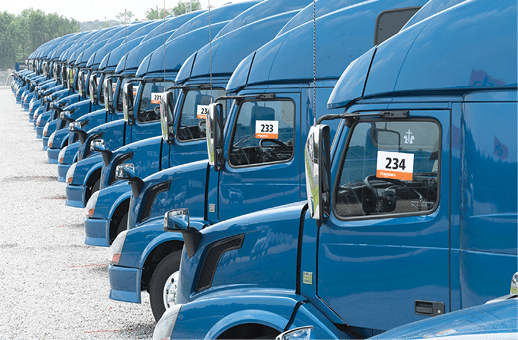
The cost of preparing a truck for remarketing depends on a combination of factors: the age, mileage/hours, and how well it has been maintained during its life.
Photo: Ritchie Bros. Auctioneers
Remarketing Costs
In addition to the costs associated with a truck while it’s in service, fleets should also consider the costs of remarketing it once it’s reached its lifecycle. Although remarketing has an associated cost, that investment often results in higher work truck resale values.
Rob Slavin, senior valuation analyst at Ritchie Bros. Auctioneers, said the cost of preparing a truck for remarketing depends on the age, mileage/hours, and how well it has been maintained during its life. “I’ve seen units with over a million miles in better condition than four-year-old units with 500,000 miles,” he said.
Slavin said the following remarketing investments are likely to yield the largest returns:
Professional cleaning and detailing. Slavin estimates this to cost between $900-$1,600, depending on the number of wheels and chrome that needs to be polished.
Engine and mechanical repairs. If any engine or mechanical repairs are needed, it’s worth making them. “You’ll want to appeal to an end-user, and generally end users don’t want a project — they want a truck that’s ready to work!” Slavin said.
Tires. A new set of tires may cost $5,000, but Slavin said it’s worth spending the money if they need to be replaced. “That is one less thing your buyer needs to worry about,” he said.
Exterior damage. Slavin said there is a difference between normal wear and tear, like scratches, dings, and damage. Damage is worth fixing. “As a buyer, you don’t want to see a bumper hanging, a cab extender folded over (or missing), or a broken windshield.”
PM inspection and service. “I suggest getting a full wet-b/preventive maintenance service,” Slavin said. “This usually includes changing the oil and filters, lubing the chassis, checking fluid levels, and performing a PM inspection, which consists of checking the whole truck without tearing anything apart. This is what most dealerships do in the process of getting a truck ‘frontline’ ready, and it’s what buyers expect.”
While those costs can add up, Slavin said fleets would see a return.
“Right now, with the strength of the demand in the market, I expect to get back 100%-plus of what I put into reconditioning the truck,” he said. “Alternatively, if you bring the unit in as-is and it needs $6,000-$8,000 in reconditioning, the next buyer will likely overestimate the cost to repair and bid lower accordingly. In today’s market, certain parts are in short supply, and potential buyers may skip bidding on your unit if it’s going to take a lot of effort to get it work-ready.”
Leave Room for the Unexpected
Although there are many ways fleet managers can parse and control fleet costs, Wheels Donlen’s Ingham advised always to leave a little wiggle room for the unexpected.
“Typically, fleets do a good job accounting for their spend; however, we do like to advise that the there is always a risk for turbulence in the industry. You cannot plan for everything. Regardless of whether you’ve been in fleet for two months or 20 years, you will always encounter something no one has ever seen before,” he said. “The most successful fleet managers are the ones that constantly practice ‘good blocking and tackling,’ meaning they are always sticking to the basics.”
Subscribe to Our Newsletter
More Operations

Work Truck Seeks Fleet and Industry Insights on 2026 Trends and 2027 Forecasts
Work Truck is seeking insights from fleet leaders and industry partners on the trends that shaped 2026 and what commercial fleets should prepare for in 2027. Participate today!
Read More →
30 Years in Fleet and Still Learning: Lessons Beyond Trucks
After more than three decades in fleet, Bob Adamsky has learned that knowing trucks is only part of the job. The bigger lessons come down to communication, understanding, and never assuming you know it all.
Read More →
What Every New Fleet Manager Should Know
Carolyn Edwards shares lessons on finding mentors, showing fleet’s value, and leading teams in this episode of Legends of Fleet.
Read More →From Our Partners
Basic Tracking vs Next Generation Fleet Technology
Sponsored by AT&T Business

5 Facts Every Fleet Manager Should Know About Embedded Telematics
Sponsored by Stellantis/Mobilisights
How AI Video Telematics Boosts Driver Safety and Helps to Avoid Unnecessary Costs
Sponsored by Verizon Connect

Charting the 8 Bottom-Line Benefits of Workforce Optimization
Sponsored by Verizon Connect


Les Schwab Tires Launches Foundation With $100,000 for Community Recovery
Les Schwab Tires launches a foundation with $100,000 to support recovery for Silver Rail Elementary and the Bend community following a school shooting.
Read More →
Bring Some Fleet to Your Halloween with Our Pumpkin Carving Templates
Download Work Truck’s truck-themed pumpkin patterns, explore more automotive designs, and give your shop or front porch a seasonal upgrade.
Read More →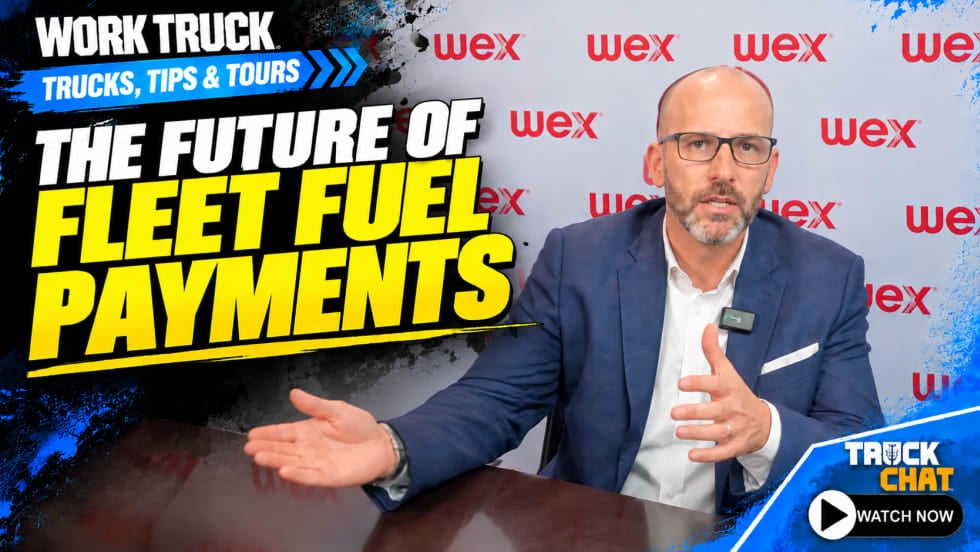
How Cardless Fuel Payments Benefit Commercial Fleets
Is it time for fleets to move beyond plastic fuel cards? David Abraham of WEX explains how cardless fuel payments can help reduce fraud, simplify driver transactions, and improve efficiency by allowing drivers to pay for fuel using their smartphones.
Read More →
Good Fleet Leadership Starts With the People You Already Have
From developing future leaders to listening to employees, discover how better leadership can help work truck fleets retain talent and build stronger teams.
Read More →
ATRI Names Next President and CEO
Page Siplon, a longtime transportation and logistics industry executive, has been chosen as the next president and CEO of the American Transportation Research Institute (ATRI).
Read More →
Coltrain Onsite Fleet Care Sponsors 2026 Cure Bowl to Support Cancer Research
The mobile fleet maintenance provider is supporting the annual college football bowl game, which has helped raise $6.83 million for cancer research since 2015.
Read More →
Racing Lessons, Electric Fleet Growth, and Ghostbusters Lead This Week's Work Truck News
Racing lessons for fleets, Republic Services' electric truck expansion, 40 years of fleet wisdom, truck trivia, autonomous yard trucks, and more headline this week's Truck Chat Cheat Sheet.
Read More →