




Avoid the 'If-it-Fits-it-Ships' Trap
Overloading can have serious consequences for truck fleets ranging from accidents to increased maintenance costs to DOT citations. Make sure fleet trucks are properly spec’d and that drivers avoid “pack-ratting” tools and other supplies.


While an extreme example of an overloaded truck, fleet managers must be aware of the obvious dangers of carrying too much material.
“If it fits, it ships.” So goes the U.S. Postal Service (USPS) slogan for its priority mail offering. The idea is that weight doesn’t really matter; it’s all about space. If there’s room in the package, you can mail whatever you want for a simple flat fee.
While this may be an effective marketing message for the USPS, the “if-it-fits-it-ships” mentality can be dangerous for fleet drivers, who assume that if there’s space in the cargo area of a van or on top of a 12-foot flatbed or inside a 16-foot box, then go ahead and load it, regardless of actual weight of the cargo.
But, that’s what the space is for anyway, right? Not really. And, it’s this thinking that leads to overloaded vehicles, putting drivers — and the public — in greater danger of accidents, while increasing employers’ exposure to lawsuits, excessive maintenance costs, and lost revenue from any public relations fallout from a crash.
Mike Sturges, regional truck manager at ARI, shared a story about a fleet client in the oil and gas market that had dealt with several of its Ford F-350 models that were being consistently overloaded, because there was still space on the truck for the extra cargo.
The problem wasn’t immediately evident, but the warning signs began to show in the form of premature maintenance.
“The company complained to us about issues with suspensions not holding up, so they wanted to go with bigger tires, thinking that would solve the problem,” Sturges said. “But, we saw this as an indication that there was a problem, not with the suspensions or tires, but with excess payload.”
The ARI team went out to the client’s location to weigh the trucks and assess what equipment and inventory each truck absolutely needed to carry to do the job.
“We decided that F-450 and F-550 model trucks, not the F-350, were the best fit for the application.
And, everything seemed to be fine for a few years,” Sturges said.
But, then maintenance costs began to trend up again. When the ARI team went back out to the client’s location to weigh the vehicles, the findings were startling.
“Some of the F-550s rated at 19,500-pounds GVWR were weighing more than 23,000 pounds,” he said.
Not surprisingly, drivers were overloading their trucks because of the extra space.
Counteracting the Cumulative Effect
Most of the overloading was, again, extra tools and materials that were not necessarily needed on a day-to-day basis.
“You see crews ‘pack-ratting’ tools ‘just in case.’ They’re storing material on the truck that could have been stored at the warehouse or job site,” Sturges said.
Rob Kooken, director, truck excellence at Element Fleet Management, has observed similar scenarios with fleets.
“Drivers have a tendency to have inventory creep, putting extra parts and equipment and tools in the truck that they think they might need,” he said.
Adding an extra tool or piece of equipment may not seem to make much of an impact on any given day, but it’s the cumulative effect that takes its toll on the truck if drivers aren’t mindful about eliminating excess cargo. Eventually the warning signs emerge in the form of premature maintenance and repair costs.
“Higher tire costs, higher brake costs — these are sure signs that the truck is operating consistently over its payload allowance,” Kooken observed.
And, the costs of overloading vehicles go beyond maintenance.
Governments are stepping up enforcement to curb occurrences of overweight trucks, increasing the likelihood of fleets getting pulled over and charged fines by the U.S. Department of Transportation (DOT). In fact, a growing number of municipalities have begun implementing virtual weigh stations, which use “weigh-in-motion” technology that includes sensor scales embedded in the highway and overhead cameras to help law enforcement quickly spot potential offenders.
“When law enforcement cites one of a fleet’s trucks for a DOT violation, the officer sees the decal on the truck. That puts the fleet’s company on their radar so they’re more on the lookout for further violations,” Sturges said.
Operating overloaded trucks also puts a fleet at greater exposure to legal liability.
It’s clear that operating overweight trucks is dangerous to drivers and the public. But, why? What makes them more prone to accidents?
The excess strain and wear on suspension systems and other critical components can make the truck unstable and difficult to control. Also, the heavier the truck, the more braking power it needs to stop.
So, if the brake system isn’t compatible with the actual payload, the truck may not be able stop in time.
As a fleet manager it can be difficult to monitor drivers and crews to ensure they don’t overload their trucks. So, what are some steps that fleet managers can take to minimize the likelihood of overloaded trucks — and reduce risk exposure for their employers?
Spec’ing Vehicles Properly
Some fleets are motivated to “under spec” a truck, for example, to avoid it falling under DOT safety and other regulations (required for vehicles 10,001 pounds gross vehicle weight and heavier, including the weight of an attached trailer).
But, if the job requires a heavier truck, spec the vehicle accordingly, advised Sturges of ARI. “Don’t try to avoid DOT. You’re going to have to accept that you need the bigger truck to avoid DOT violations and ensure safety of your drivers,” he said.
Kooken of Element Fleet Management recommended spec’ing the vehicle based on the maximum load that would be placed in the vehicle, with the total weight of the truck, including any upfits and cargo, to be within 85-percent of the truck’s gross vehicle weight rating (GVWR), the maximum allowable vehicle weight, including all fluids, people, and cargo, as certified by the manufacturer.
This “rule-of-thumb” allows for a buffer in case there’s any potential inventory creep, minimizing risk of the truck operating above maximum capacity.
But, when it comes to spec’ing a truck with sufficient payload capacity, GVWR is only the starting point to help determine the class truck needed for the job. It doesn’t provide specific information on how much cargo weight it can safely carry.
To arrive at that number — called the net payload allowance — first find out the truck’s as-spec’d curb weight, which is defined as the shipping weight of the truck or chassis cab without aftermarket upfits, including all standard equipment and options, fluids, and a full tank of fuel. Consult the truck’s original equipment manufacturer or dealer rep for curb weight estimates for the truck or chassis.
Then subtract the as-spec’d curb weight from the truck’s GVWR to calculate the gross payload capacity, the maximum amount of combined weight of cargo, equipment, and occupants a vehicle can safely carry. For example, if the truck’s GVWR is 19,500 pounds, and as-spec’d curb weight is 9,500 pounds, the truck’s payload capacity is 10,000 pounds.
This number, in other words, represents the weight the truck can safely carry before the body, such as a service body or flatbed, and any truck-mounted upfits are installed.
Then once you get the estimated weights for the body and upfits from the truck equipment manufacturers, you can calculate the net payload capacity — the weight the completed truck (with aftermarket body and equipment installed) can haul.
So, if the gross payload capacity is 10,000 pounds and the body and upfits combine to weigh 4,800 pounds, the truck’s net payload allowance is 5,200 pounds.
With net payload capacity in mind, consider the application. What exactly will be hauled in the truck or van? How much will a maximum load weigh? Does the vehicle offer sufficient net payload allowance to safely handle the maximum load, with room to spare?
Considering Optimal LoadDistribution
While matching net payload allowance to the truck’s application is important, remember to also consider load distribution — that is, where the cargo is placed on the truck — to ensure the truck does not get overloaded on a given axle.
“When helping clients spec a truck, we go out in the field with them and look at what they’re planning to use, what they’re going to carry, and where they’re going to carry it in the vehicle,” Kooken said. “It is human nature. You want to put your tools toward the back door of a van or near the tailgate of a truck because of the ease of access. But, concentrating loads behind the rear axle increases the pressure on that axle and diminishes the truck’s overall payload capacity quite a bit.”
When it comes to load distribution, the key spec to consider is gross axle weight rating (GAWR), the maximum distributed weight that may be supported by an axle.
This is because there can be a load that fits the parameters of the truck’s GVWR and net payload allowance, but if the weight is concentrated on the rear axle, it could actually exceed the GAWR, causing the entire truck to be “overweight” in the eyes of law enforcement.
“The strategy should be to distribute the load between the axles, whenever possible, instead of behind the rear axle, to maximize the truck’s payload capacity,” Kooken said.
Towing Impact
Will the truck be pulling a trailer? If so, how much weight would be on both the truck and the trailer?
These are important questions because the heavier the load on the truck the less weight the truck can legally (and safely) pull on the trailer.
“You could look at the tow guide, and it might say a truck can pull a trailer up to 25,000 pounds. But, once you do the math that takes into account the weight of the truck, estimated net payload, upfitting and so forth, that 25,000 pounds is greatly reduced,” said Sturges of ARI.
The key spec to consider for towing is gross combination weight rating (GCWR), the maximum allowable combined weight (as determined by the truck OEM) of the truck and its payload, with the trailer weight at maximum load.
GCWR is essential to calculating accurate tow capacity because it takes into account the tow vehicle’s intended payload. Why is this important?
Most tow capacity charts published by truck OEMs don’t account for a truck’s specific application. When adding weight to the truck, this detracts from the vehicle’s towing capacity.
For example, suppose a truck, at maximum load, has a GVWR of 6,500 pounds and its GCWR is 18,500 pounds. Subtract the GVWR (6,500 pounds) from the GCWR (18,500 pounds) to come up with an estimated maximum towing capacity of 12,000 pounds.
An additional 500 pounds added to the truck’s payload, which would bring the GVWR to 7,000 pounds, would then reduce towing capacity by 500 pounds, to 11,500 pounds.
The tow vehicle’s payload, therefore, directly impacts tow capacity. Lightening the truck’s payload boosts towing capacity and vice versa.
Also, consider trailer “tongue weight” and its impact on the truck’s payload.
“You have to look at towing applications and consider what the weight of the trailer is,” said Sturges. “Typically 10 percent of the trailer weight will transfer to the tongue weight. So, if you had a truck that’s pulling a 5,000-pound trailer, you could estimate 500 pounds of that will be transferred to the truck.
“We encourage fleets to weigh the truck with the trailer attached to get the precise tongue weight differential,” Kooken advised. “We find that often the trailer itself is too big to be attached to the vehicle.”
Inspecting What to Expect
So, the truck is spec’d for the job. What now? What would keep drivers from falling into the “if-it-fits-it-ships” trap? What would prevent drivers from engaging in “inventory creep” with bigger trucks?
Sturges with ARI said that one strategy clients have found effective is placing a “maximum net payload capacity” sticker on the dash of each vehicle. This helps build awareness among drivers that the truck’s payload should not exceed that number, and that they will be held accountable for compliance.
But, what’s a practical way to enforce the policy?
“To monitor the vehicles, to monitor the drivers, you have to have some policy in place so that your drivers are not hoarding equipment. Then make sure you have the trucks weighed at regular intervals. This is important because drivers may not even know they are overloading the vehicle,” Sturges said.
The Bottom Line
Just because there’s room on the truck, doesn’t necessarily mean the truck can handle the extra cargo. So, make sure each truck is built for its purpose and then educate drivers on the importance of adhering to the vehicle’s payload capacity, holding then accountable along the way, to ensure their safety — and minimize risk exposure for the organization.
More Safety
When Work Trucks Under 26,001 Pounds Need IRP Registration
Think trucks under 26,001 pounds are automatically in the clear when it comes to IRP? Not always. Learn where lighter vehicles can still run into trip permit, apportioned registration, and IFTA compliance requirements when crossing state or provincial lines.
Read More →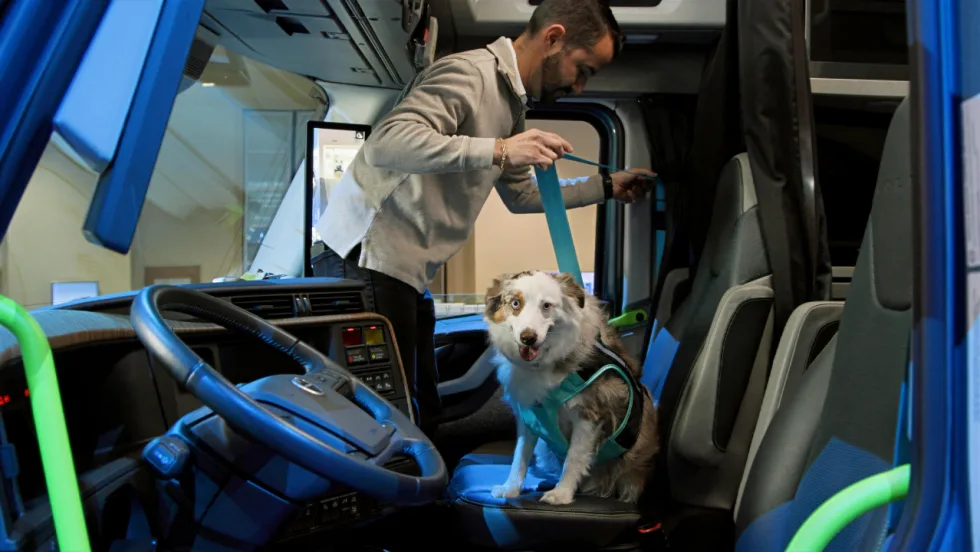
Volvo Trucks Releases New Safety Recommendations for Traveling with Pets
One of the most important recommendations for professional drivers traveling with pets is to ensure pets are properly restrained while the truck is moving. Other tips are available in the new guide from Volvo Trucks North America and Center for Pet Safety.
Read More →
API Issues Refueling Safety Guidelines
The American Petroleum Institute offers a list of safe vehicle refueling guidelines, including ways to avoid potential problems with static electricity discharges in fall, winter, and early spring.
Read More →
Winter Fleet Prep: Expert Tips to Keep Vehicles Running Smoothly
Cold weather can expose weak batteries, tires, fuel systems, and maintenance gaps fast. Use this winter fleet checklist to prepare trucks and drivers before temperatures drop.
Read More →
When a Work Truck Breaks Down, the Job Can Stop, Too
A work truck breakdown can stop more than the vehicle. Discover how payloads, jobsites, and specialty equipment change the roadside response.
Read More →
What Stronger Long-Term Fleet Service Partnerships Actually Require
Fleet service partnerships rarely fall apart all at once. Learn the three warning signs that trust is eroding and what fleets and providers can do before downtime, frustration, and lost revenue follow.
Read More →
Applause & TRUCE Software Partner to Improve Driver Safety Through AI-Powered Telematics & Employee Performance Management
Applause has integrated TRUCE driving metrics directly into its employee-first performance and safety platform that transforms mobile devices into AI-powered telematics.
Read More →
How Detroit Assurance with Active Brake Assist Works
Do you want to see what it is like to experience Detroit Assurance’s Active Brake Assist? In this video, Work Truck will put you in the cab to see how it all works and then hear more details from DTNA’s Mike Young.
Read More →
Get Left of Loss: A 5-Step Workplace Violence Prevention Framework for Fleet Operators
Violence risks do not stop at the driver’s door. Learn five practical steps fleets can take to spot threats early and protect workers before loss occurs.
Read More →
How Better Visibility Cut Speeding Violations by 48%
Fleet leaders don't need more data, they need clearer visibility into what the data is saying. This case study explores how one utility replaced speeding-event counts with a single metric — miles driven in violation — to strengthen safety and significantly reduce speeding violations.
Read More →