





Related: Upgrading Refuse Fleets to CNG: Three Considerations Beyond Economics
NGVi Certifies More than 1,000 CNG Fuel System Inspectors
Natural Gas Vehicle Institute (NGVi) has certified more than 1,000 CNG fuel system inspectors since the program was launched in late 2016.
January 30, 2020
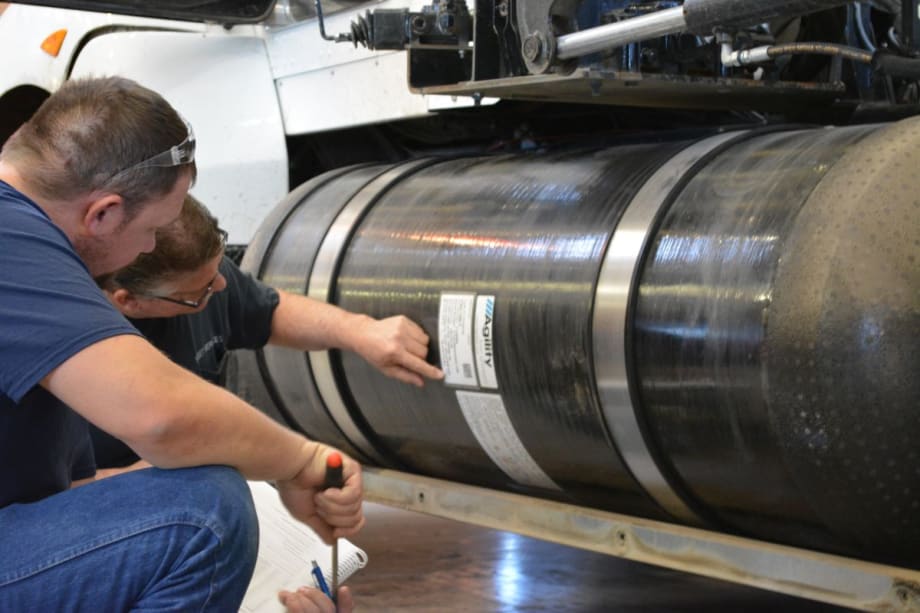
Qualified CNG fuel system inspectors must be able to thoroughly examine all components of the CNG fuel system, correctly identify and determine the extent or significance of any discovered damage, and clearly understand and prescribe what actions must be taken.
Photo: NGVi
3 min to read
Natural Gas Vehicle Institute (NGVi) has certified more than 1,000 CNG fuel system inspectors since the program was launched in late 2016. This represents ten times the number of inspectors certified just three years ago and is comprised of representatives from 51 transit agencies, 28 refuse companies, 25 trucking companies, 46 municipal fleets, as well as those from numerous school districts, cylinder manufacturers, truck manufacturers and dealers, and more.
“We are thrilled to see this growing commitment to ensuring fleet safety,” said Annalloyd Thomason, vice president and general manager of NGVi. “NGVi CNG Fuel System Inspector Certification is an important verification of the technician’s qualifications and competence, and a recognized hallmark of best practices in risk mitigation for the operation of CNG powered vehicles. The large interest in our program clearly signifies that companies recognize the importance of having their technicians certified.”
NGVi's CNG Fuel System Inspector Certification program launched in September 2016. It was created in conformance with National Commission for Certifying Agencies (NCCA) guidelines.
Qualified CNG fuel system inspectors must be able to thoroughly examine all components of the CNG fuel system, correctly identify and determine the extent or significance of any discovered damage, and clearly understand and prescribe what actions must be taken. They also must have sufficient knowledge of all applicable codes and standards governing CNG fuel system installation and CNG fuel system components, as well as be able to interpret and apply them in the inspection process.
“On-the-job applicability and practicality are the main attributes of any certification program. Right from the start, we specifically focused on creating a rigorous certification that assesses in detail the knowledge and skills technicians must apply during an actual inspection,” said Thomason. “Because the repercussions of improper installation or undetected external damage to the CNG fuel system can be serious and dangerous -- and affect not only safety of the fleet but also potentially the general public -- it’s imperative that organizations ensure their CNG fuel system inspectors are 100% qualified for the job. We are proud to provide them with an assessment tool adding that extra layer of assurance.”
The NGVi CNG Fuel System Inspector Certification program is administered independently from the company training programs, and there is no training prerequisite for technicians seeking certification.
“Training is recommended, of course, but participants in our CNG Fuel System Inspector Certification program are not required to take training from NGVi to sit for the exam,” said Thomason. “If you are prepared, you are welcome to take the exam,” she added. “We also understand the importance of convenience and accessibility. This is why, in addition to offering a live-proctored paper exam, NGVi certification exam participants may take the exam online at any convenient time.”
NGVi’s CNG Fuel System Inspector Certification is valid for five years. Participants who pass the certification exam are designated as NGVi-Certified CNG Fuel System Inspectors. They receive a certificant number, identification card and a certification document.
More Green Fleet

Fleet Forward Conference Introduces One-Day Passes for 2026
New one-day registration gives fleet professionals the flexibility to attend Tuesday, Wednesday, or Thursday, with passes available for $199 through Sept. 18.
Read More →
CALSTART Rebrands as Catalyst Mobility, Will Combine with Forth in 2027
CALSTART has rebranded as Catalyst Mobility and will combine with Forth at the start of 2027. The new organization said it is poised to become one of the world's largest, strongest, and most impactful clean transportation nonprofits.
Read More →
Electric Truck and Charging Programs to Boost Sustainability at NY & NJ Ports
Together, the Port Authority of New York and New Jersey and CALSTART will electrify drayage and terminal operations serving the East Coast’s busiest container port. A pair of incentive programs totaling $45 million has launched to accelerate adoption of zero-emission drayage trucks and terminal tractors.
Read More →
Xos Hub Surpasses One Gigawatt-Hour of Energy Delivered in the Field
A single Xos Hub has surpassed one gigawatt-hour of energy across more than 33,600 charging sessions in the field, demonstrating performance that supports Xos' expansion across new products and markets.
Read More →
Carrier Transicold Launches All-Electric Vector 8200 TRU for Diesel-Free On-Site Cold Storage
Carrier Transicold’s first engineless multi-temperature TRU helps fresh- and frozen-food fleets add supplemental cold storage capacity during seasonal peaks.
Read More →
Narro Trucks Introduces Electric Utility Vehicle
Narro Trucks officially launched its operations on Aug. 20 and hosted a ride and drive to showcase its electric truck, which will be produced in Virginia.
Read More →
Samsung SDI Takes Full Control of GM Battery JV as Indiana Plant Pivots to Energy Storage
Samsung SDI is taking full control of its Indiana battery plant with GM, marking a major shift from the EV-focused joint venture Charged Fleet first covered in 2023.
Read More →
NWSA Taps CALSTART to Administer Zero-Emission Drayage Assistance Program
CALSTART will provide free technical assistance services to drayage fleets serving the Ports of Seattle and Tacoma and looking to transition to cleaner technologies and help decarbonize freight hubs.
Read More →
EV Fleet Reality Check: What Operators Wish They Knew Before Electrifying Their Work Vans
Electric work truck upfits bring new compatibility questions. Learn how parts availability, OEM guidance, power demands, and route planning can affect fleet performance.
Read More →
Peterbilt Expands Sourcewell Partnership with Electric Vehicle Lineup
Peterbilt Motors Company’s cooperative purchasing agreement with Sourcewell and its Canadian partner, Canoe Procurement Group, now includes including Peterbilt's battery-electric vehicle lineup.
Read More →