




Trio of New EcoTec3 Engines Powers Silverado and Sierra
DETROIT – The 2014 Chevrolet Silverado 1500 and GMC Sierra 1500 will deliver more power, more torque and improved fuel efficiency, thanks in part to a trio of all-new EcoTec3 engines designed specifically for the needs of full-size truck customers.
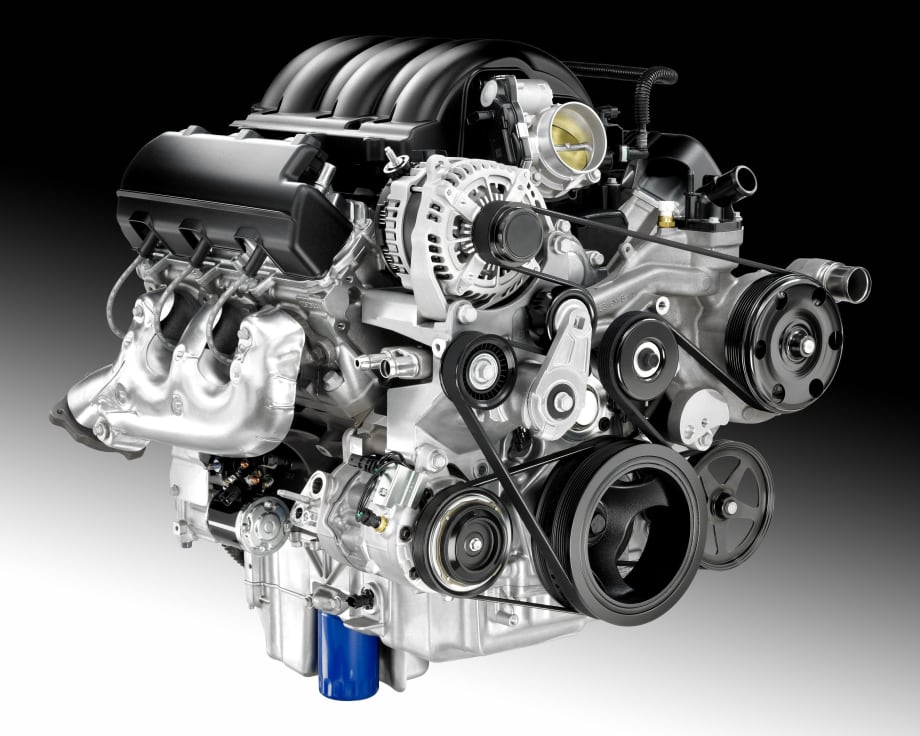
2014 4.3L V-6 EcoTec3 AFM VVT DI (LV3) for Chevrolet Silverado and GMC Sierra.
DETROIT – The 2014 Chevrolet Silverado 1500 and GMC Sierra 1500 will deliver more power, more torque and improved fuel efficiency, thanks in part to a trio of all-new EcoTec3 engines designed specifically for the needs of full-size truck customers.
The new engine family includes a 4.3L V6, a 5.3L V-8 and a 6.2L V-8.
EcoTec3 engines feature three state-of-the-art technologies – direct injection, cylinder deactivation and continuously variable valve timing – to make the most of power, torque and efficiency across a broad range of operating conditions.
“We believe these are the most technologically advanced engines ever offered in light-duty pickups, and they are 100 percent truck – specifically designed for the way customers use trucks in the real world,” said Jordan Lee, Small Block chief engineer and program manager.
“They have all the power and torque needed to confidently handle the tough jobs, and they seamlessly switch to four-cylinder mode to increase efficiency during light-load driving.
“This is technology no other truck maker can match, and we offer it in every one of our EcoTec3 engines, for every one of our customers,” said Lee. “It is not an extra cost feature. You get our best and most sophisticated technology regardless of trim level.”
Although they share only a handful of parts with previous Chevrolet and GMC engines, the new EcoTec3 engines build on experience gained from millions of trucks and billions of real-world customer miles, while incorporating the latest in advanced materials and combustion systems.
“The combination of straightforward mechanical systems, the latest in materials, and an advanced combustion system enable us to improve power and efficiency, while also reducing noise and vibration,” said Lee. “We think truck customers will find our new engines to be the right tools for the toughest jobs, while helping hold down ownership costs over the long run.”
Click to the next page to view additional information on the engine lineup.
[PAGEBREAK]
A family of three all-new engines
The EcoTec3 lineup for the 2014 Silverado and Sierra 1500 includes a 4.3L V-6 and 5.3L and 6.2L V-8s, all matched with proven, efficient six-speed transmissions in the United States and Canada.
The new 4.3L V-6 will offer budget-conscious customers a state-of-the art truck engine, with ample torque to power a crew cab and tow a trailer.
The new 5.3L V-8 is engineered for more horsepower, more torque and better fuel economy than the current 5.3L V-8.
The new 6.2L V-8 is expected to be the most capable engine offered in any light-duty pickup truck.
SAE certified horsepower and torque ratings and EPA fuel economy estimates for the new Silverado and Sierra will be available beginning early next year.
Advance combustion system drives greater power, efficiency
At the heart of the new EcoTec3 engine family is an advanced combustion system that maximizes the potential of the direct fuel injection system, cylinder deactivation, continuously variable valve timing and other technologies.
Development of this advanced combustion system involved extensive design and engineering by GM’s global powertrain organization. More than 100 iterations of the combustion systems were evaluated through computer modeling before a final design was selected for each engine variant. The overall engine design involved more than 10 million hours of computational CPU time, with the combustion process alone accounting for more than 6 million of those CPU hours.
“Owning a truck doesn’t mean settling for second-best technology,” said Lee. “Our new EcoTec3 engines harness some of the most advanced powertrain technologies in the world to meet the specialized demands of truck owners.”
For example, truck engines often need to provide maximum power under heavy load for long periods of time, such as towing a trailer up a mountain grade or slogging through mud at a job site. A rugged, large displacement engine is well suited to reliably providing this power and torque, year in and year out.
“For the 2014 Silverado and Sierra 1500s, these larger displacement EcoTec3 engines can now instantly switch to four-cylinder mode to improve efficiency when less power is required. It gives customers the best of both worlds – a rugged truck engine when they need it, with improved efficiency in light-load driving,” said Lee.
The ability to more precisely control combustion also enables the new engines to run with a higher compression ratio – 11.0:1 for the versions with regular fuel recommended. This higher compression is one of the best ways to simultaneously increases both power and efficiency.
This increased efficiency can now be maintained over a broader range of operating conditions. For example, when towing a trailer on a hot summer day, Silverado and Sierra’s advanced combustion system can reduce the need to trim back spark advance to control detonation, helping maintain both performance and real-world fuel efficiency, even when the going gets really tough.
Emissions are also reduced, particularly during cold starts, when hydrocarbon emissions are cut by about 25 percent.
Direct injection for precise fuel metering
New EcoTec3 engines use direct fuel injection, which precisely meters fuel directly into the cylinders, to optimize combustion over a broad range of conditions.
The engines also feature a new cylinder-head design and a new, sculpted piston to optimize the mixing of air and fuel in the engine and the burning of the mixture to create power.
The heads features smaller combustion chambers shaped to complement the unique topography of the piston heads. The smaller chamber size and sculpted pistons produce a compression ratio of 11.0:1 or higher, depending on the engine, while the heads features large, rectangular intake ports with a slight twist to enhance mixture motion.
To further enhance combustion, the intake and exhaust valve positions have been switched from previous versions, and the valves are now slightly canted toward the cylinder centerline. Also, the spark plug angle has been revised and the electrode is now closer to the center of the chamber to support optimal combustion.
The pistons feature unique sculpted topography that was optimized via extensive computer analysis to precisely direct the fuel spray for better mixing and more complete combustion. The contours of the piston heads are machined after casting to ensure dimensional accuracy – essential for precise control of mixture motion and the compression ratio.
Deactivating cylinders to enhance fuel economy
Cylinder deactivation, also known as Active Fuel Management, is now standard on all three engines for the Silverado and Sierra 1500.
The new trucks make the most out of cylinder deactivation, with improved engine mounts, electronic throttle control, adaptive exhaust systems, improved aerodynamics, low-rolling resistance tires, and other technologies that help the engines operate in four-cylinder mode for longer periods of time, further increasing efficiency.
“GM pioneered cylinder deactivation technology, and we consider it a great technology for improving the efficiency of full-size trucks,” said Lee.
The system uses oil pressure, controlled by the powertrain control module, to deactivate the lifters on selected cylinders, closing the valves for those cylinders. It deactivates four of the cylinders on the V-8 engines and two cylinders on the V-6 under light load conditions – operating the engines as a V-4 – and seamlessly reactivates the cylinders when the driver demands greater power. The transition takes less than 20 milliseconds and is virtually imperceptible.
“This is another great example of using a relatively simple mechanical system and powerful software to provide a real benefit to our customers,” said Lee.
2014 Silverado and Sierra EcoTec3 engines features and highlights
Proven truck engine designs: Although the EcoTec3 engines for the 2014 Silverado and Sierra are all new – sharing just a handful of small parts with previous engines – they build on a foundation of more than 100 million Small Block engines and billions of real-world customer miles.
Engines based on the Small Block architecture are typically smaller and lighter than competitive engines with overhead camshafts, and typically have lower friction. Although package size is usually not a concern with full-size pickups, lighter weight and lower friction can both contribute to improved efficiency.
Weight-saving aluminum engine blocks: For 2014, all three engines for the Silverado and Sierra use lightweight aluminum blocks with cast-in iron cylinder liners. The blocks were developed with math-based tools and data acquired in GM’s racing programs, providing a light, rigid foundation for a smooth and strong engine.
The deep-skirt block design helps maximize strength and minimize vibration. Cross-bolted main bearing caps are secured to the block with four main bolts and two cross bolts each. A structural aluminum oil pan further stiffens the bottom of the block. The result is an engine that is quieter, smoother and more dependable, even under the toughest conditions.
Advanced oiling system: The oiling system incorporates a new variable-displacement oil pump that enables more efficient oil delivery, based the engine’s operating conditions. Its dual-pressure control enables operation at a very efficient oil pressure at lower rpm, and then delivers higher pressure at higher engine speeds to provide a more robust lubrication.
Oil capacity has been increased to six quarts for the 4.3L V-6 and eight quarts for the V-8 engines. All engines use GM’s Dexos oil for increased fuel efficiency and longer oil life, and V-8s are engineered to use 0W/20 oil to improve lubrication and reduce friction.
All trucks also feature GM’s oil life monitor, which better protects engines by recommending oil changes based on actual engine operating conditions and can save owners’ money by avoiding unnecessary oil changes.
Oil-jet piston cooling: At higher engine speeds, small jets spray oil on the underside of each piston. This helps reduce piston temperature, enabling the engine to maintain maximum horsepower and torque, and also reduces engine noise.
PCV-integrated rocker covers: New domed rocker covers house a patent-pending integrated positive crankcase ventilation system that enhances oil life, reduces oil consumption and reduces exhaust emissions. The domed sections of the covers contain baffles that separate oil and air from the crankcase gases, with about three times the oil/air separation capability of previous engines.
Exhaust manifolds: The exhaust manifolds were developed to improve durability and sealing and reduce operating noise. The cast iron manifolds feature saw cuts along their cylinder head mounting flange, which split the flange into three separate sections on the V-6 and four separate sections on the V-8s, allowing each section to move under extreme hot-cold temperature fluctuations to virtually eliminate movement of the exhaust manifold gaskets. That helps ensure proper sealing for the life of the engine and reduces the chance of gasket failure. The exhaust manifolds also feature triple-layer stainless steel heat shields, which limit heat transfer to the engine bay and help further reduce noise.
Cooling system, humidity sensor and more: Additional features and technologies of new Silverado and Sierra engines include:
A revised cooling system with an offset water pump and thermostat for more efficient performance
An air induction humidity sensor ensures optimal combustion efficiency, regardless of the surrounding air’s humidity
All engines feature an engine-driven mechanical vacuum pump to enhance braking performance
58X ignition system with individual ignition coil modules and iridium-tip spark plugs
All-new “E92” engine controller.
General Motors’ investment in the new EcoTec3 engine family will create or retain more than 1,600 jobs in five North American plants, including Tonawanda, New York, which recently received upgrades to support its production.
Founded in 1911 in Detroit, Chevrolet is now one of the world's largest car brands, doing business in more than 140 countries and selling more than 4 million cars and trucks a year. Chevrolet provides customers with fuel-efficient vehicles that feature spirited performance, expressive design, and high quality. More information on Chevrolet models can be found at www.chevrolet.com.
More Operations

Work Truck Seeks Fleet and Industry Insights on 2026 Trends and 2027 Forecasts
Work Truck is seeking insights from fleet leaders and industry partners on the trends that shaped 2026 and what commercial fleets should prepare for in 2027. Participate today!
Read More →
30 Years in Fleet and Still Learning: Lessons Beyond Trucks
After more than three decades in fleet, Bob Adamsky has learned that knowing trucks is only part of the job. The bigger lessons come down to communication, understanding, and never assuming you know it all.
Read More →
What Every New Fleet Manager Should Know
Carolyn Edwards shares lessons on finding mentors, showing fleet’s value, and leading teams in this episode of Legends of Fleet.
Read More →From Our Partners
Basic Tracking vs Next Generation Fleet Technology
Sponsored by AT&T Business

5 Facts Every Fleet Manager Should Know About Embedded Telematics
Sponsored by Stellantis/Mobilisights

How AI Video Telematics Boosts Driver Safety and Helps to Avoid Unnecessary Costs
Sponsored by Verizon Connect

Charting the 8 Bottom-Line Benefits of Workforce Optimization
Sponsored by Verizon Connect


Les Schwab Tires Launches Foundation With $100,000 for Community Recovery
Les Schwab Tires launches a foundation with $100,000 to support recovery for Silver Rail Elementary and the Bend community following a school shooting.
Read More →
Bring Some Fleet to Your Halloween with Our Pumpkin Carving Templates
Download Work Truck’s truck-themed pumpkin patterns, explore more automotive designs, and give your shop or front porch a seasonal upgrade.
Read More →
How Cardless Fuel Payments Benefit Commercial Fleets
Is it time for fleets to move beyond plastic fuel cards? David Abraham of WEX explains how cardless fuel payments can help reduce fraud, simplify driver transactions, and improve efficiency by allowing drivers to pay for fuel using their smartphones.
Read More →
Good Fleet Leadership Starts With the People You Already Have
From developing future leaders to listening to employees, discover how better leadership can help work truck fleets retain talent and build stronger teams.
Read More →
ATRI Names Next President and CEO
Page Siplon, a longtime transportation and logistics industry executive, has been chosen as the next president and CEO of the American Transportation Research Institute (ATRI).
Read More →
Coltrain Onsite Fleet Care Sponsors 2026 Cure Bowl to Support Cancer Research
The mobile fleet maintenance provider is supporting the annual college football bowl game, which has helped raise $6.83 million for cancer research since 2015.
Read More →
Racing Lessons, Electric Fleet Growth, and Ghostbusters Lead This Week's Work Truck News
Racing lessons for fleets, Republic Services' electric truck expansion, 40 years of fleet wisdom, truck trivia, autonomous yard trucks, and more headline this week's Truck Chat Cheat Sheet.
Read More →