





Disaster-Proofing Fleet Operations: How to Maintain Uptime When Conditions Are Anything but Normal
Severe Storms Are Reshaping Recovery Operations for Contractors and Work Truck Fleets
Hailstorms are creating costly new challenges for work truck fleets, from damaged onboard tech to longer recovery timelines and tactical storm planning.
May 12, 2026
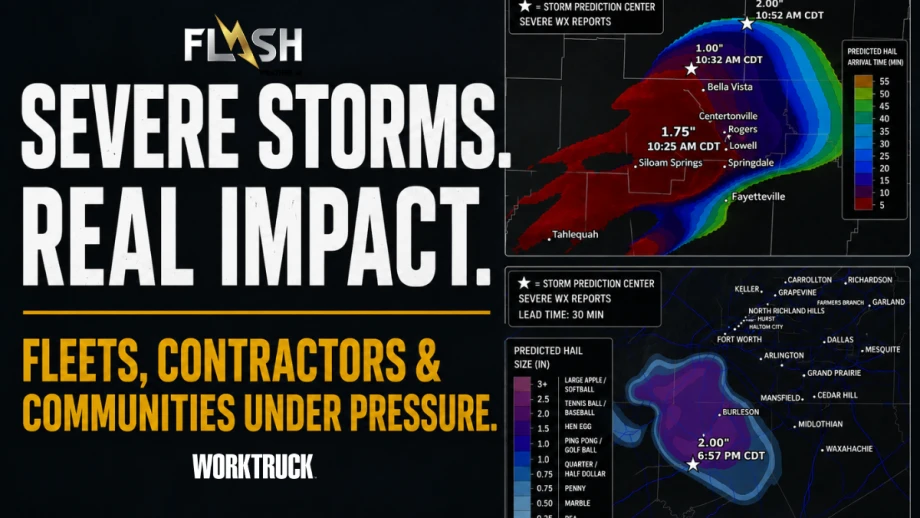
As severe hail events grow more frequent and costly, contractors and fleet operators are facing mounting pressure to protect equipment, reduce downtime, and respond faster during storm recovery operations.
Credit:
Work Truck | Flash Weather AI
5 min to read
- Hailstorms are increasingly causing damage to work truck fleets, impacting the onboard technology systems.
- The recovery operations for contractors now face extended timelines due to the weather-induced challenges.
- Tactical planning for severe storm scenarios is becoming essential for work truck fleet management.
*Summarized by AI
Severe convective storms are creating new operational pressures for contractors, restoration companies, utilities, and the work truck fleets supporting recovery efforts across the U.S., according to Cotality’s 2026 Severe Convective Storm Risk Report.
The report highlights how hail, tornadoes, and straight-line winds are no longer viewed as secondary weather threats. Instead, they are becoming some of the largest drivers of insured property losses while increasing demand for rapid-response service vehicles, mobile crews, and recovery equipment.
Cotality estimates that more than 43.5 million U.S. properties fall into moderate- or higher-hail-risk categories, representing approximately $17.8 trillion in reconstruction cost value (RCV). Texas led all states in exposure with nearly 8 million at-risk properties and $3.1 trillion in exposed RCV.
The report also identified what it called the “Chicago Anomaly,” in which the dense concentration of high-value real estate in the Chicago metro area pushed the region’s total exposed reconstruction value above that of Dallas-Fort Worth, despite Texas experiencing more frequent, severe hail activity.
Hidden Costs Beyond Vehicle Damage
For fleets operating in storm-prone regions, the biggest operational headaches often extend well beyond visible body damage.
“When people hear hail damage, they usually picture dented hoods and trunks,” said Dave Downey, lead meteorologist for FLASH Weather AI. “From what I'm hearing from operators, that's not where the real cost is.”
Downey said many service trucks, utility vehicles, and municipal fleet units now carry expensive roof-mounted technology and connected equipment that can be significantly more costly to replace than exterior body panels.
“Service trucks, utility rigs, and a lot of municipal vehicles are loaded with LiDAR, sensors, antennas, mobile data terminals, and roof-mounted gear that costs way more than the truck body itself,” said Downey. “A ping pong ball-sized stone doesn't have to total the truck to cause tens of thousands of dollars in equipment damage, taking it offline for weeks while waiting on parts already on backorder after a regional event.”
The report noted that large storm outbreaks can create simultaneous demand surges for roofing contractors, utility crews, debris removal teams, and emergency response providers, placing additional strain on vehicle availability and replacement parts inventories.
Downey also pointed to post-event insurance documentation as an overlooked operational challenge for fleets managing dozens of vehicles spread across wide storm paths.
“The other piece nobody discusses is documentation,” said Downey. “After a major hail event, an operator must prove, vehicle by vehicle, what got hit and how hard, or insurance pushes the claim back.”
He added that precise hail mapping and weather verification data are becoming increasingly important during claims processing and fleet recovery efforts.
“If you've got fifty trucks scattered across a county-wide hail swath, that paperwork problem can stall the whole fleet for weeks,” said Downey. “Precise hail data has become a forensic tool for insurance, not just a weather forecast.”
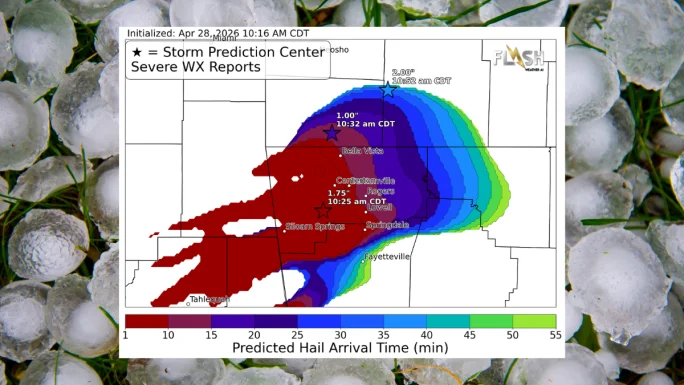
Projected hail arrival timing maps are becoming a more important planning tool for fleets staging vehicles, protecting equipment, and coordinating response operations ahead of severe weather outbreaks.
Credit:
Work Truck | Flash AI
Storm Response Is Becoming More Complex
According to the report, severe convective storms are triggering overlapping workflows across emergency stabilization, water mitigation, reconstruction, debris removal, and contents restoration divisions.
Emergency response teams are often deployed immediately after storms to tarp roofs, board up, and remove debris, while mitigation crews work to prevent secondary water damage before insurance claims are fully processed.
The company also pointed to longer project timelines caused by labor shortages and supply chain constraints. Unlike localized damage events, large storm outbreaks can affect thousands of homes across a metro area simultaneously, stretching contractor capacity and extending projects from weeks to months.
That prolonged response cycle can place additional pressure on service fleets responsible for transporting crews, hauling equipment, staging materials, and supporting around-the-clock operations during recovery periods.
Cotality highlighted the June 2023 Texas storm cluster as an example of how concentrated hail events can rapidly escalate operational and financial impacts. The company estimated that the storm caused between $7 billion and $10 billion in insured losses, with hail responsible for approximately 95% of the damage.
According to the report, if that same storm system had shifted just 15 to 20 miles north into the center of the Fort Worth metropolitan area, insured losses could have climbed to nearly $30 billion.
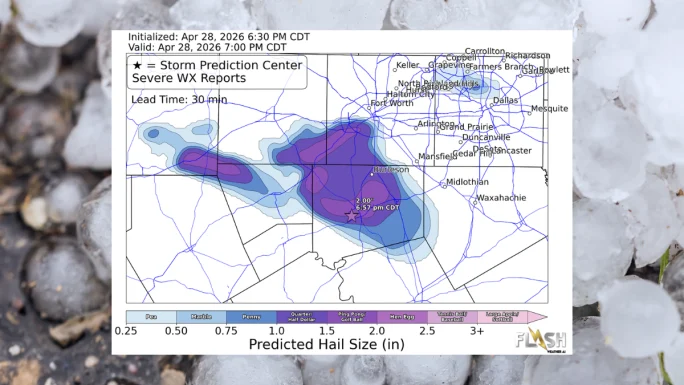
FLASH Weather AI forecasting data shows projected hail sizes across the Dallas-Fort Worth region, where large hail events are increasingly forcing fleets and contractors to make rapid operational decisions before storms hit.
Credit:
Work Truck | Flash Weather AI
Fleet Planning Is Becoming More Tactical
Downey said severe hail activity is also changing how contractors and fleet managers approach seasonal preparedness planning.
“For decades, the pre-season question was basically ‘is it a bad hail year, and which region do I worry about?’” said Downey. “You answered it in February and mostly forgot about it until next February.”
Instead, he said operators are now focused on highly localized, short-term forecasting that can determine whether equipment needs to be relocated or protected before storms arrive.
“The question is changing to ‘where exactly is hail going to fall in the next 55 minutes, and is it big enough to do something about,’” said Downey. “That's not a strategic question anymore, it's a tactical one.”
According to Downey, some operators are investing in covered staging yards, hail protection systems, and mutual-aid agreements with facilities outside projected storm paths to reduce fleet exposure during severe weather events.
“Operators are putting real dollars into covered staging yards, hail tarps on standby, and mutual-aid agreements with sister yards out of harm's way,” said Downey. “But those investments only pay off if the in-season warning is sharp enough to trigger the response.”
Cotality reported that damaging hail measuring two inches or greater impacted more than 600,000 single- and multifamily homes across the U.S. in 2025. Texas accounted for more than 235,000 impacted homes, while Wyoming, Oklahoma, Wisconsin, and Kansas also experienced significant activity.
The company also recorded 142 days of damaging hail across the U.S. last year, exceeding the 20-year average of 122 days.
“That’s the trend driving the conversation from ‘did we get unlucky this season’ to ‘what does our pre-season playbook need to look like,’” said Downey.
The report emphasized that resilience efforts are becoming increasingly important across the recovery ecosystem, including the use of impact-resistant materials, upgraded building standards, and faster deployment coordination among insurers, contractors, and restoration providers.
As severe weather activity intensifies, contractors and fleet operators may increasingly find themselves managing longer-duration response operations that require more specialized vehicles, mobile equipment, and rapid-deployment support capabilities.
More Disaster Response
When Disaster Response Goes Mobile
Drones and robotic systems can give emergency teams a view of a disaster before crews ever reach the scene. But the real challenge is keeping those machines, vehicles, operators, and command centers connected when traditional infrastructure may already be compromised.
Read More →
Experts Forecast Broader Impact of Wildfires in 2026
This year’s wildfire season will likely be more intense than in 2025. The 2026 wildfire forecast from AccuWeather is for fewer fires, but even more acreage will be impacted this year.
Read More →
Farmers Insurance Backs Red Cross Disaster Response Efforts With $250,000 Commitment
Farmers Insurance joined the Red Cross Disaster Responder Program to help support emergency response and recovery during disasters nationwide.
Read More →
After the Storm Clears: Why Cargo Risk Spikes During Disaster Recovery
When the storm ends, cargo theft risk can spike. Here’s why the restart phase is the danger zone and what fleets can do to stay ahead.
Read More →
Your Suppliers Are Part of Your Disaster Plan
Your suppliers can make or break disaster response. Here’s how fleets can reduce vendor risk and keep critical parts flowing when storms hit.
Read More →
When the Process Breaks (Why Fleet Workflows Collapse During Disaster Response)
When disaster hits, fleet workflows don’t collapse all at once. They unravel quietly. Here’s where breakdowns start and how to build resilience before it’s too late.
Read More →
How Federal Disaster Declarations Work and Why Fleet Leaders Need to Know
How federal disaster declarations work and why fleet leaders should care about funding, reimbursements, infrastructure repairs, and recovery timelines.
Read More →
Disaster Readiness Is Not a Fleet Count, It’s a Stress Test of the Whole System
Fleet readiness isn’t about your vehicle count. It’s about condition, capacity, and whether your system can actually perform under stress.
Read More →
Disaster-Proofing Fleet Operations: How to Maintain Uptime When Conditions Are Anything but Normal
When disaster strikes, fleet uptime depends on prep, mobile maintenance, clear visibility, and disciplined execution before, during, and after the event.
Read More →
Finding the Vital Strand: Equipment Repairs in Remote Locations
When a stranded excavator stalled a remote Alaska project, disciplined troubleshooting and teamwork uncovered the one connection that made it run again.
Read More →