




Ram Truck to Adopt SAE Towing Standard
Beginning with the 2015 model-year, Ram will adopt the Society of Automotive Engineers (SAE) J2807 standardized tow rating practices across all three full-size pickup truck segments, including the ½-ton Ram 1500, ¾-ton Ram 2500 Heavy Duty, and 1-ton “King of the Hill” Ram 3500 Heavy Duty,
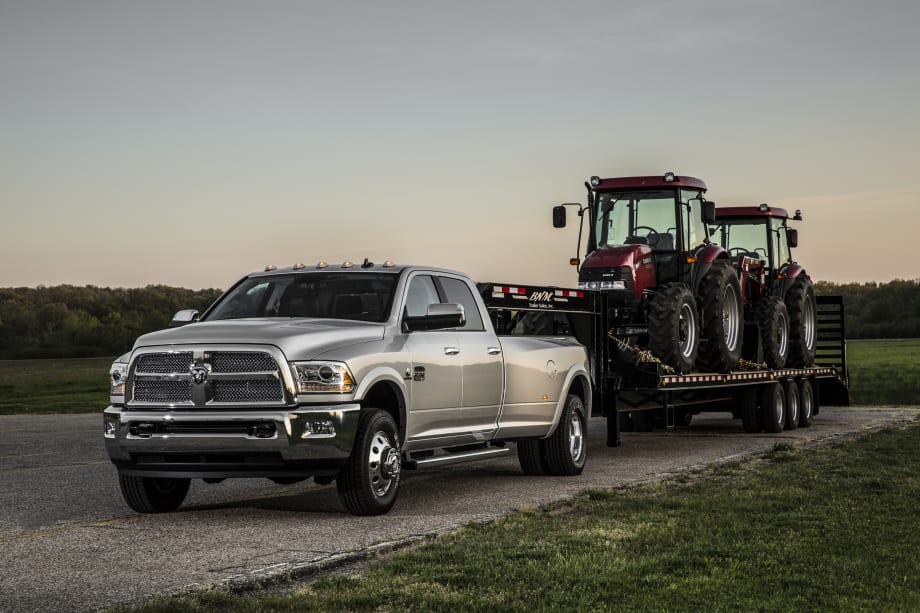
The SAE J2807 towing capacity for a 2015 Ram 3500 with 6.7L Cummins diesel is 30,000 pounds - 2013-MY vehicle pictured. (PHOTO: Chrysler)
The SAE J2807 towing capacity for a 2015 Ram 3500 with 6.7L Cummins diesel is 30,000 pounds - 2013-MY vehicle pictured. (PHOTO: Chrysler)
Beginning with the 2015 model-year, Ram will become the first automaker to adopt the Society of Automotive Engineers (SAE) J2807 standardized tow rating practices across all three full-size pickup truck segments, including the ½-ton Ram 1500, ¾-ton Ram 2500 Heavy Duty, and 1-ton “King of the Hill” Ram 3500 Heavy Duty, according to the automaker.
“Because our customers asked for it, every single 2015 model year pickup truck Ram sells will come with a trailer-tow rating achieved using SAE’s J2807 testing protocols,” said Reid Bigland, president and CEO – Ram Truck Brand. “No other automaker can make that claim.”
On the heels of finalized SAE towing specifications that now include trucks up to 14,000-pounds GVWR, Ram has validated its full pickup line with the SAE J2807 Towing Standard – the only truck maker to adopt the standard in all three pickup truck weight classes, according to Ram Truck.
“Ram Truck has been preparing for integration of the SAE towing standard over the past few years and adding heavier ¾ and 1-ton trucks to the criteria gives it more teeth,” said Mike Cairns, director- Ram Truck Engineering, Chrysler Group LLC. “For too long, an uneven playing field existed and towing capacities went unchecked. We’re happy to be the only pickup truck manufacturer to align with the SAE J2807 towing standard across our pickup truck lineup.”
The SAE J2807 towing standard outlines dynamic and performance criteria as it relates to a given vehicle. Examples within the standard include a number of tests while towing: 0-60 mph time allowance, tackling the notorious Davis Dam Grade while maintaining no less than 40 MPH for single-rear-wheel trucks and 35 mph for dual-rear-wheel trucks, a constant radius understeer test while increasing speed and a sway maneuver using aggressive steering input. The purpose is to put all trucks through the schedule of tests in which operators will likely see in the real world. SAE standards have existed in a number of other areas including engine torque and horsepower. Ram Truck is the first to adopt the official towing standard for ½-ton, ¾-ton, and 1-ton trucks.
2015 Ram SAE J2807 towing capacities:
Ram 1500 V-6 with 3.6L gasoline Pentastar – 7,600 pounds
Ram 1500 V-6 with 3.0L EcoDiesel – 9,200 pounds
Ram 1500 V-8 with 5.7L gasoline HEMI – 10,650 pounds
Ram 2500 V-8 with 6.4L gasoline HEMI – 16,300 pounds
Ram 2500 with 6.7L Cummins diesel – 17,970 pounds
Ram 3500 V-8 with 6.4L gasoline HEMI – 16,420 pounds
Ram 3500 with 6.7L Cummins diesel – 30,000 pounds
Check out a video below:
Originally posted on Automotive Fleet
More Operations

Family Ties Inside the Fleet Families Building Careers Across Generations
Three fleet families share what it really takes to work together, learn across generations, and keep business from following them home.
Read More →
Shades of Fleet Call for Voices: Fleet's Hidden Heroes
Fleet’s hidden heroes are often the ones keeping everything moving behind the scenes. September’s Shades of Fleet is looking for dispatchers, coordinators, parts specialists, and other support pros to share their stories.
Read More →
Truck Centers, Inc. Celebrates National Truck Driver Appreciation Week with $1,000 Fuel Card Giveaways
During National Truck Driver Appreciation Week, Truck Centers, Inc. is offering customers a chance to fuel up for free. Customers at all Truck Centers locations can enter to win one of four $1,000 fuel cards from Sept. 14 - 18.
Read More →
Fleet Guides, AI Time-Savers, Truck Tariffs & Fuel Strategy Lead the News
This week’s Truck Chat Cheat Sheet covers new fleet vehicle guides, practical AI use cases, U.S.-Canada truck production, mixed-energy strategy, and more.
Read More →
What Fleet Employers Are Missing When Hiring Veterans
What if some of the strongest candidates for fleet are already out there, but their experience is written in a language our industry does not always recognize?
Read More →
Automotive Fleet Opens 2026 Personal Use Survey for Commercial Fleet Managers
Less than two weeks left! Commercial and corporate fleet managers are invited to share how their organizations handle company vehicle personal-use policies, charges, and driver eligibility.
Read More →
What Resilient Fleets Do Differently When Conditions Change
Fleet resilience is about more than reacting to disruption. Lauren Fletcher talks with AP Fleet’s Alex Coveney about flexibility, planning, scaling, and what helps fleets adapt when business conditions shift.
Read More →
If We Want the Next Generation in Automotive, We Have to Give Them a Reason to Care
The automotive industry talks constantly about its workforce shortage. But before we can recruit the next generation, we may need to do a better job giving kids a reason to care about automotive in the first place.
Read More →
Ram ProMaster City Under $40K, Truck Tariffs, and AI Maintenance Lead the News
A sub-$40K commercial van, tariff questions, AI-powered maintenance, and a new EV production strategy headline this week’s Truck Chat Cheat Sheet.
Read More →
Bob Adamsky Shares the Fleet Lessons You Usually Learn the Hard Way
After more than 30 years in fleet, Arrow International’s Bob Adamsky has learned that the job is about far more than vehicles. He shares the lessons he wishes every fleet manager could learn a little earlier.
Read More →