July 2024 Diesel Prices See Small Drop in Most Regions
What's the story with diesel fuel prices in the U.S.? How do they compare to previous weeks? The average price of diesel fuel in the U.S. decreased in most regions again. What impact is that having on your fleet?
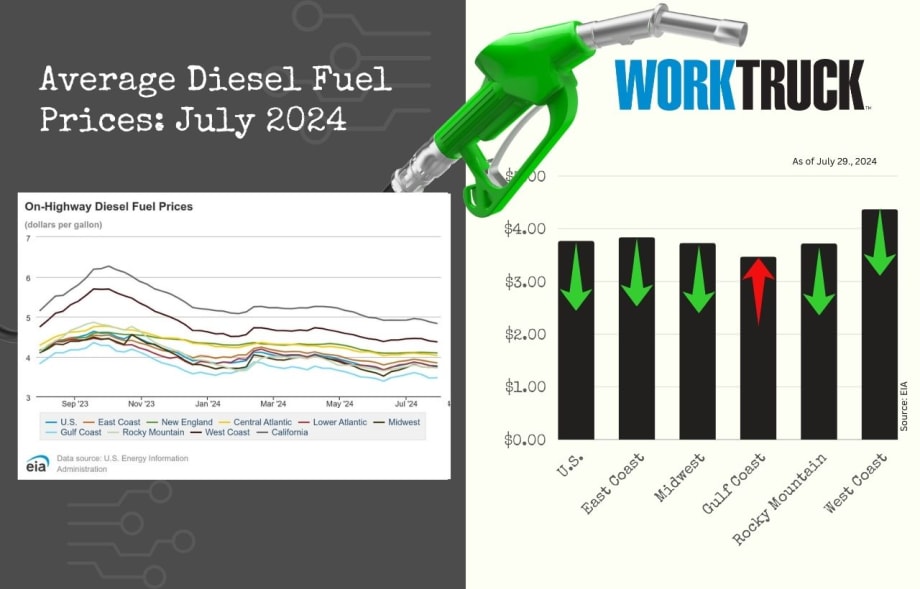
Average diesel prices in the U.S. decreased across nearly all regions of the U.S. as of July 29, 2024.
Photo: Work Truck | EIA
4 min to read
What's the story with diesel fuel prices in the U.S.? How do they compare to previous weeks? According to the most recent report by the U.S. Energy Information Administration (EIA), the average cost of diesel fuel for fleets has decreased for the second week in a row across all five regions of the country.
Ad Loading...
The average price of diesel fuel in the U.S. per gallon dipped slightly as of July 29, 2024. The national average price, $3.77, represents a decrease of less than 1 cent from last week and a decrease of 36 cents compared to the previous year. This third week of price declines follows several weeks of price increases.
Ad Loading...
Prices are still down drastically from April of this year.
Most regional prices decreased this week, ranging from just over half a cent to more than 4 cents per gallon, with the East Coast region seeing the largest decrease week over week. However, the Gulf Coast region saw nearly a 1-cent increase.
The most expensive place to buy diesel is Hawaii, at $5.43 per gallon. The least costly is still Oklahoma, at $3.35 per gallon.
U.S. Regional Diesel Prices: End of July
Heading into the final week of July 2024, the average diesel prices as of July 29, 2024, reported by region are:
East Coast: $3.84
Midwest: $3.73
Gulf Coast: $3.47
Rocky Mountain: $3.72
West Coast: $4.37
Ad Loading...
U.S. Regional Diesel Prices: 4th Week of July
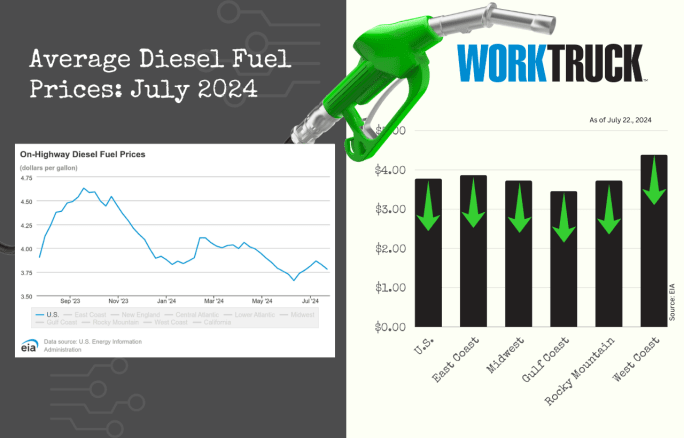
Average diesel prices in the U.S. decreased across all regions of the U.S. as of July 22, 2024.
Photo: Work Truck | EIA
As we hit the fourth and final full week of July 2024, the average diesel prices as of July 22, 2024, reported by region are:
East Coast: $3.91
Midwest: $3.74
Gulf Coast: $3.55
Rocky Mountain: $3.75
West Coast: $4.45
U.S. Regional Diesel Prices: 3rd Week of July
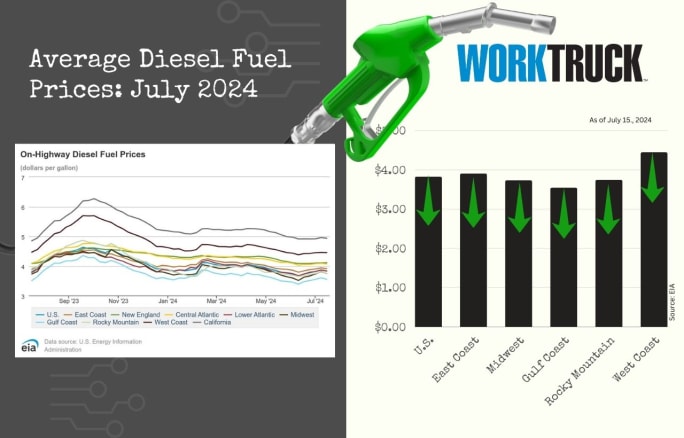
Average diesel prices in the U.S. decreased across all regions of the U.S. as of July 15, 2024.
Photo: Work Truck | EIA
As we head into the third week of July, the average diesel fuel prices as of July 15, 2024, reported by region are:
East Coast: $3.91
Midwest: $3.74
Gulf Coast: $3.55
Rocky Mountain: $3.75
West Coast: $4.45
U.S. Regional Diesel Prices: 2nd Week of July
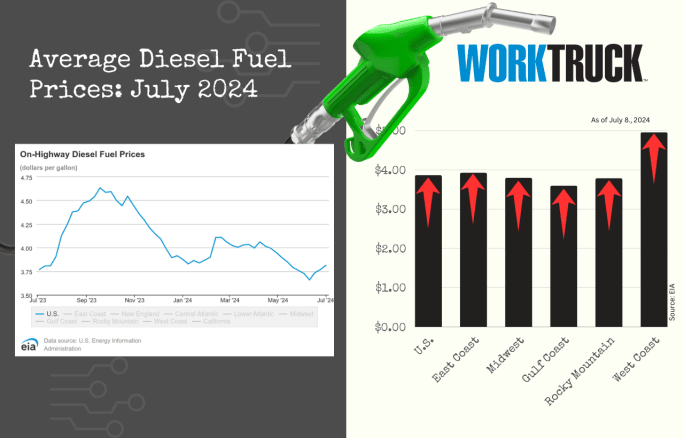
Average diesel prices in the U.S. rose for a fourth week in a row across all regions of the U.S. as of July 8, 2024.
Photo: Work Truck | EIA
As we head into the second week of July and the holiday weekend, the average diesel fuel prices as of July 8, 2024 reported by region are:
Ad Loading...
East Coast: $3.93
Midwest: $3.80
Gulf Coast: $3.60
Rocky Mountain: $3.79
West Coast: $4.96
U.S. Regional Fuel Prices: 1st Week of July
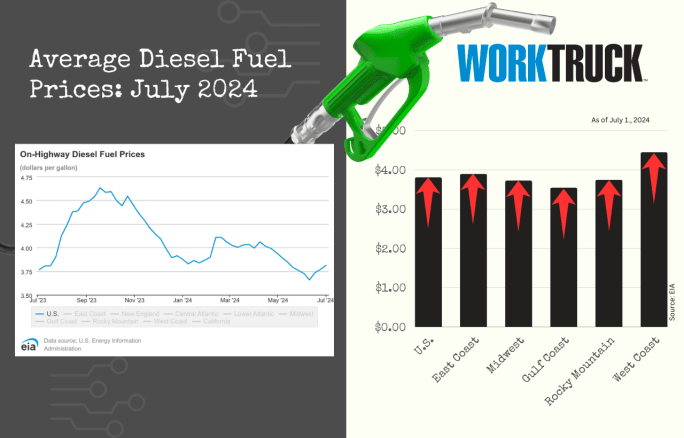
Average diesel prices in the U.S. rose across all regions once again as of July 1, 2024.
Photo: Work Truck | EIA
As we head into the first week of July and the holiday weekend, the average diesel fuel prices as of July 1, 2024 reported by region are:
East Coast: $3.90
Midwest: $3.73
Gulf Coast: $3.55
Rocky Mountain: $3.75
West Coast: $4.45
Gasoline Prices Start to Rise
National average gasoline prices stopped their steady decline starting out July 2024, settling at $3.50, according to the AAA.
Why the rise? According to AAA, the move came as the cost of oil crossed the $80 per barrel mark, putting upward pressure on pump prices. With oil costs accounting for about 54% of what you pay at the pump, more expensive oil usually leads to more expensive gas. This trend suggests the potential for further price increases, necessitating proactive planning and cost management strategies.
Ad Loading...
According to new data from the Energy Information Administration (EIA), gas demand fell 9.38 million b/d to 8.96 last week. This demand level is about 240,000 b/d below the same week of last year. Meanwhile, total domestic gasoline stocks rose from 231.2 to 233.9 million barrels.
“Summer got off to a slow start last week with low gas demand,” said Andrew Gross, AAA spokesperson. “But with a record 60 million travelers forecast to hit the road for the July 4th holiday, that number could pop over the next ten days. But will oil stay above $80 a barrel, or will it sag again? Stay tuned.”
Rising Fuel Taxes
According to the AAA, several states will adjust fuel taxes and fees starting on Monday, July 1st.
Indiana is increasing the tax on gasoline/gasohol by one cent to 35 cents per gallon.
Virginia increased the tax on gasoline, gasohol, and alternative fuels such as CNG and LNG by one cent to 30.8 cents per gallon.
Michigan will keep the current gas tax rate at 18.8 cents per gallon while reducing the tax on clear diesel fuel and kerosene from 21.3 cents per gallon to 20.4 cents per gallon.
Mixed-energy fleets aren’t about picking a winning fuel. Sarah Booth of WEX explains how vehicle data, duty cycles, charging strategy, and real-world costs can help fleets choose the right energy source for each job.
New research suggests neglected diesel aftertreatment systems could waste up to $30 in fuel per vehicle each day. Here's why vocational fleets should pay attention.
This week’s product launch with Standard Fleet’s connected vehicle platform reflects WEX Venture Capital's strategy of turning startup innovation into customer solutions. Standard Fleet is now available to WEX fleet customers.
The new Energy Hub combines fuel transactions, EV charging data, vehicle range, and energy costs in one dashboard for fleets operating multiple vehicle and energy types.
The DriverDash mobile payment app, by WEX, has been integrated into the CITGO merchant network, which means WEX has expanded its U.S. station footprint with the addition of approximately 4,000 CITGO locations.
Mixed energy fleets are becoming the new normal. Learn how fleet managers are balancing EVs, gas and diesel vehicles while controlling costs and planning for the future.
The national average price of a gallon of diesel has dropped again, this week by more than 16 cents. All five regions reported lower average prices, ranging from almost 13 cents to more than 28 cents cheaper than a week ago.
RoadFlex Direct connects fuel cards, controls, and data to the telematics and fleet management systems fleets already run, from Geotab and Samsara to Fleetio and RTA, with no separate dashboard or double data entry.