




Ford Lowers Noise Levels in F-650/F-750 Trucks
Ford's redesigned 2016 F-650 and F-750 trucks will offer a lower noise level than outgoing models mostly due to the redesigned turbo diesel engine, Ford announced on the eve of NTEA's Work Truck Show.

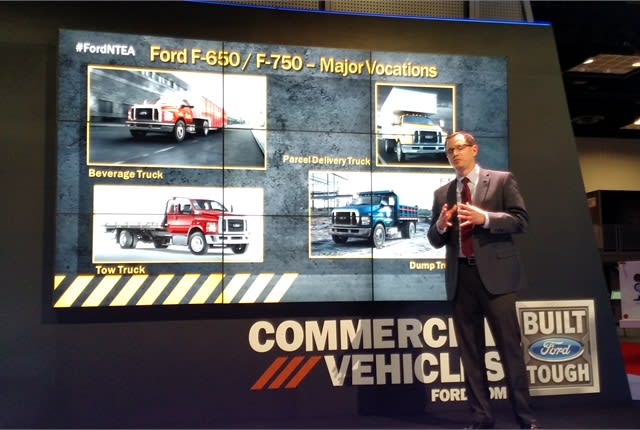
Ford's John Davis says upcoming F-650/750 will suit many applications, and powertrains were tested for heavy service.
Photo: Tom Berg
Ford's redesigned 2016 F-650 and F-750 trucks will offer a lower noise level than outgoing models mostly due to the redesigned turbo diesel engine, Ford announced on the eve of NTEA's Work Truck Show.
The 2016-MY medium-duty trucks are powered by a Ford 6.7L Power Stroke V-8 that's 25% quieter in the cabin, according to Ford. When idling, the engine is as much as 45% quieter in the cabin and 35% quieter in front of the grille.
"While the truck is able to work harder, we also made life inside the cab easier," said John Ruppert, general manager of Ford Commercial Vehicle Sales and Marketing. "Lowering in-cab and exterior noise levels improves driver comfort and minimizes disturbances while idling at work sites."

The 2016-MY medium-duty trucks are powered by a Ford 6.7L Power Stroke V-8 that's 25% quieter in the cabin.
Photo: Ford
When traveling at 60 mph, the level of engine noise in the cabin drops to 68 decibels from 74 decibels compared to the prior model, according to Ford. Idling levels have fallen to 48 decibels from 63 decibels.
(Decibels measure the intensity and power of sound. Each 10-unit increase represents a 10-fold increase in sound power perceived by the human ear, so a 10 decibel sound is 10 times more powerful than a zero decibel sound, and 20 decibels is 100 times stronger than zero decibels.)
Ford achieved the quieter cabin through engine engineering.
The PowerStroke V-8 is the only diesel to be used in the new Ford Class 6 and 7 models. The 6.8-liter gasoline V-10, which is convertible to propane and natural gas, will also be available in the F-650. They will be mated to a 6-speed TorqShift automatic that has been beefed up to take the engines’ output in comparatively heavy service.
Enhancements to the Power Stroke combustion system, structural integrity of the compacted graphite iron block and a single turbocharger mounted to the engine block account for many of the noise, vibration and harshness improvements over the previously offered diesel.
Fuel injectors were upgraded to optimize the combustion process, which features a two-stage combustion event instead of a single-injection event, further avoiding harsh, sudden and loud combustion, said John Davis, chief engineer.
A pilot fuel injection into cylinders begins the compression process before the main injection. The result is smoother fuel burning with less diesel clatter and a reduction of intrusive engine sound both inside and outside the truck.
At idle, two pilot injection events are used to make the firing process even smoother and to aid in quietness. The “ticking” of the high-speed injectors is masked by specially designed covers on the engine.
Mounting the engine’s turbocharger inside the engine block valley also brings improvements in overall noise, vibration and harshness.
“We used smart engineering and our unique Power Stroke engine architecture to create a powerful yet quiet diesel for our commercial customers,” Davis said. The powertrains have been tested to more than 50,000 pounds gross combination weight.
The trucks will be available this summer.
Originally posted on Automotive Fleet
More Operations

Family Ties Inside the Fleet Families Building Careers Across Generations
Three fleet families share what it really takes to work together, learn across generations, and keep business from following them home.
Read More →
Shades of Fleet Call for Voices: Fleet's Hidden Heroes
Fleet’s hidden heroes are often the ones keeping everything moving behind the scenes. September’s Shades of Fleet is looking for dispatchers, coordinators, parts specialists, and other support pros to share their stories.
Read More →
Truck Centers, Inc. Celebrates National Truck Driver Appreciation Week with $1,000 Fuel Card Giveaways
During National Truck Driver Appreciation Week, Truck Centers, Inc. is offering customers a chance to fuel up for free. Customers at all Truck Centers locations can enter to win one of four $1,000 fuel cards from Sept. 14 - 18.
Read More →
Fleet Guides, AI Time-Savers, Truck Tariffs & Fuel Strategy Lead the News
This week’s Truck Chat Cheat Sheet covers new fleet vehicle guides, practical AI use cases, U.S.-Canada truck production, mixed-energy strategy, and more.
Read More →
What Fleet Employers Are Missing When Hiring Veterans
What if some of the strongest candidates for fleet are already out there, but their experience is written in a language our industry does not always recognize?
Read More →
Automotive Fleet Opens 2026 Personal Use Survey for Commercial Fleet Managers
Less than two weeks left! Commercial and corporate fleet managers are invited to share how their organizations handle company vehicle personal-use policies, charges, and driver eligibility.
Read More →
What Resilient Fleets Do Differently When Conditions Change
Fleet resilience is about more than reacting to disruption. Lauren Fletcher talks with AP Fleet’s Alex Coveney about flexibility, planning, scaling, and what helps fleets adapt when business conditions shift.
Read More →
If We Want the Next Generation in Automotive, We Have to Give Them a Reason to Care
The automotive industry talks constantly about its workforce shortage. But before we can recruit the next generation, we may need to do a better job giving kids a reason to care about automotive in the first place.
Read More →
Ram ProMaster City Under $40K, Truck Tariffs, and AI Maintenance Lead the News
A sub-$40K commercial van, tariff questions, AI-powered maintenance, and a new EV production strategy headline this week’s Truck Chat Cheat Sheet.
Read More →
Bob Adamsky Shares the Fleet Lessons You Usually Learn the Hard Way
After more than 30 years in fleet, Arrow International’s Bob Adamsky has learned that the job is about far more than vehicles. He shares the lessons he wishes every fleet manager could learn a little earlier.
Read More →