




Cummins Receives EPA 2010 Certification for Heavy-Duty & Midrange Engines
COLUMBUS, IN - Cummins Inc. received certification from the Environmental Protection Agency (EPA) for its 2010 Heavy-Duty big-bore ISX15 and MidRange ISB6.7, ISC8.3 and ISL9 engines.
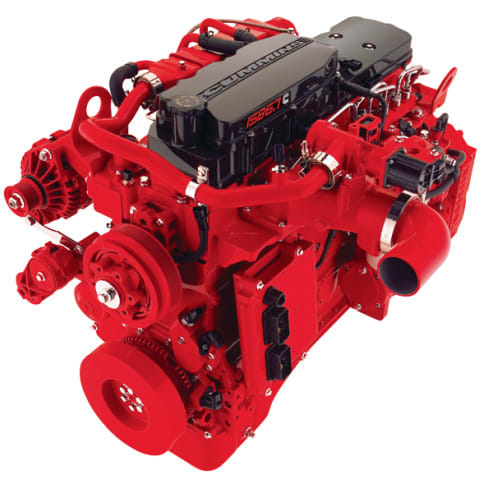
ISB 6.7L
COLUMBUS, IN - Cummins Inc. received certification from the Environmental Protection Agency (EPA) for its 2010 Heavy-Duty big-bore ISX15 and MidRange ISB6.7, ISC8.3 and ISL9 engines. Certification of these engines means that the Cummins 2010 engine lineup for on-highway applications meets the near zero emissions levels required for all engines manufactured in 2010.
The new EPA regulations, which took effect Jan. 1, 2010, are the most stringent emissions regulations in the world, with Oxides of Nitrogen (NOx) and Particulate Matter (PM) emissions levels of 0.2 grams and 0.01 grams per brake-horsepower-hour, respectively.
"Receiving the formal certificates is an important step in the process as we enter 2010 with customer-ready products," said Jim Kelly, President, Engine Business. "This confirms that customers can be confident in the technology choice we've made to meet the new, more stringent emissions standards."
Cummins will utilize Selective Catalytic Reduction (SCR) technology to meet the EPA 2010 near-zero emissions standards. Cummins committed to using SCR technology because of a step change in performance which provides a significant increase in efficiency and durability. "Our decision to use SCR technology has given us the ability to provide customers with the most fuel efficient engines for on-highway applications. We expect to see at least 5 percent fuel economy improvement for the ISX15 and up to 3 percent improvement for the MidRange products," Kelly said.
Cummins EPA 2010 engines will include an enhanced cooled EGR system and a single VGT (TM) Turbocharger. The ISX15, ISL9, and ISC8.3 feature the Cummins XPI fuel system, and the ISB6.7 features an improved High Pressure Common Rail (HPCR)fuel system. The new SCR catalyst is included along with the Cummins Particulate Filter, first introduced in 2007, in the Cummins Aftertreatment System. Incorporating SCR technology will also require the use of Diesel Exhaust Fluid (DEF) at an average rate of 2 percent of diesel fuel consumption. DEF is currently available at numerous retail locations throughout the United States and Canada including all Cummins distributor locations.
With the introduction of the new EPA 2010 engines, Cummins maintains engine availability across a broad range of on-highway applications. The Heavy-Duty ISX15 offers fuel economy leadership for the heavy-duty Class 8 truck market along with better performance and better reliability compared to today's industry-leading ISX. And, the MidRange ISB6.7, ISC8.3, and the ISL9 are designed for and available in a wide variety of applications, including the medium-duty truck, school bus, fire and emergency and recreational vehicle markets.
To best serve customers in the vocational and less-than-truckload markets, the Cummins ISX11.9 will be introduced later in 2010. The ISX11.9 is on target for limited production in mid-2010 with full production commencing in late summer of 2010. Cummins will submit necessary documentation for EPA 2010 certification for the ISX11.9 later this year, prior to introduction to the marketplace.
More Operations

Family Ties Inside the Fleet Families Building Careers Across Generations
Three fleet families share what it really takes to work together, learn across generations, and keep business from following them home.
Read More →
Shades of Fleet Call for Voices: Fleet's Hidden Heroes
Fleet’s hidden heroes are often the ones keeping everything moving behind the scenes. September’s Shades of Fleet is looking for dispatchers, coordinators, parts specialists, and other support pros to share their stories.
Read More →
Truck Centers, Inc. Celebrates National Truck Driver Appreciation Week with $1,000 Fuel Card Giveaways
During National Truck Driver Appreciation Week, Truck Centers, Inc. is offering customers a chance to fuel up for free. Customers at all Truck Centers locations can enter to win one of four $1,000 fuel cards from Sept. 14 - 18.
Read More →
Fleet Guides, AI Time-Savers, Truck Tariffs & Fuel Strategy Lead the News
This week’s Truck Chat Cheat Sheet covers new fleet vehicle guides, practical AI use cases, U.S.-Canada truck production, mixed-energy strategy, and more.
Read More →
What Fleet Employers Are Missing When Hiring Veterans
What if some of the strongest candidates for fleet are already out there, but their experience is written in a language our industry does not always recognize?
Read More →
Automotive Fleet Opens 2026 Personal Use Survey for Commercial Fleet Managers
Less than two weeks left! Commercial and corporate fleet managers are invited to share how their organizations handle company vehicle personal-use policies, charges, and driver eligibility.
Read More →
What Resilient Fleets Do Differently When Conditions Change
Fleet resilience is about more than reacting to disruption. Lauren Fletcher talks with AP Fleet’s Alex Coveney about flexibility, planning, scaling, and what helps fleets adapt when business conditions shift.
Read More →
If We Want the Next Generation in Automotive, We Have to Give Them a Reason to Care
The automotive industry talks constantly about its workforce shortage. But before we can recruit the next generation, we may need to do a better job giving kids a reason to care about automotive in the first place.
Read More →
Ram ProMaster City Under $40K, Truck Tariffs, and AI Maintenance Lead the News
A sub-$40K commercial van, tariff questions, AI-powered maintenance, and a new EV production strategy headline this week’s Truck Chat Cheat Sheet.
Read More →
Bob Adamsky Shares the Fleet Lessons You Usually Learn the Hard Way
After more than 30 years in fleet, Arrow International’s Bob Adamsky has learned that the job is about far more than vehicles. He shares the lessons he wishes every fleet manager could learn a little earlier.
Read More →