





Fueling Pros & Cons: Diesel vs. Gas in Class 3-4 Trucks
Truck Fuel Pros & Cons: Biodiesel vs. Diesel
What is biodiesel fuel? Produced from vegetable oils, the clean-burning biodiesel can be used in conventional engines with few, if any, modifications and is distributed through existing infrastructures.
May 1, 2006
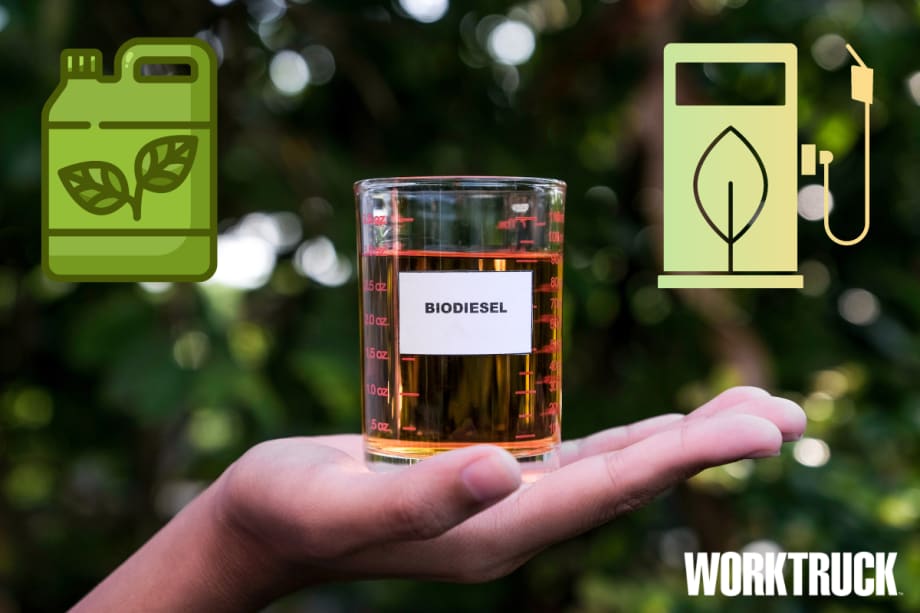
Biodiesel fuel is a clean-burning alternative renewable fuel produced from vegetable oils (such as soybean oils) and yellow grease (recycled cooking oil from restaurants.)
Photo: Work Truck
7 min to read
In March 2005, Eastman Chemical Company, based in Kingsport, Tenn., began using B-5 (a blend of 5% biodiesel with 95% petroleum diesel) in its entire diesel fleet of 200 vehicles and heavy equipment.
Within two months, they increased to 20% biodiesel (B-20), and now operate on as much as 30% biodiesel (B-30) in their tractor-trailers, medium-duty trucks, dump trucks, cranes, bulldozers, and backhoes.
What feedback has Eastman Chemical received from its drivers and equipment operators?
“Positive,” said Darren Curtis, fleet administrator for 15 years with Eastman Chemical.
“The switch has been transparent in terms of performance. The biggest thing they noticed was the decreased odor and smoke. The exhaust smells more like French fries cooking instead of the normal diesel fumes,” he said.
But, what is biodiesel fuel? Biodiesel is a clean-burning alternative renewable fuel produced from vegetable oils (such as soybean oils) and yellow grease (recycled cooking oil from restaurants.) Proponents place their hope in biodiesel as a means to wean the United States from foreign oil and to promote a cleaner environment.
Biodiesel fuels requires a relatively low initial investment because it operates in conventional diesel engines with few, if any, modifications and is distributed using today’s infrastructure.
Why did Eastman make the switch to biodiesel?
"Why delay a good thing?” recalled Curtis. “It was an opportunity to do something beneficial for the community and the environment at the same time. We researched biodiesel thoroughly before making the move, getting everyone from senior management to equipment operators in the decision process. We thought to ourselves, ‘What’s really the risk here? If we find we don’t like it, we can always go back (to petroleum diesel).’ ”
Biodiesel Trucks Fuel Market Expands
Eastman Chemical is in good company. More than 600 fleets operate with biodiesel fuel in some form, including all four branches of the United States armed forces, the U.S. Postal Service, several public transit systems, municipalities, and private fleets, including LL Bean and Sysco Transportation.
According to the National Biodiesel Board (NBB), a leading industry trade association, the biodiesel market has grown from producing 500,000 gallons in 1999 to nearly 75 million gallons in 2005. This is still a very small percentage of the total diesel market of approximately 60 billion gallons.
However, Robert McCormick, principal engineer at the National Renewable Energy Laboratory (NREL), in Golden, Colo., projects the biodiesel market has the potential to produce one billion gallons within the next five years. “Longer term, the focus on crops specifically for biodiesel fuels and advancements in agricultural industry practices may allow for production of up to 10 billion gallons annually by 2030.”
What’s driving the market for biodiesel? The following are three significant growth drivers, among others.
EPAct Amendment. The Energy Policy Act (EPAct) was amended by the Energy Conservation Reauthorization Act of 1998 to include biodiesel fuel use as a way for federal, state, and public utility fleets to meet alternative fuel requirements. Covered fleets can earn one EPAct credit for every 450 gallons of B-100 purchased for use in blends of 20% or higher in vehicles in excess of 8,500 lbs. gross vehicle weight rating (GVWR). Considering that most existing diesel equipment and distribution systems are compatible with biodiesel blends, biodiesel is a cost-effective means to earning EPAct credits.
Tax Incentives. A federal tax credit for biodiesel was included as part of the American Jobs Creation Act of 2004. This tax credit equates to a one-penny per percent of biodiesel in a fuel blend made from agricultural products (such as vegetable oils like soybean oil) and 1/2-penny per percent of recycled oils (such as used cooking oils from restaurants). This incentive is taken by the petroleum distributors and passed on to the end users. There are more than 1,500 fuel distributors carrying biodiesel, and more than 600 retail pumps selling it. “The federal biodiesel tax incentive is helping build up the industry infrastructure, which leads to easier, more cost-effective access.” In July 2005, the U.S. Congress extended the biodiesel tax incentive, set to expire this year, to 2008," says Amber Pearson, National Biodiesel Board spokes woman.
Federal and State Laws. In September 2005, Minnesota became the first state to mandate that the state’s entire diesel fuel supply contains 2-percent biodiesel (B-2). The National Biodiesel Board projects that several other states will follow suit.
Pros and Cons of Diesel vs. Biodiesel Fuel
As its use expands in the marketplace, how does biodiesel really compare to regular petroleum diesel? What are the pros and cons? Here are four considerations to evaluate the potential impact on fleet.
1. Biodiesel Fuel Cost Comparison
The National Biodiesel Board suggests a general rule of thumb when comparing cost of biodiesel: Add one cent per gallon for each percent of biodiesel blended with petrodiesel. For example, B-5 would be approximately five cents more per gallon than petrodiesel. B-20 would be 20 cents more, and so forth.
Another guide is the Department of Energy’s “Clean Cities Alternative Fuel Price Report,” available at www.eere. energy.gov/afdc. According to the September 2005 issue, biodiesel prices for low-level blends (B-2 to B-5) are about the same as regular diesel, $2.81 per gallon biodiesel versus $2.81 regular diesel. B-20 blends are about 10 cents more at $2.91. Pure biodiesel (B-100) costs about 59 cents more per gallon at $3.40 than regular diesel.
2. Impact on Pollution
According to the “Clean Alternative Fuels: Biodiesel,” produced by the United States Environmental Protection Agency (EPA), here’s how biodiesel impacts emissions compared to regular diesel.
Reductions in carbon monoxide emissions of 10% (B-20) and 50% (B-50).
Reductions in particulate emissions of 15% (B-20) and 70% (B-100).
Reductions in total hydrocarbon emissions of 10% (B-20) and 40% (B-100).
Reductions in sulfate emissions of 20% (B-20) and 100% (B-100).
Increases in nitrogen oxide emissions of 2% (B-20) and 9% (B-100).
The increase in nitrogen oxide (NOx) emissions is a concern because NOx is a significant contributor to ozone. To counteract and reduce NOx emissions in biodiesel, fuel suppliers for fleets like Eastman Chemical blend appropriate additives with the fuel. For example, research sponsored by the NREL found that by adding cetane enhancers, such as di-tert-butyl peroxide at 1% or 2-ethylhexl nitrate at 5%, can reduce NOx emissions. The study also says that NOx can be reduced by blending biodiesel with kerosene or Fischer-Tropsch diesel.
“For fleets interested in reducing petroleum usage and greenhouse gas emissions along with regulated pollutants, biodiesel is a better option,” says McCormick of the NREL.
3. Biodiesel Fuel Quality
“The one downside we experienced in our transition to biodiesel was the fuel quality issue we had with our original supplier,” says Curtis with Eastman Chemical. Biodiesel that does not meet strict quality standards can diminish engine performance, clog filters and injectors, and cause numerous other costly repairs.
Eastman Chemical switched suppliers within the first few months of their biodiesel program and has since not encountered fuel issues. Curtis strongly urges fleet managers, who are considering operating biodiesel, to make sure their fuel supplier adheres strictly to the guidelines of ASTM D6751. ASTM refers to the American Society of Testing and Materials International, one of several world standard-setting organizations that has adopted approved specifications for biodiesel.
ASTM D6751 is the most common standard referenced in the United States. This standard is designed to protect consumers from poor products, reduce the cost of buying and selling biodiesel, and streamline the procurement process.
“The benefits can only be realized if high-quality biodiesel meeting the specifications of ASTM D6751 is used for blending,” McCormick cautions. “Out-of-specification biodiesel can cause engine operating problems and increased emissions.”
4. Performance
What is biodiesel’s impact on engine performance versus regular diesel? According to the Engine Manufacturers Association (EMA), the net impact of using pure biodiesel is a loss of 5-7% in maximum power output. That is with 100% biodiesel. As long as fuel quality meets ASTM standards, lower ratio blends, such as B-2, B-5, or even B-20, seem to have little, if any impact on perceived performance. One performance concern is due to biodiesel’s higher lubricity. On one hand, high lubricity helps prevent premature fuel system wear and tear.
However, when first transitioning from existing diesel systems to biodiesel, the higher lubricity could cause problems. For example, it can act as a solvent to some fuel system components and concrete-lined tanks, releasing deposits accumulated on tank walls and pipes from diesel fuel storage, initially causing fuel filter clogs. The EPA recommends vehicle owners change fuel filters, especially after the first tank of fuel.
Another concern is cold weather performance.
“The performance of biodiesel in cold conditions is markedly worse than that of petroleum diesel,” says Anthony Radich, with the Department of Energy, in his analysis paper “Biodiesel Performance, Costs, and Use.”
He says that the temperature at which wax crystals can form and potentially clog fuel lines and filters in a vehicle fuel system is higher than that for petroleum diesel.
The Bottom Line
Once considered a fringe fuel, biodiesel production has grown 150-fold over the past six years, and federal and state governments are incentivizing its continued growth.
As a result, work trucks and equipment operated with diesel at some point will encounter biodiesel - whether in pure form, more commonly in blends (B-5 and B-20), or even in smaller blends (such as B-2) as a fuel additive to improve engine performance and longevity.
Subscribe to Our Newsletter
More Green Fleet

Fleet Forward Conference Introduces One-Day Passes for 2026
New one-day registration gives fleet professionals the flexibility to attend Tuesday, Wednesday, or Thursday, with passes available for $199 through Sept. 18.
Read More →
CALSTART Rebrands as Catalyst Mobility, Will Combine with Forth in 2027
CALSTART has rebranded as Catalyst Mobility and will combine with Forth at the start of 2027. The new organization said it is poised to become one of the world's largest, strongest, and most impactful clean transportation nonprofits.
Read More →
Electric Truck and Charging Programs to Boost Sustainability at NY & NJ Ports
Together, the Port Authority of New York and New Jersey and CALSTART will electrify drayage and terminal operations serving the East Coast’s busiest container port. A pair of incentive programs totaling $45 million has launched to accelerate adoption of zero-emission drayage trucks and terminal tractors.
Read More →
Xos Hub Surpasses One Gigawatt-Hour of Energy Delivered in the Field
A single Xos Hub has surpassed one gigawatt-hour of energy across more than 33,600 charging sessions in the field, demonstrating performance that supports Xos' expansion across new products and markets.
Read More →
Carrier Transicold Launches All-Electric Vector 8200 TRU for Diesel-Free On-Site Cold Storage
Carrier Transicold’s first engineless multi-temperature TRU helps fresh- and frozen-food fleets add supplemental cold storage capacity during seasonal peaks.
Read More →
Narro Trucks Introduces Electric Utility Vehicle
Narro Trucks officially launched its operations on Aug. 20 and hosted a ride and drive to showcase its electric truck, which will be produced in Virginia.
Read More →
Samsung SDI Takes Full Control of GM Battery JV as Indiana Plant Pivots to Energy Storage
Samsung SDI is taking full control of its Indiana battery plant with GM, marking a major shift from the EV-focused joint venture Charged Fleet first covered in 2023.
Read More →
NWSA Taps CALSTART to Administer Zero-Emission Drayage Assistance Program
CALSTART will provide free technical assistance services to drayage fleets serving the Ports of Seattle and Tacoma and looking to transition to cleaner technologies and help decarbonize freight hubs.
Read More →
EV Fleet Reality Check: What Operators Wish They Knew Before Electrifying Their Work Vans
Electric work truck upfits bring new compatibility questions. Learn how parts availability, OEM guidance, power demands, and route planning can affect fleet performance.
Read More →
Peterbilt Expands Sourcewell Partnership with Electric Vehicle Lineup
Peterbilt Motors Company’s cooperative purchasing agreement with Sourcewell and its Canadian partner, Canoe Procurement Group, now includes including Peterbilt's battery-electric vehicle lineup.
Read More →