




About the Authors: Rick D. Longobart is Fleet Operations Manager for the City of Raleigh and a principal of Longobart-Ross Consulting Inc., with more than 40 years of fleet industry experience spanning public-sector fleet management, equipment replacement, lifecycle cost analysis, budgeting, and operational improvement. Cynthia Ross is President and Principal of Longobart-Ross Consulting Inc. and the company’s Project Manager, bringing expertise in strategic planning, equipment replacement software, cost management, and developing practical strategies that help fleets improve efficiency and achieve operational goals.
The Hidden Cost of Idling
A low-mileage truck can still be one of the fleet’s hardest-working and most worn assets. Engine hours, idle time, and duty cycle reveal what the odometer misses.
by Cynthia Ross and Rick Longobart | Longobart-Ross Consulting
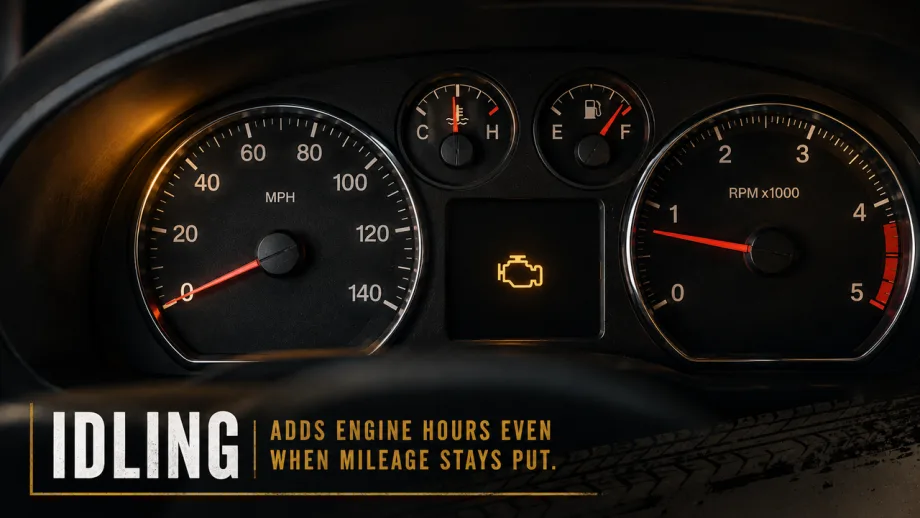
A vehicle can accumulate engine hours and wear even when the odometer is not moving. For idle-heavy vehicles, engine hours can reveal use that mileage alone does not capture.
Credit:
Work Truck
10 min to read
- A low-mileage truck can be heavily used and worn, despite what the odometer indicates.
- Engine hours and idle time are crucial metrics for understanding a vehicle's usage and wear.
- Duty cycle analysis provides deeper insights into a vehicle's operational demands and efficiency.
*Summarized by AI
Editor’s note: This is Part 1 of a two-part series examining how fleets can look beyond mileage when evaluating vehicle condition and replacement timing. Part 2 explores the data fleets should track and how to build a more complete replacement model.
Two of the same class vehicles can enter service on the same day and look very different five years later. One may have 120,000 mostly highway miles and a relatively clean maintenance history. The other may show only 75,000 miles but spend much of its working day idling, powering equipment, making short trips, or moving through stop-and-go routes.
On paper, the lower-mileage truck looks like the healthier asset. In the shop, it may be the one generating repeat repairs, after-treatment problems, higher fuel costs, and unplanned downtime.
That is the problem with relying too heavily on mileage. The meter shows how far a vehicle has traveled or been used. It doesn't show how long the engine has been running, how often the vehicle idles, how much time it spends supporting a PTO, how much time it spends as a mobile office, or how demanding its route has been.
Meter readings still matter. They just don't always tell the whole story on their own.
The Odometer or Hour Meter Blind Spot
Mileage became a standard replacement benchmark for good reason. It is easy to track, easy to explain, and useful for vehicles operating under predictable conditions. For a highway unit, the relationship between distance and wear is relatively straightforward. As the miles add up, so does use of the tires, brakes, suspension, driveline, and other components.
That relationship becomes less reliable when a vehicle performs much of its work while standing still. Consider a utility truck parked roadside while its engine powers hydraulic equipment, auxiliary equipment, or lighting. The odometer does not move, but the engine, cooling system, electrical system, and exhaust aftertreatment equipment keep working.
A refrigerated vehicle may sit in place while maintaining cargo temperature. A service truck may run a compressor or generator through its PTO. An ambulance may be idle to support lighting, communications, HVAC, and medical equipment.
An urban delivery vehicle presents another version of the problem. It may accumulate modest mileage or hour meter while making frequent stops, running short routes, and cycling through repeated starts, braking events, and temperature changes. This can happen even when the vehicle is not performing its intended tasks.
In all of these cases, the vehicle is working harder than the odometer suggests. That can lead fleets into two different mistakes. They may replace highway vehicles too early because those units accumulate miles quickly, while keeping lower-mileage vocational vehicles long after rising maintenance and downtime indicate they should be reviewed.
The odometer is not wrong. It simply has a blind spot.
Idling Costs More Than Fuel
When fleet managers talk about idling, fuel is usually the first expense that comes to mind. A vehicle that runs while parked consumes fuel without covering any ground. Fuel is also the easiest cost to see. The less obvious effects tend to appear later through maintenance, component failures, and downtime.
Extended idling can affect engine oil, emissions systems, batteries, alternators, cooling systems, HVAC equipment, and other accessories. Because those costs are spread across different parts of the maintenance operation, they are not always traced back to idle time.
No single afternoon of idling destroys a truck. The cost builds over months and years of operation.
Engine Wear Without Odometer Miles
An idling engine is still operating. Internal components continue moving, oil circulates, and the cooling, fuel, electrical, and exhaust systems remain active. The amount and type of wear depend on the application. An engine supporting a heavy PTO load is doing different work than one left running to maintain cab temperature. Neither situation is fully reflected in mileage.
Some fleets use formulas that convert engine hours into an estimated mileage equivalent. Those formulas may provide a starting point, but they should not be treated as universal. The effect of an engine hour varies by engine, load, temperature, and duty cycle. OEM guidance and the fleet’s own maintenance history should carry more weight than a general industry conversion.
The practical takeaway is simpler: when the engine is running, the vehicle is accumulating use, even if the odometer is not moving.
Diesel Aftertreatment Problems
Idle-heavy duty cycles can be particularly challenging for modern diesel vehicles. Diesel particulate filters collect soot and periodically burn it off through regeneration. That process generally requires sufficient exhaust temperature for a sustained period.
Vehicles that spend long stretches idling, traveling short routes, or operating at low speeds may struggle to complete regeneration cycles. Soot continues to accumulate, leading to warning lights, forced regenerations, derates, clogged filters, and potentially premature component replacement.
Those repairs can cost thousands of dollars and take the vehicle out of service. Yet a mileage-based replacement policy may provide little warning that the problem is developing. A truck can have relatively low mileage and still have a long history of interrupted regeneration and aftertreatment-related repairs because of how it has been used.
Oil Degradation and Contamination
Oil change intervals are another area where mileage can fall short. Idle-heavy operation, short trips, and cold-weather use may prevent an engine from consistently reaching and maintaining proper operating temperatures. Moisture or fuel dilution can build in the oil, reducing its ability to protect internal components.
A vehicle following a meter reading only oil change interval may spend more time operating on degraded lubricant than the fleet realizes. Many severe-duty maintenance schedules already account for engine hours, time, operating conditions, or application. Fleets with high idle percentages should review whether their service intervals reflect the work their vehicles are actually doing.
Oil analysis can also help. It gives the fleet a clearer look at fuel dilution, contamination, viscosity, and signs of abnormal wear instead of relying on the odometer alone.
Wear Beyond the Engine
The effects of idling do not stop at the engine block. Accessory loads place additional demand on batteries and alternators. HVAC systems may operate continuously. Cooling systems continue cycling. Fuel injectors and exhaust components remain exposed to prolonged low-load operation.
These issues may show up as more frequent maintenance, shorter component life, additional technician workload, and more days out of service. Individually, each repair may look routine. Viewed together, they can reveal a vehicle that is aging faster than its mileage suggests.
Warranty Voided by Excessive Idle Times
Excessive engine idling causes severe wear on powertrain components and accelerates oil breakdown, which can lead to major mechanical damage like engine sludging. To account for this hidden operational wear, vehicle manufacturers evaluate total engine run hours alongside odometer readings and often enforce explicit engine-hour limits on powertrain warranty coverage.
When a vehicle accumulates high idle time and is maintained using standard distance intervals rather than hour-based severe-duty schedules, dealerships can deny warranty claims on the grounds of exceeded parameters or inadequate preventative maintenance.
When Miles Matter and When Hours Matter More
The choice is not between mileage and engine hours. Fleets need to understand which measure best represents the work being performed. Mileage remains a practical primary metric for vehicles that spend most of their time traveling at sustained speeds. Over-the-road trucks, highway service vehicles, and intercity units generally have a more consistent relationship between distance and wear.
Engine hours have become more important for vehicles that spend substantial time idling, working at low speeds, or powering equipment while stationary. Utility trucks, construction vehicles, refuse haulers, emergency vehicles, service trucks, and urban delivery units often fall into this category. A line truck may travel only a few miles to a job site and then spend most of the day powering equipment. A refuse truck may cover a limited distance while completing hundreds of stops. An ambulance may sit in place for hours while its systems remain fully active.
Judging those vehicles primarily by mileage ignores a large part of their working lives. The construction equipment industry has long used operating hours to schedule maintenance and evaluate equipment life because machinery often performs its hardest work without going anywhere. Vocational fleets can apply the same thinking to vehicles whose job involves more than transportation.
Why Do Identical Vehicles Age Differently?
Fleet managers see this all the time. Two vehicles with the same year, make, model, and mileage can have completely different maintenance histories. One has been dependable. The other seems to return to the shop every few weeks. The difference often comes down to the route, application, operator, and environment.
1. Route and Application
A highway truck may accumulate miles quickly, but it generally operates at sustained temperatures and under relatively steady loads. An urban or vocational vehicle may cover fewer miles but experience repeated starts, stops, braking events, short trips, and thermal cycling.
And application matters just as much. Two identical pickups may perform very different work. One may be assigned to a supervisor who drives between locations. The other may carry tools, tow equipment, operate in dusty conditions, or power auxiliary equipment for hours at a time.
Grouping those vehicles together simply because they share the same specifications can hide major differences in wear. Replacement planning should reflect duty cycle, not just vehicle type.
2. Driver Behavior
Drivers also affect how quickly a vehicle ages. Aggressive acceleration, hard braking, unnecessary idling, and other operating habits can increase fuel use and component wear. Telematics can help identify those patterns and create opportunities for coaching.
The data needs context, however. High idle time is not always a driver problem. The job may require the vehicle to remain running for safety, HVAC, refrigeration, lighting, hydraulic equipment, or other onboard systems. In those cases, coaching alone will not solve the issue.
The fleet may need to consider auxiliary power, anti-idling technology, equipment changes, or revised operating procedures. The goal is to separate necessary idle time from avoidable idle time and address the causes the fleet can realistically control.

Driver behavior can affect fuel use and vehicle wear, but high idle time needs context. Routes, equipment, weather, safety requirements, and operating procedures can all influence how long a vehicle remains running.
Credit:
Work Truck | This image was edited with OpenAI. Please refer to our terms of use.
3. Climate and Operating Environment
A vehicle working through winter in a road-salt region faces different conditions than the same model operating in a dry climate.
Cold starts, warm-up time, battery stress, heat, corrosion, dust, and prolonged HVAC use all affect vehicle condition. None of those factors appear in the mileage total. A truck with 90,000 miles in one region may have a very different remaining useful life than a similar truck with 90,000 miles somewhere else.
A fixed replacement threshold treats them as though their service histories are identical.
Recognizing the High-Cost Stage
Vehicles rarely go from reliable to unmanageable overnight. The warning signs usually appear in maintenance history first. A vehicle may require one expensive repair and then return to dependable service. Another may develop a steady stream of smaller problems, repeat diagnostic visits, and growing downtime.
The second vehicle can be more disruptive even when no individual invoice looks especially alarming. Fleet managers should pay attention when maintenance costs continue rising over several reporting periods, the same systems require repeated repairs, fault activity increases, or operators begin losing confidence in the unit.
High idle time combined with aftertreatment, electrical, or cooling-system problems deserves particular attention.
This is where a mileage/hours only replacement plan often falls behind. By the time the vehicle reaches the approved mileage threshold, the fleet may already have spent heavily to keep it working.
Engine hours, idle history, maintenance trends, and downtime can help identify that high-cost stage sooner. That gives the fleet more time to budget, place an order, and replace the vehicle before a major failure forces the decision.
Look Beyond the Odometer
Meter readings remain one of the most accessible and useful measures in fleet management. It should not be discarded. But many fleet vehicles do not spend their entire working lives traveling from one location to another.
They idle. They power equipment. They support accessories. They work through short routes, extreme temperatures, and stop-and-go conditions that the odometer cannot fully capture.
The first step is to identify the vehicles whose work is least accurately represented by mileage. Compare those units using engine hours, idle time, maintenance history, and downtime. Vehicles whose condition doesn't match their odometer readings are most likely to reveal the hidden cost of idling.

Credit:
Work Truck | Longobart-Ross Consulting Inc.
Quick Answers
A low-mileage truck can still be heavily used because factors like engine hours, idle time, and duty cycle contribute to wear and tear beyond what the odometer reflects.
*Summarized by AI
Subscribe to Our Newsletter
More Remarketing & Lifecycle
Building a Better Vehicle Replacement Model
Meter readings still matter, but engine hours, idle time, maintenance trends, and utilization can help fleets spot costly vehicles before the odometer does.
Read More →
AP Fleet Management Expands Remarketing Program for Commercial Work Trucks
AP Fleet Management expanded its commercial vehicle remarketing program with dedicated resale services and an online marketplace for used work trucks.
Read More →
What Actually Makes a Truck Reliable for Fleets?
What makes a truck reliable for fleets? From uptime to maintenance and spec’ing, here’s what really drives performance, and where fleets can weigh in.
Read More →

REP Inspection Services Launches, Delivering Professional Equipment Inspections
REP Inspection Services, led by someone with more than 30 years of industry experience, has launched its professional inspection services for trucks, trailers, and equipment across the commercial vehicle industry.
Read More →
Introducing Work Truck’s 2025 Remarketing Report Series
Work Truck’s 2025 Remarketing Report Series uncovers how data, timing, and technology are reshaping resale value and driving smarter fleet strategies.
Read More →
Fleet Remarketing Outlook 2026: EVs, Policy, and the Power of People [Part 4]
From EVs to policy changes, the 2026 fleet remarketing outlook is all about people, progress, and finding opportunity in stability.
Read More →
Digital Fleet Remarketing: How Tech and Transparency Build Buyer Confidence [Part 3]
Technology and trust are reshaping fleet remarketing in 2025. See how data, transparency, and partnerships drive better resale outcomes.
Read More →
Fleet Replacement Strategy 2025: When to Hold and When to Fold [Part 2]
Knowing when to sell or hold is key in 2025. Discover how fleet professionals use data and TCO insights to make smarter remarketing calls.
Read More →
The 2025 Work Truck Remarketing Market: Prices, Pressure, and What Comes Next [Part 1]
Fleet remarketing in 2025 is stabilizing. Experts share how prices, rates, and new tech are shaping used truck values and resale strategies.
Read More →
Copart and One Inc. Partner to Improve Auto Claims Process
ChatGPT said: One Inc and Copart partner to speed up lienholder payments, helping insurers process total loss vehicle claims faster and improve customer experiences.
Read More →