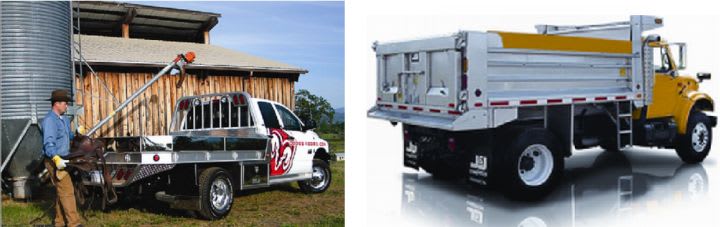
Truck bodies rust in salt-laden environments, whether in coastal areas or regions that require road salts for de-icing. To lengthen truck body life — and help contain fleet costs — consider five factors in spec’ing bodies.
If you operate trucks in salty air coastal regions or the northern “Snow Belt” areas that require harsh road salts to de-ice highways, you must account for corrosion prevention when spec’ing truck bodies. Otherwise, rust will shorten the useable life of your trucks and drive up overall fleet costs.
How should truck bodies be spec’ed to prevent corrosion and maximize return on investment? Here are five factors to consider:
1. Choose Corrosion-Resistant Truck Body Materials
What materials should be spec’d to resist corrosion? Most commonly promoted for their anti-corrosion properties are aluminum, stainless steel, fiberglass, and composites.
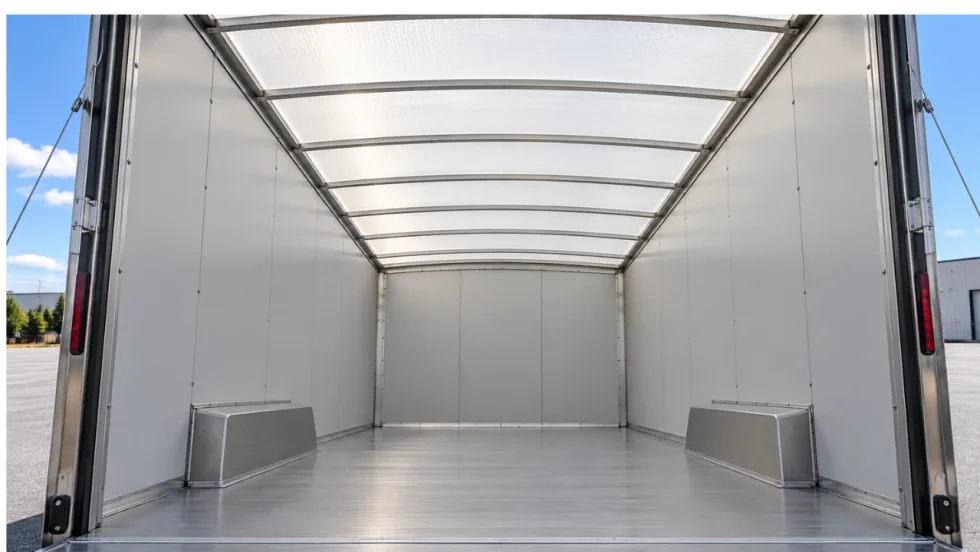
Aluminum Truck Bodies
“One of the trends in corrosion prevention we’re seeing right now is more aluminum bodies,” said Bill Sammons, director of national accounts for Reading Fleet Services.
“The reason is because the cost differential between steel and aluminum has really stabilized,” he explained. “The biggest knock on aluminum bodies has always been ‘it costs too much.’ I can save 45% of the weight, but it’s going to be 2-3 times the money. That’s a hard trade-off. Now, the price of aluminum has come within 10-20% of the steel. So you pay $1,000 more for an aluminum body [versus steel], which is going to give you more corrosion resistance, and it’s going to be lighter so you’ll have a better payload capacity.”
What are potential downsides to aluminum to factor in your decision?
“There are not a lot of people out there who know how to work on aluminum,” says Sammons. “That’s been one of the knocks. That’s always going to be an issue when making repairs out there in the field.”
Newer designs, such as Eby’s aluminum Renegade service body, offer additional examples of how manufacturers address body weight, corrosion resistance, and equipment access.
Stainless Steel Truck Bodies
“Stainless steel is used prominently in the ‘Snow Belt’ region because it holds up better against magnesium chloride, used to de-ice roads,” says Bob Johnson, fleet relations director with the National Truck Equipment Association (NTEA) and a former fleet manager with more than 30 years experience.
“Even aluminum, unless properly treated, can corrode just as easily as conventional steel bodies when exposed to road salt,” Johnson adds.
While the initial price for stainless steel is usually higher than conventional steel and other truck body materials, if trucks are operated in areas with harsh winters, the ability to resist corrosion from road salt is an important factor to consider when projecting lifecycle body costs.
Fiberglass Truck Bodies
“Fiberglass bodies are very corrosive-resistant, assuming the steel understructure is properly treated,” says Johnson. “These bodies are lighter than steel and, if manufactured right, also have an attractive appearance in terms of finish.”
What’s the typical trade-off when selecting a fiberglass body over steel? One, the up-front price typically is higher. Additionally, while fiberglass is rust-proof, it’s not as forgiving of day-to-day abuse as steel, which can shorten truck body life, depending on how harsh the conditions in which the truck is operated on a regular basis.
Heavy-Duty Composite and Plastic Truck Bodies
Composite bodies are typically constructed of light-weight, impact-resistant, rust-proof plastic. Advantages include:
- Low heat conductivity to better protect cargo from temperature swings.
- Corrosion resistance and ability to handle abuse, contributing to longer life and reduced maintenance and repair costs.
- Light weight, translating into greater fuel efficiency and heavier payload capacity.
For examples of newer equipment, Work Truck’s 2025 light-duty truck gallery includes BrandFX’s corrosion-resistant EverLast composite body.
2. Evaluate Truck Body Designs for Moisture and Debris Traps
What about steel bodies? If you operate trucks in regions at high risk for corrosion, should steel be avoided altogether?
Not necessarily. According to Johnson, some manufacturers build steel bodies that hold up well against corrosion through enhanced engineering and design. Most steel bodies are made of galvanneal steel panels formed with a rust-resistant finish. In addition, the lower price point for steel, compared to most alternative materials, makes steel a viable option — if the design is right.
“One of the things to look for,” Johnson advises, “is that the basic design should avoid creating ‘traps’ for mud, dirt, water, and chemicals. A lot of your utility bodies have guards around fuel-filler hoses in the wheel well. If the guard is not properly designed, it will accumulate dirt, salt, and chemicals that will cause rust. So the design of the body can be just as important to corrosion resistance as the materials themselves.”
These details belong in the broader discussion of choosing the right truck body for the application, alongside loading requirements, materials, and long-term operating costs.
Small protective features also deserve attention. For example, Reading Truck’s 2026 body introductions include an aluminum fuel-fill cup designed to protect against refueling nicks and scratches.
3. Review Truck Body Manufacturing and Corrosion Protection
When considering a steel body, Johnson recommends examining how the panels and other components are fabricated.
“The more you bend and fold and weld on stuff, the more prone it is to corrosion,” he says. “Some body companies will use structural steel components that are hot-rolled and relatively corrosion-resistant, while others will form their structural components by taking sheet steel and bending it — roll-forming it. The roll-forming process in general can create high stress areas in the metal that are more prone to corrosion.”
Also, beware metal left exposed after cutting and welding.
“Prior to manufacturing the body, the steel is pre-coated. So when you cut and weld, you’re exposing areas to corrosion,” Johnson points out. “Quality body manufacturers will do something to restore treatment to those areas — dip the bodies in phosphate, manually apply primer to those areas where the body is ground, and make sure they get an extra coating there.”
According to Johnson, a growing number of manufacturers are starting to use heavy-duty adhesive bonding — a process of gluing the parts together — to eliminate the need for welds and holes altogether.
“This [adhesive] technology has been used in the aviation industry for years, and it’s starting to find its way into other applications. This process completely fills the seam, leaving no space for moisture to seep in. Any time you have a seam, you have a chance for corrosion,” says Johnson.
For a closer look at manufacturing practices, Work Truck’s tour of IMT’s production facility follows how mechanics bodies and cranes are built, including the use of galvanneal material and a five-stage paint line.
Other manufacturers are also revisiting construction details. Stellar’s 2025 TMAX mechanics truck lineup combines aluminum construction with a redesigned rear section that reduces welded holes.
4. Inspect Truck Body Coatings, Paint, and Surface Preparation
How is the body treated and painted?
“Some body companies will do full dips, e-coats, and high-quality paint jobs. Others will just hose the body off with a pressure washer and shoot the paint on them. So the quality of the finish is very important,” Johnson advises. “When you do a full dip on the body, pre-clean it, and e-coat it, you’re much more likely to get all of the seams, nooks and crannies, and all that is prone to corrosion.”
“E-coat,” the abbreviation for electrocoat, refers to a coating process that uses electrical current to fuse paint directly onto the body. Another approach is powder coating, which uses high voltage spray equipment to coat the body with fine polyester particles that cure to form a hard skin, tougher than conventional paint in resisting corrosion.
Work Truck’s coverage of Palfinger’s mechanics truck body manufacturing process provides a closer look at how pretreatment and e-coating are used to protect bodies and cranes.
That protection remains important when a body combines materials. Palfinger’s PAL Pro 43, shown at Work Truck Week 2026, pairs aluminum sidepacks with a steel understructure treated through a 12-step e-coat process.
Whatever coating is used, Johnson cautions proper body prep is crucial.
“If the body is not properly prepped and any dirt or dust gets under the coat, those particles will actually de-laminate the sheet,” says Johnson. “I’ve seen powder coat come off in a sheet because it lost adhesion. I’ve literally seen it blow off a truck going down the road.”
5. Protect Truck Bodies Against Corrosion After Upfitting
"The other thing you have to be careful about is modifying the body after the fact,” Johnson cautions.
“I get a body from a manufacturer that is very well protected against corrosion. Then I send it to the upfitter who starts welding and grinding and drilling holes in the body to add equipment to it,” Johnson explains. “When they drill holes, do they go back and prime them? Many bodies are manufactured with the proper coated materials. But once you weld on them, you can burn the coating off. And when you do clean-up grinding on them, you grind the coating off. So the areas where there are welds on the body are also vulnerable to corrosion.”
Make sure upfitters take corrosion prevention into account when they install new equipment on new finished bodies.
Include coatings, seals, and corrosion-resistant components in the specification review. These are among the overlooked upfit details that can affect equipment life and fleet costs.
Match Corrosion Prevention Specs to Fleet Operating Conditions
When it comes to corrosion-resistant bodies, one spec does not fit all. Examine the entire process — material selection, design, manufacturing process, body finish, and modifications — to ensure you’ve covered all the bases in spec’ing a body that lasts in any climate.
Once the truck enters service, winter preparation and regular washing also belong in the fleet’s plan for managing exposure to road salt and other corrosive conditions.