





Related: Santa Monica Launches Zero-Emissions Delivery Zone, First in U.S.
Replacing Commercial Loading with Smart Zones — Does it Work?
The process of loading and unloading in commercial loading zones is antiquated. A curb management pilot with the City of Aspen promises a better way. What do the findings say?
April 20, 2021
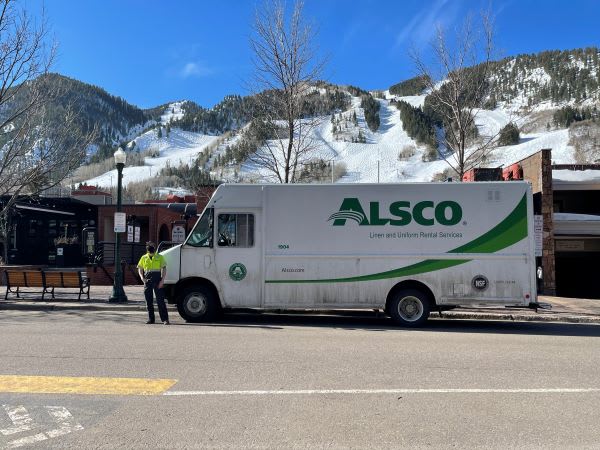
From each of his stops, usually in a commercial loading zone or an alley, Matt McCullough loads multiple 50- to 100-lb. boxes of linens onto a dolly to navigate Aspen’s minefields of snow, ice, and other vehicles through back doors, up staircases, and into bars and restaurants.
Photo courtesy of Matt McCullough.
6 min to read
If you ask Matt McCullough of Alsco, a nationwide linen service, finding parking for his 18-foot delivery van in Aspen’s busy downtown is one of the least appealing parts of his job.
McCullough makes 20 to 25 stops a day. From each of his stops, usually in a commercial loading zone or an alley, he delivers to four to six locations. He loads multiple 50- to 100-lb. boxes of linens onto a dolly to navigate Aspen’s minefields of snow, ice, and other vehicles through back doors, up staircases, and into bars and restaurants. After the weekend, he’ll pick up large loads of used linens from the weekend’s dining.
While Aspen qualifies as a small town, traversing its 16-block downtown during peak ski season can induce as much stress as driving in a much larger city. But for McCullough and legions of delivery drivers in other parts of the country, dealing with the decades-old game of blindly showing up to jockey for commercial curb space to unload is merely a cost of doing business.
Things changed in November 2020, when the City of Aspen and Coord, a curb management company, launched a pilot program to figure out how to better manage commercial loading in the city’s downtown. Coord is also running pilots in West Palm Beach, Florida; Omaha, Nebraska; and Nashville, Tennessee.
In Aspen, the city converted 11 of its busiest loading zones — seven curbside and four in alleyways — into “Smart Zones.” Drivers use the Coord Driver mobile app to find available Smart Zones, reserve space, and pay. In Aspen, Smart Zone fees are $2 per hour or a fraction thereof.
Curb management? The idea might not have been imagined just 10 years ago. But today car parking and truck deliveries compete for curb space with new transportation modes such as micromobility and ride hailing, which have been exacerbated further by pandemic changes such as online shopping deliveries, outdoor dining, and curbside pickup.
The curb is now a hot commodity. An estimated 28% of commercial driver trip time is spent searching for parking, according to a University of Washington study.
The Driver’s Process
To reserve a Smart Zone, McCullough enters his delivery stop’s address and taps on a Smart Zone near the stop. When he is about a half mile away from the stop, the system holds the nearest Smart Zone. As he travels to that zone, the system marks the space as unavailable to other drivers.
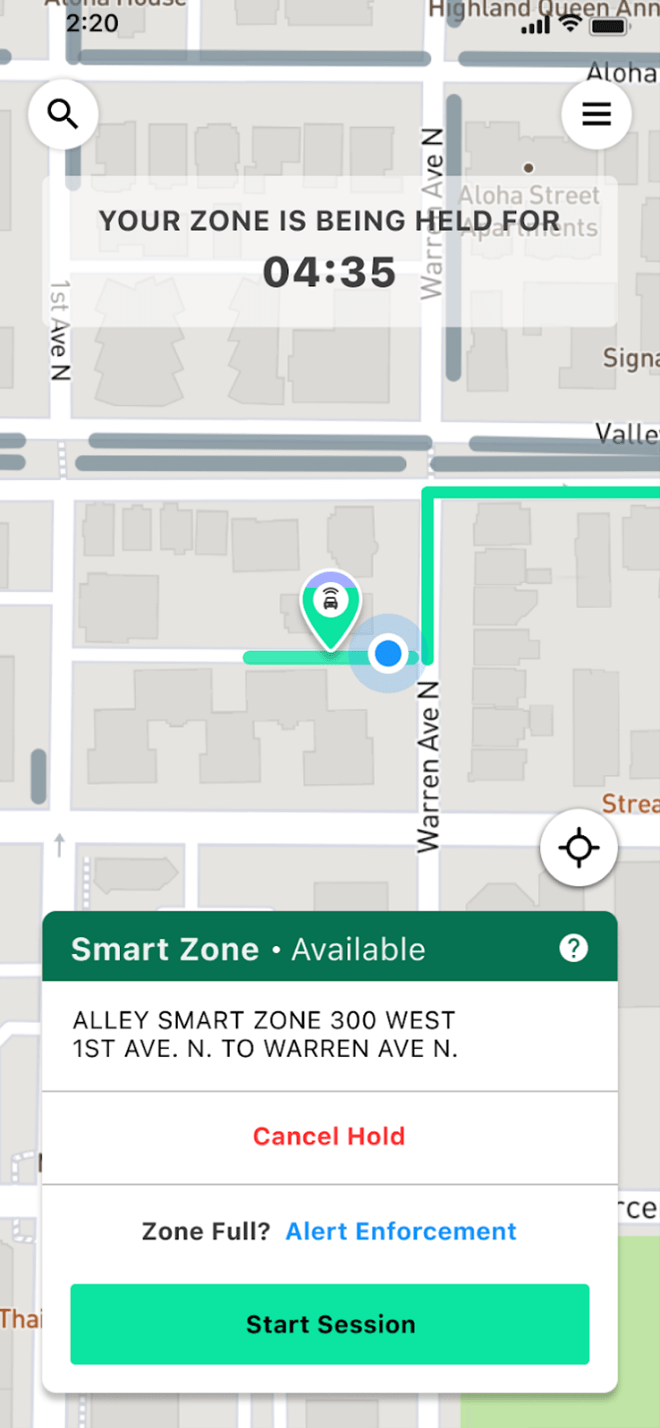
Image courtesy of Coord.
Once McCullough has pulled into the Smart Zone, he taps the app to start his session, and once more when he’s done. The session is billed directly to Alsco.
The system was updated recently with more flexibility. It now allows McCullough to hold the space from as far away as the Alsco depot 70 miles away, where he starts and ends his day. When he gets within a half mile of his first spot, he has 10 minutes to arrive at the space or the spot is released.
In anticipation of the next stop, McCullough opens the app to hold his next Smart Zone. If that zone is booked by another driver, he may rearrange his schedule to book a Smart Zone near his next stop.
“The convenience of the app is being able to see what (space) is in use and what isn’t, and plan accordingly rather than going in blind,” he says. “If you’re coming from the other side of town and you can’t find an open loading zone, you’ve wasted a lot of time.”
McCullough surmises that vendors like the system because it offers a more efficient use of the space to get goods loaded and unloaded. For McCullough, it allows him to finish his day quicker. “Five minutes here, 15 minutes there, it adds up,” he says.
100-Day Metrics
Coord gathered and analyzed metrics from the first 100 days of the Aspen deployment using Coord system data, driver, fleet manager, and city staff feedback, and a camera-based evaluation.
According to a Coord report, 38 fleets joined the Aspen program within the first 100 days. Those include local and regional fleets as well as national brands such as Sysco, FedEx Ground, Coca-Cola, US Foods, Frito Lay, and Alsco.
Coord says 118 drivers signed up for the program, 53% of which work for a fleet; the remaining were independent commercial drivers. More than 91 unique drivers completed 1,020 loading sessions.
Over the first 100 days, Coord reported 3.2 “zone full” reports for every 100 sessions, or driver-logged reports that the Smart Zone was unavailable at the time of arrival.
For the first three weeks of the program, the City issued warnings to drivers in Smart Zones. After three weeks, they began issuing $30 citations.
Based on camera footage, compliance varied based on type of loading zone. The monitored curbside loading zones were booked 58% and 62% by the Coord app, which “is in line with rates of compliance with paid personal vehicle parking seen in many cities,” according to Coord.
In the monitored Smart Zone alley, however, only 29% of commercial loading events were booked using the app. Coord surmised that this may be because enforcement officers are less accustomed to patrolling alleys than they are patrolling curbs.
In terms of impact on safety and congestion, Coord recorded a decrease in passenger vehicles using designated Smart Zone alleys as a shortcut and found a 23% lower rate of illegal parking.
Vehicles picking up or dropping off passengers spent 80% to 90% less time at the three monitored sites than they did when the spaces were regular loading zones. This is likely due to the drivers’ knowledge that these spaces were only legally available to vehicles that booked them, Coord surmised.
Smart Zone implementation coincided with a shift in mode share at the curb towards commercial delivery vehicles and buses while reducing personal vehicle usage. At the same time, conflicts between vehicles and pedestrians and cyclists decreased during the pilot period.
Fleet and City Feedback
Feedback from fleets and drivers revealed their biggest concern was that drivers would be distracted or waste precious time using a smartphone app. To address this, Coord automated several steps of the Smart Zone holding and booking process. Consistent communication and education was vital.
The City of Aspen, meanwhile, was able to use pilot data to determine loading space demand by the time of day and days of the week.
The data revealed demand surges from 9-11 a.m. weekdays and that Tuesday was the busiest day while Wednesday was the least busy. The average session duration was 35 minutes, though it varied significantly by time of day. Vehicles that arrived early in the morning typically had longer loading sessions, while those later in the day tended to be shorter.
Coord says this reflects in part the different users at different times of day, with large trucks delivering to stores and restaurants early in the morning and parcel delivery companies delivering to businesses and residents later in the afternoon.
Based on the findings, the city will identify opportunities to align loading zone allocations with demand, Coord said. The program “also helped open a new dialog between fleets and the city and created a valuable communications channel to these stakeholders that had not previously existed.”
The City of Aspen extended its initial three-month pilot program for an additional four months and is adding 45% more Smart Zones to the program.
Metrics aside, the new Smart Zone system has McCullough’s job a little easier. “I’ve found Smart Zones and the Coord Driver app to be a huge improvement over the previous chaos of deliveries at the curb and in alleyways,” he says.
Originally posted on Automotive Fleet
Subscribe to Our Newsletter
More Operations
Family Ties Inside the Fleet Families Building Careers Across Generations
Three fleet families share what it really takes to work together, learn across generations, and keep business from following them home.
Read More →
Shades of Fleet Call for Voices: Fleet's Hidden Heroes
Fleet’s hidden heroes are often the ones keeping everything moving behind the scenes. September’s Shades of Fleet is looking for dispatchers, coordinators, parts specialists, and other support pros to share their stories.
Read More →
Truck Centers, Inc. Celebrates National Truck Driver Appreciation Week with $1,000 Fuel Card Giveaways
During National Truck Driver Appreciation Week, Truck Centers, Inc. is offering customers a chance to fuel up for free. Customers at all Truck Centers locations can enter to win one of four $1,000 fuel cards from Sept. 14 - 18.
Read More →
Fleet Guides, AI Time-Savers, Truck Tariffs & Fuel Strategy Lead the News
This week’s Truck Chat Cheat Sheet covers new fleet vehicle guides, practical AI use cases, U.S.-Canada truck production, mixed-energy strategy, and more.
Read More →
What Fleet Employers Are Missing When Hiring Veterans
What if some of the strongest candidates for fleet are already out there, but their experience is written in a language our industry does not always recognize?
Read More →
Automotive Fleet Opens 2026 Personal Use Survey for Commercial Fleet Managers
Less than two weeks left! Commercial and corporate fleet managers are invited to share how their organizations handle company vehicle personal-use policies, charges, and driver eligibility.
Read More →
What Resilient Fleets Do Differently When Conditions Change
Fleet resilience is about more than reacting to disruption. Lauren Fletcher talks with AP Fleet’s Alex Coveney about flexibility, planning, scaling, and what helps fleets adapt when business conditions shift.
Read More →
If We Want the Next Generation in Automotive, We Have to Give Them a Reason to Care
The automotive industry talks constantly about its workforce shortage. But before we can recruit the next generation, we may need to do a better job giving kids a reason to care about automotive in the first place.
Read More →
Ram ProMaster City Under $40K, Truck Tariffs, and AI Maintenance Lead the News
A sub-$40K commercial van, tariff questions, AI-powered maintenance, and a new EV production strategy headline this week’s Truck Chat Cheat Sheet.
Read More →
Bob Adamsky Shares the Fleet Lessons You Usually Learn the Hard Way
After more than 30 years in fleet, Arrow International’s Bob Adamsky has learned that the job is about far more than vehicles. He shares the lessons he wishes every fleet manager could learn a little earlier.
Read More →