





Learn More: Usage and Maintenance Tips for a Propane Dispenser
Propane Provides Competitive Edge
Competitive Lawn Service may soon become the first lawn care company in the United States to run its vehicles and equipment entirely on propane.
May 12, 2010
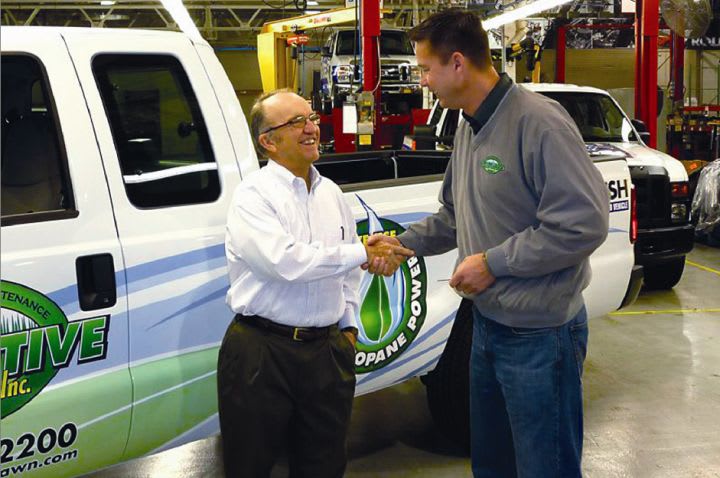
Eric Hansen, founder and president of Competitive Lawn Care, takes delivery of the first propane-powered Ford F-350 from Jack Roush at the ROUSH Performance assembly plant.
Photo: Competitive Lawn Care
5 min to read
When Eric Hansen set out on his mission to create the first propane-powered lawn care crew in 2008, he couldn't have imagined the attention his 10-vehicle fleet would eventually attract. Last December, the founder and president of Downers Grove, Ill.-based Competitive Lawn Service Inc., took delivery of the first propane-fueled Ford F-350 from the ROUSH Performance assembly plant in Livonia, Mich. Auto racing and engineering mogul Jack Roush greeted Hansen at the plant and personally filled the truck's underbed tank as the cameras rolled.
It was more publicity than the unassuming Hansen was used to, but he didn't hesitate to lend his name to the movement toward alternative-fuel use in commercial fleets. The ROUSH truck is Competitive's first propane vehicle, but Hansen's interest in alternative fuels began back in 2008, when gasoline hit $4.50 per gallon and the company had to find ways to cut costs.
Investing Strategies
Hansen started by retrofitting lawn care equipment such as mowers, trimmers and blowers to run on propane. There were a few bumps in the road as the Competitive team learned how to maintain the equipment on the fly. But for every obstacle, the "new" fuel seemed to present an advantage: propane can't be spilled, and the cleaner burn produced quieter engines, less maintenance, and fewer oil changes. Most importantly, the savings, even on a small scale, "Fifty bucks here and there," as Hansen recalls, began to add up.
Impressed, he pressed on. After testing all the new-to-market propane-powered equipment he could get his hands on, Hanson started looking into replacing his gas and diesel F-150s, F-250s, F-350s, and Super Duty dump truck.
"Ford began producing vapor propane trucks in the late '90s, but there were two concerns for us," Hansen says. "One, they were 30-percent less fuel efficient, which we couldn't quite make up in the per-gallon cost. Two, they were F-150s — not big enough for our needs."
Competitive's needs also include full use of the cargo area, as it would be impossible for his slide-in dump/haulaway units to share space with an in-bed fuel tank. Luckily for Hansen, ROUSH's F-350 was already in development, and the design included an underbed tank.
"They really worked hard to get it right," Hansen says. "It's a 100-percent liquid system, so the propane goes in full liquid direct to the cylinders. There's no drop-off in performance or hauling power, and its range is about 300‑320 miles. And where the vapor Ford F-150s were 30-percent less efficient, this truck is only 10-percent less efficient. With the reduced cost for fuel, that's viable."
To accommodate the switch, Hansen installed a private, above-ground fill station on company property. The installation cost $10,000, but Competitive now spends only $1.50 to $1.70 per gallon of propane. Hansen says that was the only option because the retail cost of propane in Downers Grove is more than $3 per gallon. The company also recoups 50 cents on every gallon that goes into the truck, thanks to a federal tax credit which, unfortunately for Hansen, does not apply to the fuel that powers the equipment.
"That creates a little work for our accountant," he says. "He's working on how to split the expenses. I don't necessarily want to lead the fight to extend the tax credit to lawn equipment, but they did see the need to extend it to forklifts. It's possible that our equipment also could eventually qualify."
There are two ways to obtain a single propane-fueled F-350 from ROUSH. A new truck can be ordered through the Ford dealership or lease management company with ROUSH's ship-through code. For an existing truck, ROUSH can send a conversion kit to a local dealer, where it will be installed with support from the company. To retrofit an entire fleet that operates in multiple locations, ROUSH works with fleet managers to determine where their "SWAT" teams should be sent to support the conversions.
Reducing Emissions
Even as he enjoys the cost savings, Hansen is equally proud of his company's shrinking carbon footprint.
"With 60-percent less emissions, we're also reducing our total annual output of CO2," he says. "We currently use about 35,000 gallons per year of unleaded gasoline and diesel. In 2009, we were able to use 1,500 gallons of that as propane. For 2010, our goal is to use between 5,000 and 10,000 gallons of propane and cut our usage of unleaded and diesel fuel to 25,000‑30,000 gallons. The heavy initial cost should pay for itself over the course of the next few years."
The propane-powered F-350 and equipment display a prominent "Green Propane Power" logo. Hansen believes that branding will help attract environmentally aware clients.
"Larger companies are getting into the green initiatives," he says. "They're going to their plant managers and looking for lists of ways to cut emissions. When I meet a prospective client, I'll say, 'Every time we service your property, we're creating 60-percent less carbon output. Does that matter to you?' For smaller companies, the answer may be 'not really.' For larger companies, it will likely be 'yes.' "
Spreading the Word
Hansen's efforts have already brought in phone calls and e-mails from other business owners across the country. Most of them want to know about the maintenance and tax-credit aspects of switching to propane.
"I tell them we know how to maintain the equipment, but not the trucks — yet," he says. "As for the tax credits, we know the implications at the state and municipal level, but of course those will vary from place to place."
The purchase of the propane-fueled pickup earned Competitive a one-time credit of $4,500 from the State of Illinois. Hansen hopes to pick up a few more in 2010 by retrofitting some of his existing fleet trucks. "We'll do two or three more this year," he says. "There's also a federal credit of $5,000, so if we apply for both, the conversion cost is a wash."
Subscribe to Our Newsletter
More Green Fleet

Fleet Forward Conference Introduces One-Day Passes for 2026
New one-day registration gives fleet professionals the flexibility to attend Tuesday, Wednesday, or Thursday, with passes available for $199 through Sept. 18.
Read More →
CALSTART Rebrands as Catalyst Mobility, Will Combine with Forth in 2027
CALSTART has rebranded as Catalyst Mobility and will combine with Forth at the start of 2027. The new organization said it is poised to become one of the world's largest, strongest, and most impactful clean transportation nonprofits.
Read More →
Electric Truck and Charging Programs to Boost Sustainability at NY & NJ Ports
Together, the Port Authority of New York and New Jersey and CALSTART will electrify drayage and terminal operations serving the East Coast’s busiest container port. A pair of incentive programs totaling $45 million has launched to accelerate adoption of zero-emission drayage trucks and terminal tractors.
Read More →
Xos Hub Surpasses One Gigawatt-Hour of Energy Delivered in the Field
A single Xos Hub has surpassed one gigawatt-hour of energy across more than 33,600 charging sessions in the field, demonstrating performance that supports Xos' expansion across new products and markets.
Read More →
Carrier Transicold Launches All-Electric Vector 8200 TRU for Diesel-Free On-Site Cold Storage
Carrier Transicold’s first engineless multi-temperature TRU helps fresh- and frozen-food fleets add supplemental cold storage capacity during seasonal peaks.
Read More →
Narro Trucks Introduces Electric Utility Vehicle
Narro Trucks officially launched its operations on Aug. 20 and hosted a ride and drive to showcase its electric truck, which will be produced in Virginia.
Read More →
Samsung SDI Takes Full Control of GM Battery JV as Indiana Plant Pivots to Energy Storage
Samsung SDI is taking full control of its Indiana battery plant with GM, marking a major shift from the EV-focused joint venture Charged Fleet first covered in 2023.
Read More →
NWSA Taps CALSTART to Administer Zero-Emission Drayage Assistance Program
CALSTART will provide free technical assistance services to drayage fleets serving the Ports of Seattle and Tacoma and looking to transition to cleaner technologies and help decarbonize freight hubs.
Read More →
EV Fleet Reality Check: What Operators Wish They Knew Before Electrifying Their Work Vans
Electric work truck upfits bring new compatibility questions. Learn how parts availability, OEM guidance, power demands, and route planning can affect fleet performance.
Read More →
Peterbilt Expands Sourcewell Partnership with Electric Vehicle Lineup
Peterbilt Motors Company’s cooperative purchasing agreement with Sourcewell and its Canadian partner, Canoe Procurement Group, now includes including Peterbilt's battery-electric vehicle lineup.
Read More →