




How to Make the Transition to ELD in 6 Important Steps
With the deadline for the FMCSA’s ELD Mandate Final Rule just around the corner, check out tips to make the journey to compliance in six straightforward steps.
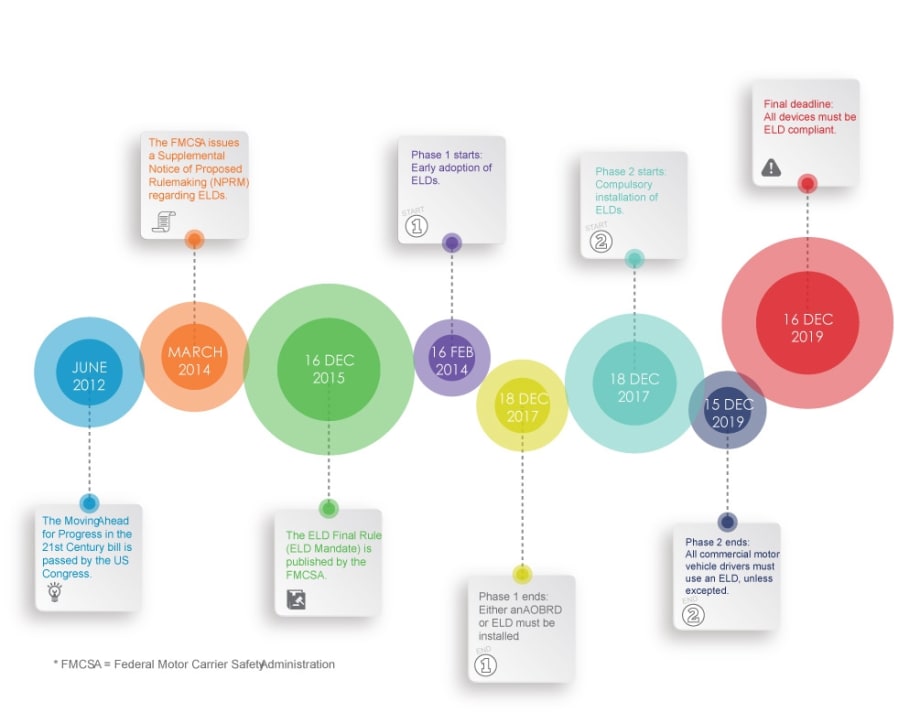
ELD Timeline courtesy of MiX Telematics
With the deadline for the FMCSA’s ELD Mandate Final Rule just around the corner, check out tips to make the journey to compliance in six straightforward steps. MiX Telematics provides some suggestions to make the transition as smooth as possible for your organization:
Step 1: Assess Your Current Situation - Paper, AOBRD, or ELD
The first step to compliance is understanding how the ELD Mandate will affect your fleet. Take note that it applies to all drivers currently required to keep records of duty status (RODS). To do this you need to look at your current system – are your drivers using paper logs or do you have Automatic On-Board Recording Devices (AOBRDs) or electronic logging devices (ELDs) installed? If you’re still using paper logs, you’ll need to have either an AOBRD or an ELD installed by December 2017. If you have AOBRDs, you have until December 2019 to make sure they comply with FMCSA’s regulations as set out in the ELD Mandate.
Step 2: Pick a Provider
The ELD Mandate Final Rule requires that all device providers first self-certify and register the device with the FMCSA, who will then maintain a list of vendors and make it available for review by motor carriers and drivers. However, self-certified does not equal verified. There could be some vendors that self-certify their devices for various reasons, without meeting all ELD requirements. So how do you find the right provider? Ask yourself whether you’ve heard of the vendor before or if you know of other fleets using its products. If the answer is “no”, it’s probably best to do more research and continue your search. Try to stick to one of the big names in the industry, with a solid reputation. Non-compliant vendors will be removed from the FMCSA’s list.
Step 3: Pick a Device
As we move closer to the deadline, there will be more and more ELD solutions to choose from and your options may appear unlimited. However, all devices must meet certain criteria as set out by the FMCSA in its Final Rule. There are various specifications that the device needs to meet, but basic requirements include:
Being integrally synchronized. The ELD must be directly connected to the vehicle’s engine (if it is model-year 2000 or later).
Self-certification. The vendor must be able to provide proof that the device meets the FMCSA’s strict ELD requirements.Ability to electronically send HOS at
Ability to electronically send HOS at the roadside. The device must be able to send Hours of Service data to law enforcement officers using one of two options:
Step 4: Begin Installation
Now that you’ve evaluated your needs and chosen a provider and device, you can set about installing the system across your fleet.
Step 5: Train Staff
Even before picking a vendor and specific make and model of electronic logging devices, you can begin educating staff on the general benefits they offer everyone from drivers and dispatchers to maintenance teams and managers. That way, any resistance to compliance can be tackled head-on as early as possible. Once the specifics of the system are known, you can plan a schedule to train all relevant staff on how to use it. Moving from a manual system to ELD means more than simply changing the hardware and software – it will affect most aspects of the company, including the culture. The key is to be transparent about the whole process from the start.
Step 6: Implement the Transition
Now that you’ve installed the devices and trained your staff, you’re ready to begin using your new ELD. Give yourself and your fleet enough time to test the new processes so you can work out any bugs or conduct additional training well before the relevant deadline.
Transitioning from a manual system to an ELD is no small order, but following these six steps should make the process smoother and ensure you’re not missing any red flags, and hitting all of your targets each step of the way.
About the Author
Pete Allen is the executive vice president for MiX Telematics North America. In his role, Allen is responsible for managing the customer experience. This includes building and managing the Sales and Account Management teams.
More Operations
Family Ties Inside the Fleet Families Building Careers Across Generations
Three fleet families share what it really takes to work together, learn across generations, and keep business from following them home.
Read More →
Shades of Fleet Call for Voices: Fleet's Hidden Heroes
Fleet’s hidden heroes are often the ones keeping everything moving behind the scenes. September’s Shades of Fleet is looking for dispatchers, coordinators, parts specialists, and other support pros to share their stories.
Read More →
Truck Centers, Inc. Celebrates National Truck Driver Appreciation Week with $1,000 Fuel Card Giveaways
During National Truck Driver Appreciation Week, Truck Centers, Inc. is offering customers a chance to fuel up for free. Customers at all Truck Centers locations can enter to win one of four $1,000 fuel cards from Sept. 14 - 18.
Read More →
Fleet Guides, AI Time-Savers, Truck Tariffs & Fuel Strategy Lead the News
This week’s Truck Chat Cheat Sheet covers new fleet vehicle guides, practical AI use cases, U.S.-Canada truck production, mixed-energy strategy, and more.
Read More →
What Fleet Employers Are Missing When Hiring Veterans
What if some of the strongest candidates for fleet are already out there, but their experience is written in a language our industry does not always recognize?
Read More →
Automotive Fleet Opens 2026 Personal Use Survey for Commercial Fleet Managers
Less than two weeks left! Commercial and corporate fleet managers are invited to share how their organizations handle company vehicle personal-use policies, charges, and driver eligibility.
Read More →
What Resilient Fleets Do Differently When Conditions Change
Fleet resilience is about more than reacting to disruption. Lauren Fletcher talks with AP Fleet’s Alex Coveney about flexibility, planning, scaling, and what helps fleets adapt when business conditions shift.
Read More →
If We Want the Next Generation in Automotive, We Have to Give Them a Reason to Care
The automotive industry talks constantly about its workforce shortage. But before we can recruit the next generation, we may need to do a better job giving kids a reason to care about automotive in the first place.
Read More →
Ram ProMaster City Under $40K, Truck Tariffs, and AI Maintenance Lead the News
A sub-$40K commercial van, tariff questions, AI-powered maintenance, and a new EV production strategy headline this week’s Truck Chat Cheat Sheet.
Read More →
Bob Adamsky Shares the Fleet Lessons You Usually Learn the Hard Way
After more than 30 years in fleet, Arrow International’s Bob Adamsky has learned that the job is about far more than vehicles. He shares the lessons he wishes every fleet manager could learn a little earlier.
Read More →