




Everything You Need to Know About Advanced Driver-Assistance Systems
Work truck fleets look toward advanced vehicle technologies, including ADAS, to reduce accidents and associated costs. Check out this ADAS 101 tutorial and recap of real-world applications and results.


Training on ADAS features is critical to ensure drivers don’t over-rely or under-rely on the technology.
Photo: Mobileye
Today’s automotive technology looks a lot different than it did when modern cruise control was invented in 1948 or when anti-lock braking systems were introduced in the late ’70s. And while we still await fantastical flying cars, we no longer have to wait for automatic braking, back-up cameras, and lane-assist tech, which come standard in many vehicles today.
This advancing technology continues to impact the fleet industry as more companies strive to keep their drivers and the public safer by investing in vehicles with the latest safety devices. In fact, many fleet managers are ordering vehicles with Advanced Driver Assistance Systems (ADAS) or are retrofitting their vehicles with ADAS.
The long-term benefits of ADAS outweigh the system costs in many cases. Recent research by Bosch measured the impact of ADAS, including lateral actuator systems, in heavy trucks. The research report, titled “Safety + Enhanced Driver Comfort: Steering in Commercial Vehicle ADAS Systems,” revealed that lateral actuator systems in Class 7 and 8 trucks reduced accident costs by $3,700 each year per truck. Further, the research found those crash injuries could be lowered by up to 23% and fatalities reduced by up to 19%.
“Increasing levels of automation and driver assistance help to reduce accidents and make drivers’ lives easier,” said Kevin O’Keefe, regional president of Robert Bosch Automotive Steering LLC. “The Bosch accident research findings illustrate how features like Lane Change Assist and Lane Keeping Support can contribute positively in multiple ways — reducing property damage, injuries, and fatalities.”
What is ADAS?
ADAS is vehicle technology that supports driver and/or vehicle assist functions or provides warning notifications to assist the driver in vehicle operating decision-making. ADAS packages available today help drivers avoid vehicle collisions and mitigate vehicle crashes that can’t be prevented.
“ADAS is sort of an industry-invented category for pretty much any system which assists the driver in operating the vehicle in a safe manner,” said Ben Johnson, director of product management, Mitchell1, a repair information solutions company. “This leaves it open to interpretation as to what’s included.”
Features that are generally considered part of ADAS include:
Lane Keep Assist: Warns the driver with signals and a “nudge” of the steering wheel if the vehicle begins to drift out of its lane.
Blind-spot monitoring: Alerts the driver if they signal that they’re about to change lanes and there is another vehicle in their blind spot.
Rear cross-traffic alert: Warns a driver if they are about to back out of a parking spot and other vehicles are approaching.
Pedestrian detection/avoidance: Can provide warning and/or actuate the brakes if a person is detected in the road ahead of the vehicle.
Accident avoidance: Detects if a vehicle has slowed and there is probability of a collision — can alert and/or apply brakes to avoid a collision.
Adaptive cruise control: Maintains a set distance between the vehicle being driven and the vehicle in front of it. Will adjust speed and apply brakes as necessary to maintain a pre-set distance.
“One could make the argument that back-up cameras, traditional cruise control, and other systems should be included in the ADAS category,” added Johnson.
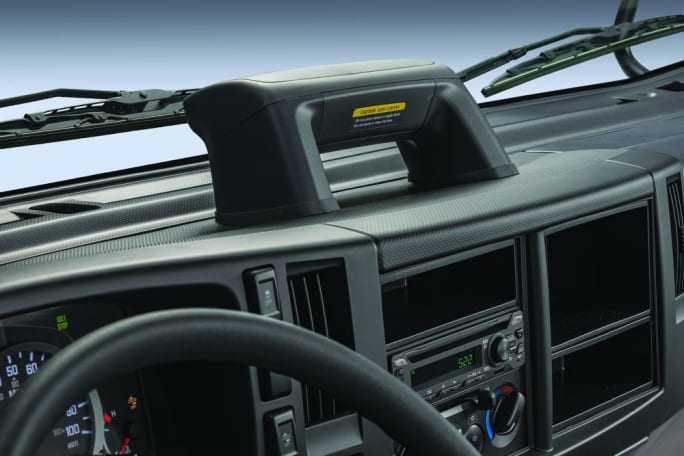
Isuzu’s all-new 2022i model-year N-Series diesel truck offers an optional ADAS package that includes an Automatic Emergency Braking System (AEBS).
Photo: Isuzu Commercial Truck of America
Four Main ADAS Technologies
A typical ADAS application incorporates many technologies, but four stand out, according to Gary Johnson, director of Risk and Compliance Management at Lytx Inc., a fleet management solutions company. Those four technologies are processors, sensors, software algorithms, and mapping.
Processors, such as Electronic Control Units (ECUs) and Microcontroller Units (MCUs), are essential for most ADAS applications, including autonomous driving.
Sensors gather information on their immediate environment, such as pedestrians and oncoming cars.
Software algorithms, which run on ECUs and MCUs, use the input from sensors to synthesize the environment surrounding a vehicle in real-time. The algorithms then provide output to the driver or specify how the system should actively intervene in vehicle control.
When GPS coverage fails, such as during tunnel travel, detailed and accuiate mapping systems can help prevent accidents. These systems also store geographical and infrastructure information, making updates as needed, and communicate with onboard sensors to determine a car’s exact location.
The bottom line: This automated technology detects and, in some cases, identifies nearby objects. The detected obstacles are then processed by a control unit to warn the vehicle operator or, in some instances, assist with vehicle operation.
Passive vs. Active ADAS
Most ADAS features are either active or passive. With passive ADAS, the system alerts the driver to changing conditions, such as the presence of another vehicle in a blind spot or other object-detection capabilities. Alerts range from sounds to visual cues to haptic feedback, such as rumbling on the steering wheel or driver’s seat.
Commonly found passive ADAS features include forward collision warning, lane departure warning, and traffic sign recognition.
“The driver is in complete control over how they will react to the information,” said Lytx’s Johnson, explaining passive ADAS.
With active ADAS, the driver gets a warning, but if the driver does not react, the ADAS intervenes to avoid or mitigate a collision. More advanced active features include adaptive cruise control, Lane Keeping Assist, and automatic emergency braking.
Manufacturers Respond to ADAS Demand
As more fleets look toward advanced vehicle technologies to minimize accident costs, manufacturers are responding to the demand. For instance, Isuzu’s all-new 2022i model-year N-Series diesel truck offers an optional ADAS package that includes an Automatic Emergency Braking System (AEBS) and a Lane Departure Warning System (LDWS).
While many ADAS features, including LDWS, provide warnings to help the driver react in time to avoid a collision, the AEBS will, under certain circumstances, actually operate the truck’s brake pedal independently if the driver does not heed the warning and allows the truck to get too close to a vehicle or other object in front of it, according to an Isuzu Representative.
In many cases, additional sensors are installed on the vehicle to determine the vehicle’s operating characteristics. For example, the Automatic Emergency Braking (AEB) system on 2022i Isuzu N-Series diesel trucks employs a dual camera system mounted on the dash.
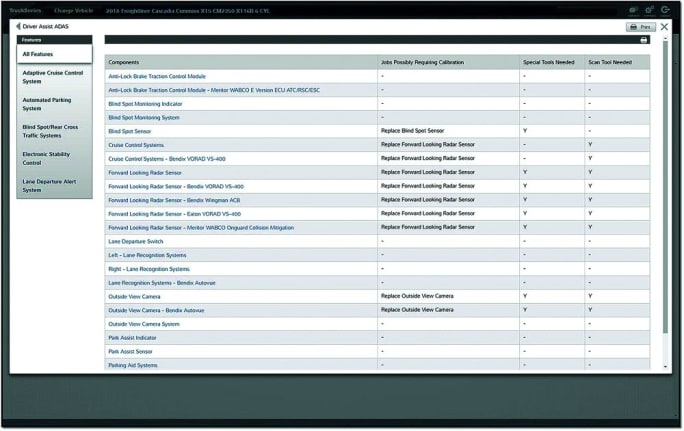
ADAS packages available today help drivers avoid vehicle collisions and mitigate vehicle crashes that can’t be prevented.
Photo: Mitchell1
Real-World ADAS in Action
The AAA Foundation for Traffic Safety estimates that advanced truck safety technologies could prevent up to 63,000 truck-related collisions a year. And one New York-based fleet recently learned this first hand.
Ambu-Trans Ambulette, which provides non-emergency medical transportation services in New York, turned to ADAS to minimize vehicle accidents. It had been experiencing 35 to 50 vehicle accidents each year. The annual cost of these crashes reached about $1 million.
Company management decided it was time to leverage vehicle technology to lower its accident rate and the associated costs, and after a thorough investigation into vehicle safety products, Ambu-Trans decided to install Mobileye collision avoidance systems in their fleet.
The results were dramatic, as collisions fell to just five or six per year, a 91% reduction in collision-related losses.
“Beyond this, they saw a drastic reduction in insurance claims, allowing for a lower insurance premium,” according to a Mobileye spokesperson. “Ambu-Trans’ investment in Mobileye paid for itself in just three months.”
ADAS and the Importance of Driver Training
Training on ADAS features is critical to ensure drivers don’t over-rely or under-rely on the technology.
“Proper training is needed to understand the intended safety benefits of a given feature for the full realization of the feature’s capabilities,” said Mark Chung, vice president, roadway practice, at the National Safety Council. “Drivers need to clearly understand their role in operating the vehicle while the given ADAS feature is activated.”
Chung gave the example of lane departure warning technology, which alerts the driver if the vehicle begins to exit the traveling lane when not intended (if the blinker isn’t activated, for instance). In this case, the feature will alert the driver to take action, but it’s not intended to keep the vehicle from exiting the lane autonomously.
Lytx’s Gary Johnson agrees, pointing out that as more ADAS features roll out, drivers need coaching to prevent complacency and inattention and to keep their defensive-driving skills sharp.
“Fleets must be vigilant about new types of risky behavior as drivers adapt to vehicle technologies in unintended ways,” he concluded.
More Safety

Volvo Trucks Releases New Safety Recommendations for Traveling with Pets
One of the most important recommendations for professional drivers traveling with pets is to ensure pets are properly restrained while the truck is moving. Other tips are available in the new guide from Volvo Trucks North America and Center for Pet Safety.
Read More →
API Issues Refueling Safety Guidelines
The American Petroleum Institute offers a list of safe vehicle refueling guidelines, including ways to avoid potential problems with static electricity discharges in fall, winter, and early spring.
Read More →
Winter Fleet Prep: Expert Tips to Keep Vehicles Running Smoothly
Cold weather can expose weak batteries, tires, fuel systems, and maintenance gaps fast. Use this winter fleet checklist to prepare trucks and drivers before temperatures drop.
Read More →
When a Work Truck Breaks Down, the Job Can Stop, Too
A work truck breakdown can stop more than the vehicle. Discover how payloads, jobsites, and specialty equipment change the roadside response.
Read More →
What Stronger Long-Term Fleet Service Partnerships Actually Require
Fleet service partnerships rarely fall apart all at once. Learn the three warning signs that trust is eroding and what fleets and providers can do before downtime, frustration, and lost revenue follow.
Read More →
Applause & TRUCE Software Partner to Improve Driver Safety Through AI-Powered Telematics & Employee Performance Management
Applause has integrated TRUCE driving metrics directly into its employee-first performance and safety platform that transforms mobile devices into AI-powered telematics.
Read More →
How Detroit Assurance with Active Brake Assist Works
Do you want to see what it is like to experience Detroit Assurance’s Active Brake Assist? In this video, Work Truck will put you in the cab to see how it all works and then hear more details from DTNA’s Mike Young.
Read More →
Get Left of Loss: A 5-Step Workplace Violence Prevention Framework for Fleet Operators
Violence risks do not stop at the driver’s door. Learn five practical steps fleets can take to spot threats early and protect workers before loss occurs.
Read More →
How Better Visibility Cut Speeding Violations by 48%
Fleet leaders don't need more data, they need clearer visibility into what the data is saying. This case study explores how one utility replaced speeding-event counts with a single metric — miles driven in violation — to strengthen safety and significantly reduce speeding violations.
Read More →
13 Safe Driving Tips for Commercial Vehicle Drivers
Make sure you are spending time on the road safely with these important tips.
Read More →