Fuel-management solutions continue to evolve as work-truck fleets strive to minimize operational costs and lower fuel emissions. Here are five current fuel-management trends to keep in mind.
As a top operational expense for work-truck fleets, fuel consumption remains top of mind for businesses large and small. Ensuring effective fuel management saves both time and money, so overcoming causes of poor fuel economy — such as vehicle idling, improper tire pressure, underperforming mechanical parts, and poor driving habits — means improved miles per gallon (mpg), lower fuel costs, less downtime, and even fewer harmful vehicle emissions.
Fuel typically costs between 20–30% of the total fleet budget, according to the NTEA – The Association for the Work Truck Industry. And medium-duty trucks (Classes 3–6) use more than 8 billion gallons of fuel each year, according to an Environmental Defense Fund report “Greenhouse Gas Management for Medium-Duty Truck Fleets — A Framework for Improving Efficiency and Reducing Emissions.”
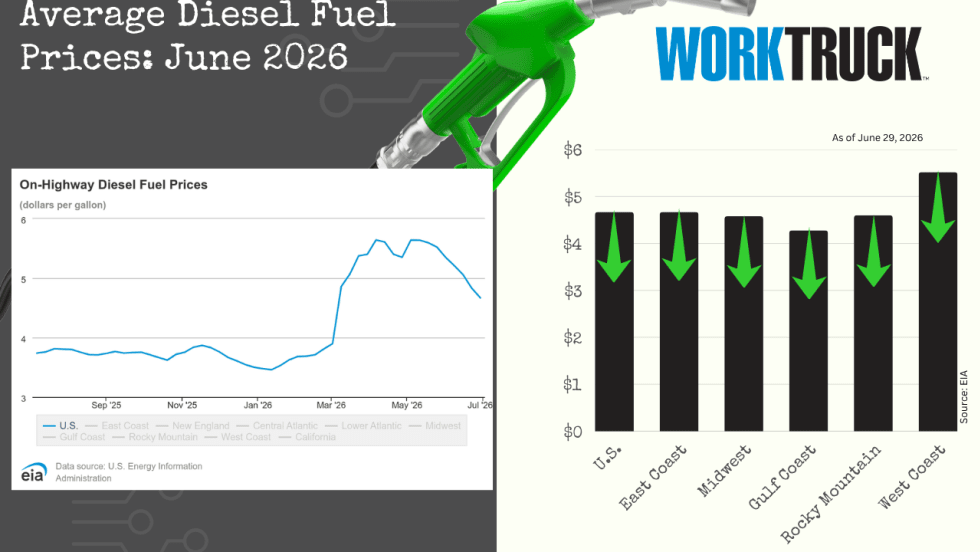
These statistics illustrate the importance of fleet managers working to decrease fleet dependence on such a price-volatile commodity.
Work Truck magazine checked in with fuel-management technology providers, fleet managers, and work-truck associations to find out how the industry is effectively handling fuel management and what the latest trends are.
The latest fuel-management trends include fuel-access apps and mobile refueling solutions to minimize refueling time, installing in-cab tech, and using tech that automatically maintains tire-inflation pressure.
Trend 1: Fuel-Access Apps
One recent trend takes advantage of mobile technology to streamline the refueling process: Some drivers now use fuel-access apps on their smartphones, according to George Survant, senior director of fleet relations at the NTEA. At least one app currently in use uses a biometric sensor (fingerprint detector) that displays on the screen of users.
“This allows the driver to turn on the pump and type in the odometer from the cab before exiting the truck to interact with the pump,” Survant said. “Not only does this make the fuel transaction less subject to the whims of weather on the operator, but the biometric signature will also decrease errors in truck assignments along with giving the operator an easier task in capturing the odometer reading.”
To date, at least two major fuel retailers nationwide have signed agreements with the technology supplier, according to Survant.
Trend 2: Mobile Refueling
Another fuel-management trend minimizes driver downtime as a result of refueling. Service companies, such as Booster Fuels, are arriving on the scene to help organizations lower fuel costs. The San Mateo, Calif.-based startup uses its app-based service to deliver and pump gas in office parking lots. The company says its mobile-fueling service helps manage fuel costs, improve fleet maintenance, and increase productivity, resulting in a savings of up to $1,500 per vehicle every year.
This service significantly helps fleet managers minimize driver downtime while refueling, according to Tyler Raugh, co-founder and president of fleet at Booster Fuels.
“On average, fleets are taking 20 minutes between time off route, time paying at the pump, time pumping gas, and unnecessary time in the convenience store,” Raugh said.
Stanley Steemer franchisee Dale See uses Booster’s mobile fueling for his 40-vehicle fleet headquartered in San Jose, Calif. Because fueling is so expensive for his business, See always searches for operational fuel efficiencies.
“Labor is one of our highest costs when it comes to fueling. The less time spent at the gas station, the more time employees can spend doing their job,” he said. “Even looking at the cost of gas to get gas for the fleet is expensive.”
See’s vehicles require about 400 fill-ups each month, and by using mobile fueling, the company saves about $1,000 per month in additional fuel burned just driving to fill up the tank.
“I try to find ways to make my fleet more efficient whenever I can,” he added.
Trend 3: In-Cab Driver Education
One current fuel management strategy focuses on real-time driver education. While vehicle aerodynamics and mechanical add-ons can improve fuel economy by up to 2%, drivers have the most significant impact on fuel efficiency, according to Ethan Sweeney, director of customer success at Vnomics, a provider of onboard fuel optimization solutions that combine real-time driver coaching and detailed fuel efficiency insights.
“Many fleets realize that the best investment is in coaching technology in-cab,” Sweeney said. “Fleets have seen 4% or 5%-plus improvements in their fuel consumption by engaging with their drivers through in-cab tech.”
Advancing technologies continue to help the fleet industry harness and leverage vehicle data to lower operational costs, making the upfront investments in these technologies well worth it for both large and small fleets, according to Sweeney.
“Large fleets are tackling integrations with tech providers to collect and automate performance reports of active fuel campaigns, programs, and policies at each critical level of the organization, empowering the key players to have significant impact, while smaller fleets are using the provider’s tool-suite of mobile-friendly apps on phones/tablets or web-based reporting services to fill the same need on a different scale,” he stated.
But no matter the size of the fleet, Sweeney underscored the value of current and emerging tech available to fleet managers to help develop and maintain fuel policies and programs.
Trend 4: Tire-Inflation Tech
Ensuring proper vehicle tire-pressure also continues to stay top of mind for fleet management to maximize fuel economy.
“By keeping tires optimally inflated, fleets can see a 1–2% improvement in fuel economy,” said Judith Monte, vice president of marketing and customer success at Aperia Technologies.
Aperia Technologies’ Halo Tire Inflator was developed to improve fuel economy and road safety while reducing tire expenditures, and driver downtime for commercial fleets, including for dual and wide-based tires drive and trailer axles, commercial buses, box trucks, and refuse vehicles. It’s a bolt-on device that automatically maintains tire-inflation pressure.
The company also introduced its Halo Connect platform earlier this year, which combines automatic inflation with machine learning. The technology uses proprietary algorithms to categorize tire maintenance issues by severity, virtually eliminating unplanned tire-related downtime.
Trend 5: Mobile Power Stations
Mobile solar systems installed directly on trucks now help private fleets and commercial carriers reduce fuel consumption. One supplier, eNow, specializes in renewable energy systems. Its solar systems convert, store, and distribute electricity, powering applications such as liftgates, in-cab HVAC, refrigeration, telematics, and hotel loads, like appliances and lighting. Primary applications are for medium- and heavy-duty trucks, buses, and emergency vehicles.
The benefits of a mobile solar system include minimizing idling and a reduced load on the alternator, lowering fuel usage. It also results in extended battery life and less wear-and-tear on electrical components.
“The system can eliminate 10-plus hours of idling per day and extend the run time of certain equipment, including battery-APUs and liftgates,” said Guy Shaffer, chief marketing officer at eNow.
C&S Wholesale Grocers installed the eNow solar technology on some of its trucks to address liftgate battery reliability and performance in modern delivery applications with low drive cycles. Leveraging this type of technology helps the company maximize equipment use and lower fuel usage.
“Effective fuel management is a key indicator of asset performance, supports our P&L, reduces our corporate GHG exposure, and supports our broader investments in sustainability,” said Chris Trajkovski, VP of transportation, fleet maintenance & assets, safety and compliance at C&S.
Taking Lessons From Heavy-Duty Trucks
While newer fuel-management technology solutions are enthusiastically tested and implemented in the heavy trucking industry, it’s a different story for the light- and medium-duty truck industry, according to Daryl Bear, chief operating officer and lead engineer at Mesilla Valley Transportation Solutions, which offers testing and consulting services to the trucking industry.
“Our parent company is a long-haul fleet that is 50% more fuel-efficient than the rest of the industry. This proves there are substantial improvements to be found. So how much savings are available in the light- and medium-duty segment? How much would reducing fuel cost by 50% mean to a company?” he asked.
The investment in tech on the front end is well worth the long-term back-end savings when approached correctly, according to Bear. “Keep working on it, and keep looking at tech to help. Don’t get discouraged if you are the only ambassador in your company on an initiative. Once you get a win, you’ll start to get support,” he advised.
Another organization helping measure and benchmark fuel efficiency is the North American Council for Freight Efficiency (NACFE). The organization works to drive the development and adoption of efficiency-enhancing, environmentally beneficial, and cost-effective technologies, services and methodologies in the North American freight industry.
“We want to help the industry understand how good is good. What can fleets expect when ordering a spec, and where should they set their corporate goals?” said Dave Schaller, industry engagement director at NACFE.
NACFE scales available technologies, promotes emerging technologies, and works on guiding future technology solutions to maximize fuel economy. The Council’s Run on Less event focuses on those core issues.
“The basic premise is let us use our telematics to monitor your best tractor, trailer, and driver in their normal operation to see how well the best of the best perform,” Schaller stated. “Only currently available options are allowed, so there is no engineering prototyping activities to throw off the benchmarking.”
The 2017 Run on Less event was for irregular route long-haul tractor-trailers. Against an industry average for this application of 6.4 mpg, the seven participating fleets saw an average of 10.1 mpg. The 2019 event focused on regional-haul applications, which averages 6 mpg. However, the 10 fleets that participated in the event averaged 8.3 mpg, with the one CNG truck in the mix pulling down the average.
“Excluding the CNG truck, the nine diesel regional haul tractors averaged 8.7 mpg,” Schaller added, saying the organization is willing to consider a future Run on Less that assesses vocational tractors or last-mile delivery trucks, if appropriate sponsorship can be secured.