




2026 Outlook for EV Truck Charging
As commercial battery-electric vehicle adoption continues to grow, what is the state of electricity as a fuel source, and what are the growth trends in charging capability in 2026?

Although electricity and charging costs are expected to rise over time, the transition to battery-electric vehicles is not the primary driver of increased demand on the power grid. What charging trends are taking shape in 2026?
Credit: CALSTART/Work Truck
In 2026, battery-electric vehicle charging opportunities are increasing, both public and private, and technologies, efficiency gains, and smart decisions can help fleets control costs during the transition to electric vehicles. And sure, the move toward electric vehicles will increase energy demand, but not as much as something that is shaping up to be a much larger consumer of electricity.
Commercial Charging Availability
While charging sites for passenger vehicles have grown, is charging availability for commercial vehicles increasing as well? Yes.
There are more and more charging sites breaking ground, according to CALSTART, which tracks public charging availability in California.
“Availability for fleets within their depots is steadily increasing, and many incentives for equipment, as well as new emerging vendors, are decreasing the costs of installations; as far as publicly available sites, this is emerging at the moment. Some sites have broken ground or are about to break ground this year,” said Stacey Simms, CALSTART senior director, clean fuels and infrastructure.
“There’s no doubt the industry has learned a lot about electrification in the past decade. In the early days many, if not most, fleets thought very big,” said Scott Griffith, Workhorse CEO. “They launched aggressive charging infrastructure projects and big bets. We’re now seeing fleets moving more deliberately, strategically, and in phases.”
Griffith said that depot-based charging, in particular, is well understood, widely deployed, and increasingly standardized for medium-duty and return-to-base operations.
“We believe our space, depot-based Class 4-6, is the sweet spot for electrification. These vehicles can charge off-peak, use Level 2 charging, and optimize routes based on range and charging capability,” Griffith added.
He also pointed out that public charging is expanding, with more DC fast-charging sites coming online that can support commercial use. While availability still varies by region, Griffith called the overall trajectory “positive” and noted that fleets today have far more options than they did even a few years ago.
Growth & Reliability of Private & Public Charging Sites
Reliability has improved significantly for private charging sites, according to Griffith. He shared that fleets operating today areseeing consistent, dependable performance from well-designed depot charging systems,particularly when paired with monitoring and managed charging software. Plus, hardware costs arecoming down across the board, and smart route planning can optimizecharging levels.
Rick Mihelic, NACFE director of emerging technologies, said there are now more than 3,200 heavy-duty truck charging stations in the United States. In one of NACFE’s recent Run on Less programs, there were some battery-electric trucks running cross-country, including one that traveled from Texas to Sacramento, California.
“What was interesting is that's a heavy-duty Class 8 truck, and they were able to find charging all along that route in New Mexico, Arizona, and Nevada, as well as where you would expect it, in California, but they also found it in Texas,” Mihelic said.
He explained the truck simply used charging sites at places like Walmart, chargers designed for passenger cars, yet they could charge a Class 8 truck. He noted that many car-charging locations now offer Class 2 or higher charging, which he said can be used by light- and medium-duty vehicles.
“So capacity is not really the issue where it was five or six years ago. There's a lot of capacity out there for those light-duty and medium-duty vehicles in the public sector,” Mihelic added.
Simms, however, said private sites are encountering reliability issues, and vendors are looking for ways to improve.
“There are a lot of avenues emerging to increase reliability,” Simms added. “One key development is that vendors are emerging with dedicated monitoring tools to assess issues; additionally, vendors of infrastructure increasingly feature service guarantees to provide real-time reporting of uptime and availability. As it is usually operated by one fleet, or a small handful of fleets with tight coordination, the variables for operational management are fewer.”
She suggested that fleets plan for hiccups and don’t wait for perfect reliability; instead, go ahead now and lock in vendor agreements. Simms also suggested fleets enter the transition with an understanding of how much downtime they can tolerate and the impact on operations. It is good for fleets to build downtime management services or processes into their risk management plan with the chosen vendor or charging service, she recommended.
“Plan holistically, and not as if this new technology should perform exactly like previous technology,” Simms said.
Creatively Charging to Extend Range
During NACFE’s recent Run on Less - Messy Middle, one of the fleets was doing long-haul with a Tesla semi-truck during the day.
The Tesla, operating in California, traveled from Stockton to Bakersfield and back at night, and when it returned to the depot, it connected to a high-rate charger for 30 minutes to an hour. Then the next driver arrived and ran an urban delivery route during the day. After the second route, the truck returned to the depot and was charged for a few hours to prepare for the long-haul run the next day.
Mihelic recalled that the fleet achieved 860 miles in a single day with two drivers in a single electric truck.
“That's pretty decent miles,” he said.
Fleet BEV Adoption Considerations in 2026
What should fleets consider before expanding BEV adoption in 2026?
“Hands down, the consideration we see and hear from our top-tier fleets is cost comparability,” Griffith said.
He said the new Workhorse (which combined with Motiv Power Systems, Inc. in December 2025) has delivered more than 60% savings compared with internal combustion engines (ICE) in fuel and maintenance costs.
“If fleet managers arestrategic about how they build their infrastructure and how they design their routes, the move toelectric makes strong financial sense,” Griffith explained. “As we continue to see the evolution to a hub-and-spokedistribution model, serving the mid- and last-mile routes can be done cost-efficiently byBEV.”
Griffith offered 12 considerations for fleets to weigh over the next two years to move from early adoption to what he termed confident scaling. Those considerations are:
Operational alignment
Matching vehicles to routes where electrification delivers immediate value
Understanding seasonal energy use and dwell time
Training drivers and operations teams for consistency and efficiency
Infrastructure planning
Engaging utilities early and designing sites with growth in mind
Building infrastructure that supports phased expansion
Implementing managed charging from the outset
Economics and strategy
Evaluating the total cost of ownership with improving vehicle performance and incentive stability
Standardizing deployments across sites to reduce complexity
Integrating vehicles, chargers, and energy management into a single operational view
CALSTART’s Simms suggested fleets moving toward electrification should:
Talk to cargo owners: Understand cargo owners’ appetite for electric transport services and their future needs. Specifically, understand if there is more business to be gained by switching to BEVs, and whether this would offset any headaches involved in transitioning part of your operations.
Think long-term: Plan beyond next year—map out multi-year service strategies. Don’t just stick with technology readiness questions, but look more holistically into the issue, also with your customers.
Stay flexible: Charging-as-a-service or shared sites can reduce infrastructure headaches and operationally absorb technology transition issues, or issues faced by upgrading a facility and owning/operating technology by yourself.
Do the math: Weigh route changes, reliability, and other technology questions against potential new business opportunities and efficiencies.
Be proactive: Identify risks early so you can negotiate confidently with your customers and your technology vendors.
Growing Energy Demand & Fleet Electrification
How is the growing energy demand expected to affect fleet electrification?
According to GridStrategies1, forecasts indicate that total electricity use will increase by 32% by 2030. Griffith pointed out that this may lead to increased rates, thereby possibly making charging more expensive.
“Thatsaid, the cost savings of using electrons versus liquid fuels is so significant we believe electrictrucks will still be able to offer fleet operators significant operational savings,” Griffith said. “On top of that, weexpect to see the cost of batteries continue to drop and charging management systems andother software to continually improve, offering fleets other ways to reduce overall costs. Last,each generation of truck that companies like Workhorse make is more efficient in terms ofbattery usage and range than the previous.”
He also noted that rising demand encourages smarter charging strategies, such as shifting load to off-peak hours, smoothing demand, and improving overall grid efficiency.
“Fleet charging is a tiny slice of overall grid growth if utilities are bringing power to data centers; utilities should be able to handle charging sites,” Simms said. “Utilities are increasingly planning in advance. We also see that investments for the overall growth of the grid in certain areas (as with data centers) can spill over to address huge logistics sector growth in major clusters and new energy-land real estate bundles.“
Mihelic also pointed to data centers as a major driver of electricity demand.
“When it comes to demand, as more electric vehicles come on the market, it's not going to have a huge impact on electricity demand,” Mihelic said. “The bigger demand increase is coming out of a huge growth in data centers in the United States. They're projecting demand for data center power going up by 35% over the next few years, with gigawatts of capacity that have to be added to the network.”
Simms also noted that short-term fixes such as battery storage, mobile charging, and charger management systems can provide fleets with flexibility to build timelines or insulate operations from buildout challenges. Charging-as-a-service providers can also absorb fleet operations during the buildout of a charging system or even become an alternative to near-term facility upgrades.
One of the fleets that participated in NACFE’s Run on Less - Electric Depot in 2023 was waiting to get its permanent charging installation in place, and the timing just wasn't right for them to have permanent charging during Run-On-Less.
“So, they brought in mobile charging capabilities, and they were able to charge their trucks, their heavy-duty Class 8 trucks, using mobile chargers that were connected to their building. It worked out well,” Mihelic said. “They found out that they could actually charge more vehicles per day than they were expecting, and so it helped increase the capacity of trucks that they were going to be able to service when they got their permanent charging facility in.”
“I've seen multiple times that fleets are starting to realize that they can get their trucks rolling a lot faster if they bring in mobile charging systems,” he added. “They can get their charging in place and start using the trucks while they're waiting for the utilities and the city planners and everything to work the details out on their long-term charging capacity.”
Cost: Electricity as a Fuel
Mihelic expects the cost of electricity, and thereby charging rates, will probably increase over the next few years because of pressure on the demand side.
“It takes several years for the generation of power to increase significantly. You have to build power plants, you have to build solar farms, you have to build battery capacity for the utilities, and you have to build transmission lines,” he explained.
He said that over time, maybe in 2030 or 2040 or somewhere in between, the instability in pricing will go down and drive rates down.
“If you put in an electric vehicle now, your rates may go up a little bit over the next few years, and then they'll go down, probably. You can offset that by being smarter about how you use your energy through things like managing charging software that looks at when you charge your vehicles versus when you use your vehicles,” he added.
More Fuel

The Smart Way to Build a Mixed-Energy Fleet Isn’t About Picking a Side
Mixed-energy fleets aren’t about picking a winning fuel. Sarah Booth of WEX explains how vehicle data, duty cycles, charging strategy, and real-world costs can help fleets choose the right energy source for each job.
Read More →
Ignoring This Dashboard Warning Could Cost Your Fleet Thousands in Fuel
New research suggests neglected diesel aftertreatment systems could waste up to $30 in fuel per vehicle each day. Here's why vocational fleets should pay attention.
Read More →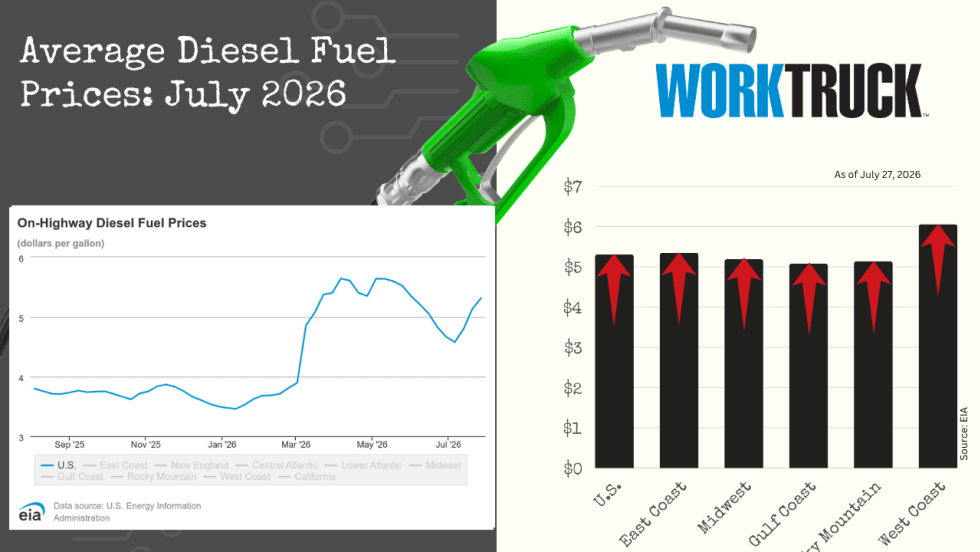
July Diesel Trends Update
The average price of a gallon of diesel increased again this week, and the EIA reported a new national average of $5.31 at the start of the week.
Read More →
WEX Brings Standard Fleet's Connected Vehicle Platform to Fleet Customers
This week’s product launch with Standard Fleet’s connected vehicle platform reflects WEX Venture Capital's strategy of turning startup innovation into customer solutions. Standard Fleet is now available to WEX fleet customers.
Read More →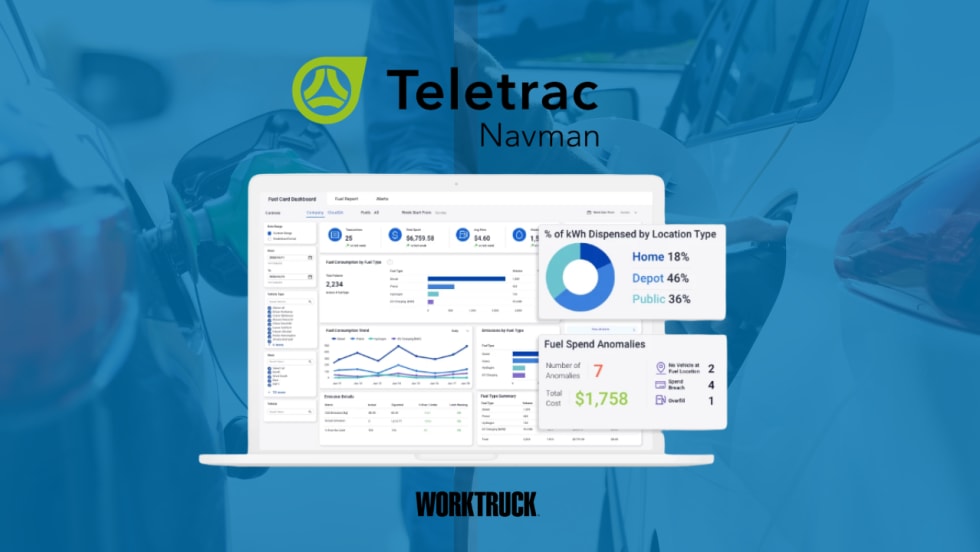
Teletrac Navman Adds Mixed-Energy Fleet Tools to TN360
The new Energy Hub combines fuel transactions, EV charging data, vehicle range, and energy costs in one dashboard for fleets operating multiple vehicle and energy types.
Read More →
WEX DriverDash adds CITGO, Expands Nationwide Access for Fleets
The DriverDash mobile payment app, by WEX, has been integrated into the CITGO merchant network, which means WEX has expanded its U.S. station footprint with the addition of approximately 4,000 CITGO locations.
Read More →
Mixed Energy Fleet Tips for Balancing EVs, Gas and Diesel Vehicles
Mixed energy fleets are becoming the new normal. Learn how fleet managers are balancing EVs, gas and diesel vehicles while controlling costs and planning for the future.
Read More →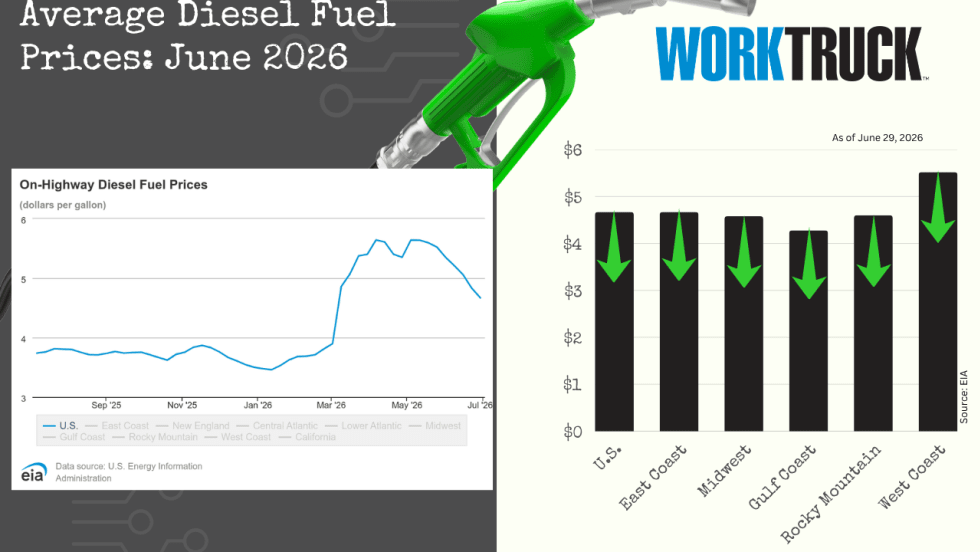
June Diesel Trends Update
The national average price of a gallon of diesel has dropped again, this week by more than 16 cents. All five regions reported lower average prices, ranging from almost 13 cents to more than 28 cents cheaper than a week ago.
Read More →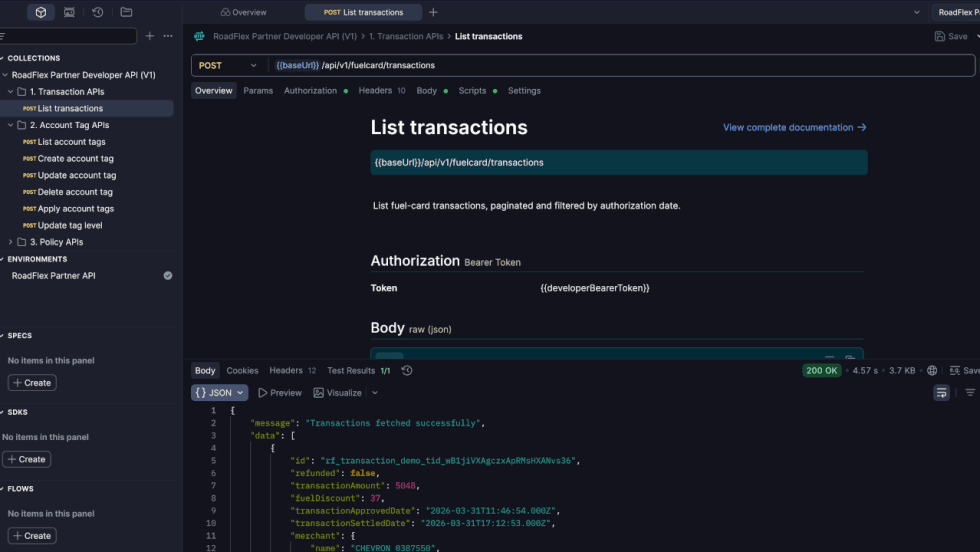
RoadFlex Launches RoadFlex Direct Open API Platform
RoadFlex Direct connects fuel cards, controls, and data to the telematics and fleet management systems fleets already run, from Geotab and Samsara to Fleetio and RTA, with no separate dashboard or double data entry.
Read More →
The Key to Fuel Efficiency Sits in the Cab
Learn how driver behavior, telematics, coaching, and fuel data can help fleets improve fuel efficiency, lower costs, and reduce emissions.
Read More →