





Learn More: How to Lead Fleetwide Compliance
2026 Regulatory & Compliance Outlook
What regulatory and compliance trends do fleets need to keep an eye on in 2026, and what is changing or new? Learn from experts what fleets need to be aware of to stay in compliance moving forward.
January 19, 2026
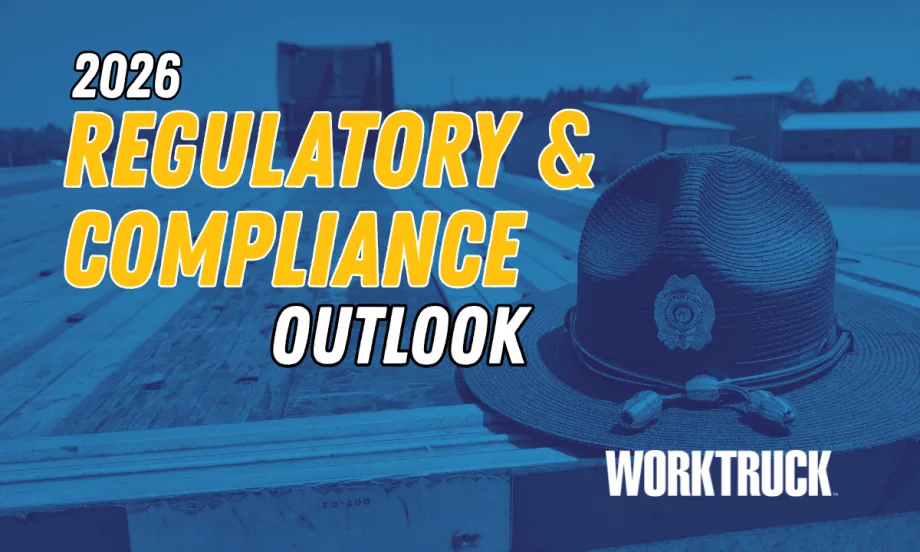
What are the regulatory and compliance trends in 2026, and what do experts think fleets should keep in mind?
Credit: Wayne Parham/Work Truck
9 min to read
Keeping all aspects of a fleet compliant can be daunting in today’s regulatory environment, whether managing emissions, tracking registrations, managing drivers’ hours of service, or complying with a myriad of state and federal requirements. In 2026, what are the anticipated regulatory trends and changes?
Anticipated Regulatory Shifts in 2026
Brent McInnis, a senior product manager at Geotab, suggested that while there may not be sweeping regulatory changes in 2026, there may be shifts in how the rules are enforced.
ELD Provider Certification
He said there’s a growing momentum to remove non-compliant Electronic Logging Devices (ELD) from the self-certified list, a move that could have real implications for fleets. Because the certification process is currently self-attested, ELD providers can appear on the list without undergoing formal validation.
“As a result, some devices may technically be listed as ‘certified’ but fall short in meeting functional or compliance standards in real-world use,” he said.
Eric Danko, head of global public policy at Samsara, pointed out that recently, the Federal Motor Carrier Safety Administration (FMCSA) has made it clear that improvements are forthcoming to the ELD certification process, which will make it more difficult for bad actors to introduce substandard products to the market.
“This recent directive is motivated by overseas providers putting out fraudulent ELD products that allow drivers to manipulate their log data prior to, or even during, roadside inspections, enabling them to exceed their Hours-of-Service (HOS) limits,” Danko explained.
Electronic Inspections
There is also a shift toward electronic inspections, which could streamline roadside checks. However, as enforcement becomes more automated and data-driven, compliance gaps could be flagged more quickly and frequently, according to McInnis.
Danko also pointed to the FMCSA's efforts to automate traditional roadside inspections through 'Level VIII Electronic Inspections,' which would allow fleets to transmit certain data captured by on-board units to inspectors while on the move, instead of stopping for a lengthy manual inspection.
Danko also explained how FMCSA is partnering with the Commercial Vehicle Safety Alliance (CVSA), technology providers, and fleets to conduct an operational test of this concept. It is still early, he said, but it is a signal of the direction the administration is trying to go in, leveraging technology to make real gains in safety and efficiency.
English Language Proficiency
The English Language Proficiency (ELP) requirement, which mandates that commercial drivers must be able to read and speak English to perform key safety-related tasks, was on the books but not enforced until June 2025, when it became an out-of-service violation. McInnis said new roadside assessments are in place.
“Heading into 2026, this enforcement is expected to remain active, prompting some fleets to reevaluate hiring practices and training programs,” McInnis said.
Hours of Service Pilot
McInnis also said the FMCSA is planning pilot programs in 2026 focused on Hours of Service (HOS) flexibility, including allowing drivers to pause the 14 -hour clock or use alternative sleeper berth splits. These pilots are limited to participating fleets, but seem to signal a broader interest in adapting the HOS rule to better reflect real-world driving conditions and fatigue management.
Broker Bonds Required
Stefan Heck, Nauto CEO and founder, said he thinks the biggest change he sees in the U.S. is that the brokers have to maintain a bond now, which will be helpful for the shippers, just in case the broker can't pay, so they're still covered.
“I think that helps mostly the smaller shippers who haven't had that much market power,” Heck said. “Of course, it still means you have to vet your brokers through the FMCSA and the SAFER website. But other than that, you know that should be a good improvement for everybody.”
Increasing Digitization
As far as shifts fleets need to consider,Stephanie Grgurich, vice president of fleet operations at Holman, sees a move to more digitization.
“More and more states are adopting digital title and registration processes. " We really imagine or expect to see states are going to accelerate that electronic titling and lien perfection requirements, which will really impact how fleets manage ownership records and need to have more real-time updating within a digital environment,” she explained.
CTC Now Twice a Year
But when it comes to compliance, there are also complexities in emissions requirements. One change, which has already occurred, is that California’s Clean Truck Check inspection requirements are no longer on an annual basis. Now, it is twice a year.
“So, for organizations that either have vehicles titled in California or even operate on the roads in California, that's a nuance that I think is really important to remember. We're going to need to have more regular updating, twice a year versus annually just at renewal,” Grgurich added.
And here’s where that twice-a-year-format can get tricky. It really does go by twice-a-year dates, so if you're late getting that first inspection of the year, it's only good until the next inspection due date, which is six months from the original date, not from the most recent inspection date.
“I really do think that for companies that are operating in and out of California, CARB (California Air Resources Board) compliance being different, twice a year, can catch fleets off guard,” she said. “It really is something that folks are playing a bit of catch-up in 2025, and we've heard rumblings that in 2027 it could go to quarterly.”
Compliance Issues That May Catch Fleets Off Guard
ForGrgurich, CARB compliance is a topic for fleets to keep an eye on, given changes.
But she also points to delayed title transfers as something to be watched. There are backlogs in various states, in the DMVs, and sometimes there can be inconsistent electronic processes that can create some exposure for fleets.
“If there are audits coming up when you're looking at compliance, really ensuring that they're monitoring those title transfers and staying on top of that work, I think, is critically important as well,” Grgurich added.
McInnis said personal conveyance (PC) is one of those regulatory areas that seems simple but can get complicated quickly. At its core, PC refers to the use of commercial motor vehicles for personal reasons while the driver is off duty, such as traveling to a hotel, going out to eat, or driving home after a drop off.
“Confusion often surrounds what qualifies as personal use versus what could be seen as advancing the load or repositioning the vehicle for business purposes,” McInnis said. “That is where fleets can run into issues, not because they are being careless, but because the line isn’t always clear and enforcement agencies are paying closer attention.”
To avoid compliance missteps, McInnis suggested fleets can consider:
Defining PC clearly in the company policy
Training drivers on acceptable vs. non-compliant scenarios using practical examples
Using ELD settings wisely, ensuring that any use of PC is properly logged and justified
Reviewing PC logs regularly to identify patterns that might raise red flags.
Driver-Related Violations & Behaviors
McInnis suggested one area that fleets should focus on is false log verification. This happens when a driver verifies a log that’s technically submitted but contains inaccurate or outdated information. He noted that this most often happens unintentionally.
He said the issue usually stems from a breakdown in the log-editing workflow and provided an example. A dispatcher might suggest a correction to a driver’s hours of service (HOS) log, but if the driver reviews and verifies it, simply assuming it's correct, that is where the problem begins.
“The verification step is critical, but it’s also where human error can creep in,” McInnis said. “Drivers may verify the wrong day, overlook an edit, or feel rushed to close out their shift. All of this can lead to non-compliant logs.”
Some simple suggestions he shared to help address this are to:
Ensure that drivers are notified clearly when log edits are suggested
Ensure there is enough time and training for them to review those edits before approving
Spot-check verifications for accuracy
“It’s not about catching drivers out, it’s about building systems and habits that support accuracy and reduce risk of audit trouble later on,” he added.
On the compliance side, Danko said the administration continues to emphasize the importance of HOS log integrity, and falsifying logs remains a top critical violation. Investigators look beyond the ELD to compare data with GPS records, fuel receipts, and Bills of Lading to uncover discrepancies, which can result in penalties averaging over $9,000.
Equipment, Inspections, & DVIR-Related Compliance Trends
Reed DesRosiers, director of product management at Samsara, said 60% of all Department of Transportation (DOT) offenses stem from vehicle maintenance violations, leading to significant financial penalties and crippling vehicle downtime.
He explained that the FMCSA also recently published changes to its Safety Management System (SMS) that split the old vehicle maintenance BASIC into two distinct categories: mechanical defects and driver-observable defects. This change is intended to clarify when a poor safety score results from drivers neglecting their pre-trip and post-trip inspections versus failures by the maintenance team.
“The increased emphasis on these vehicle maintenance violations is fueling a continued industry shift toward digitization and paperless workflows,” DesRosiers added. “Fleets are urgently seeking solutions to better manage their escalating maintenance and compliance reporting obligations.”
He also said the traditional paper-based inspection process is rapidly being replaced by AI-powered Driver Vehicle Inspection Reports (DVIRs), dramatically simplifying compliance burdens for both drivers and managers. The platform actively works to maintain compliance by triggering real-time alerts for missing DVIRs, automatically reviewing inspection results and violations, and auditing driver behavior, ultimately leading to faster inspections, streamlined repair schedules, and verifiable compliance.
Geotab’s McInnis also said fleets are moving beyond using DVIRs as just a compliance checkbox. There’sgrowing awareness that, when done right, vehicle inspection reports can improve operational performance rather than just satisfy regulatory requirements.
“As more fleets adopt ELDs with integrated telematics, they’re connecting DVIRs directlyinto their maintenance and safety systems,” McInnis explained. “Now, when a defect is reported, whether it’sa tire issue, a broken light, or brake wear, it can trigger a real-time alert, prioritize arepair, or be paired with diagnostic data from the vehicle.”
The trend is toward smarter, connectedcompliance, and McInnis said this integration helps reduce downtime, ensures issues aren’t overlooked, and providesbetter documentation in case of an audit.
Heck noted that overseas, there are increased vehicle safety standards on both new commercial and non-commercial vehicles.
“Europe's really leading the charge on pedestrian collision warning, driver drowsiness and distraction detection. So those are really good safety systems,” Heck explained. “I think those things will eventually make their way to the US, but there's no timeline for when they get implemented in the U.S.”
Preparing For Emissions Regulations or Changes
State-level emissions regulations are evolving, and fleets should be aware of changesthat could affect how they manage vehicle compliance. Programs like CTC and others, McInnis pointed out, are exploring remote emissions monitoring using vehicle telematics and onboard diagnostics.
“As other states consider adopting similar models, fleets may want to assess how their current systems support data reporting, diagnostics, and emissions visibility,” McInnis explained. “While approaches may vary by jurisdiction, having tools and processes in place that can support evolving requirements, whether through in-house tools or third-party partnership, could help fleets remain agile.”
“The complexity is real. It is challenging to stay up to date and on top of all the changes, because we're not just talking about a single federal regulation or a single change. It really is state by state, and at times it's not just the DMV, but we're talking about regulatory boards and organizations that are also monitoring emissions and safety requirements,” said Grgurich.
Subscribe to Our Newsletter
More Operations
Family Ties Inside the Fleet Families Building Careers Across Generations
Three fleet families share what it really takes to work together, learn across generations, and keep business from following them home.
Read More →
Shades of Fleet Call for Voices: Fleet's Hidden Heroes
Fleet’s hidden heroes are often the ones keeping everything moving behind the scenes. September’s Shades of Fleet is looking for dispatchers, coordinators, parts specialists, and other support pros to share their stories.
Read More →
Truck Centers, Inc. Celebrates National Truck Driver Appreciation Week with $1,000 Fuel Card Giveaways
During National Truck Driver Appreciation Week, Truck Centers, Inc. is offering customers a chance to fuel up for free. Customers at all Truck Centers locations can enter to win one of four $1,000 fuel cards from Sept. 14 - 18.
Read More →
Fleet Guides, AI Time-Savers, Truck Tariffs & Fuel Strategy Lead the News
This week’s Truck Chat Cheat Sheet covers new fleet vehicle guides, practical AI use cases, U.S.-Canada truck production, mixed-energy strategy, and more.
Read More →
What Fleet Employers Are Missing When Hiring Veterans
What if some of the strongest candidates for fleet are already out there, but their experience is written in a language our industry does not always recognize?
Read More →
Automotive Fleet Opens 2026 Personal Use Survey for Commercial Fleet Managers
Less than two weeks left! Commercial and corporate fleet managers are invited to share how their organizations handle company vehicle personal-use policies, charges, and driver eligibility.
Read More →
What Resilient Fleets Do Differently When Conditions Change
Fleet resilience is about more than reacting to disruption. Lauren Fletcher talks with AP Fleet’s Alex Coveney about flexibility, planning, scaling, and what helps fleets adapt when business conditions shift.
Read More →
If We Want the Next Generation in Automotive, We Have to Give Them a Reason to Care
The automotive industry talks constantly about its workforce shortage. But before we can recruit the next generation, we may need to do a better job giving kids a reason to care about automotive in the first place.
Read More →
Ram ProMaster City Under $40K, Truck Tariffs, and AI Maintenance Lead the News
A sub-$40K commercial van, tariff questions, AI-powered maintenance, and a new EV production strategy headline this week’s Truck Chat Cheat Sheet.
Read More →
Bob Adamsky Shares the Fleet Lessons You Usually Learn the Hard Way
After more than 30 years in fleet, Arrow International’s Bob Adamsky has learned that the job is about far more than vehicles. He shares the lessons he wishes every fleet manager could learn a little earlier.
Read More →