




Propane Autogas and Permitting Needs
When switching to propane autogas, local propane providers and infrastructure suppliers help determine the best refueling setup for a fleet. But, prior to any infrastructure installation, fleet customers will need to navigate the permitting process for their jurisdiction.
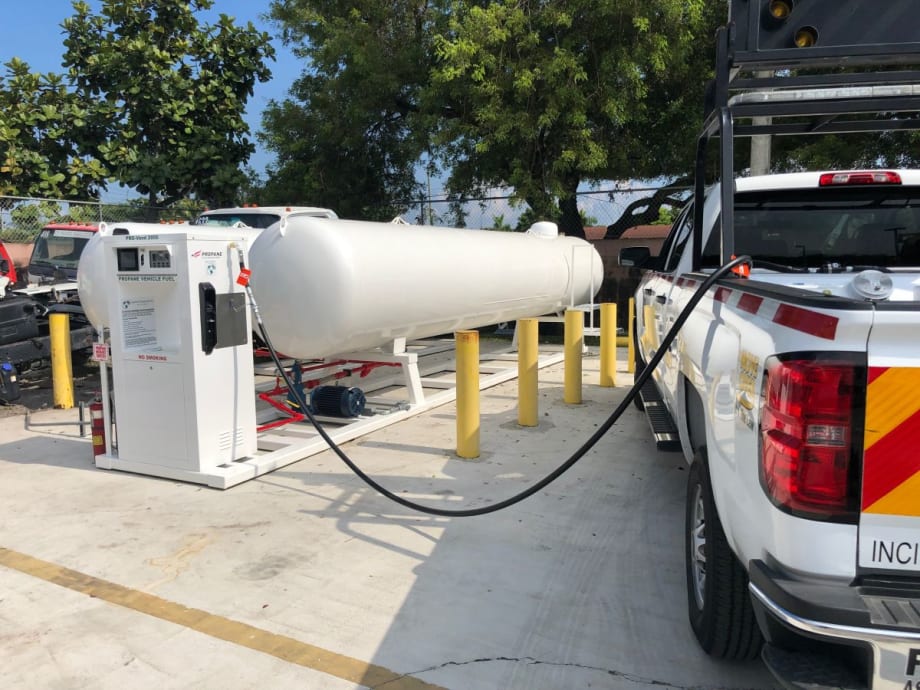
Reputable infrastructure suppliers provide knowledge and experience necessary to provide a safe and legally compliant turnkey, propane autogas system.
Photo: Superior Energy Systems
Fleets of any size can benefit from a centralized propane autogas refueling station. It’s convenient, safe to use, and can save time and money.
When switching to propane autogas, local propane providers and infrastructure suppliers help determine the best refueling setup for a fleet. They are dedicated to making the process turnkey and easy.
A permanent, on-site refueling station usually includes a concrete foundation, one or more large-capacity fuel tanks, a pump, one or more dispensers with meters, and crash protection.
Permitting Before Installation
Prior to infrastructure installation, fleet customers will need to navigate the permitting process for their jurisdiction. Permitting is controlled by the authority having jurisdiction (AHJ). Depending on location, several AHJ levels can exist.
For instance, one location may require approval from a fire marshal, state officials and city officials, but another location may only require approval from one individual. In general, larger metropolitan areas have additional levels of AHJ.
Every jurisdiction has different requirements for permitting processes, but the most common permits required include electrical and building.
Building permits relate to the entire system installation, which includes concrete, propane tank(s), piping, dispenser, and skid systems. Many times, building permits are granted by the city or county.
Generally, the equipment or fuel supplier that is installing the propane autogas refueling station secures the building permits by supplying drawings and other necessary information, or the customer may choose to do it.
At times, professional engineer stamped drawings, as well as adherence to additional requirements or ordinances, are required, which can increase the amount of time, effort and money needed to gain the permit. In addition, geographical locations can play a role; circumstances such as hurricane and seismic zones and adverse weather locations affect permitting requirements.
Additional Permit Details
The amount of time necessary to gain a building permit generally averages two weeks, but can take up to several months, depending on the permitting office’s workload. Final inspections are almost always required to complete and put the system into service.
Electrical permits are required when new electricity is being installed to power the station. Usually an electrical permit is easily gained by a licensed electrician, hired by the customer or infrastructure supplier, who is well-versed with local requirements. Following installation, an inspection is required for approval.
Some less-common permits include pressure piping, concrete and plumbing permits, which are sometimes necessary depending on how the AHJ classifies propane piping. At times, mechanical permits are also required to confirm that the entity installing the refueling station is a licensed mechanical contractor. In addition, structural permits can be required.
Propane Permit Costs
Permit cost can range from $500 to $10,000 depending on the size of the project, and are paid for by the customer that is installing the refueling station.
At times, the cost will be a flat fee, usually a few hundred dollars and other times it will be based off a percentage of the total job cost.
Larger jurisdictions are more likely to base permit costs off a percentage of the total job cost.
Reputable infrastructure suppliers provide knowledge and experience necessary to provide a safe and legally compliant turnkey, propane autogas system. The supplier is generally able to provide the engineering drawings necessary to pull various permits, which can help avoid pitfalls associated with permitting and AHJ challenges.
About the Author: Crystelle Markley is marketing director for Superior Energy Systems, based in Columbia Station, Ohio. She can be reached at crystelle@superiornrg.com.
More Green Fleet

Fleet Forward Conference Introduces One-Day Passes for 2026
New one-day registration gives fleet professionals the flexibility to attend Tuesday, Wednesday, or Thursday, with passes available for $199 through Sept. 18.
Read More →
CALSTART Rebrands as Catalyst Mobility, Will Combine with Forth in 2027
CALSTART has rebranded as Catalyst Mobility and will combine with Forth at the start of 2027. The new organization said it is poised to become one of the world's largest, strongest, and most impactful clean transportation nonprofits.
Read More →
Electric Truck and Charging Programs to Boost Sustainability at NY & NJ Ports
Together, the Port Authority of New York and New Jersey and CALSTART will electrify drayage and terminal operations serving the East Coast’s busiest container port. A pair of incentive programs totaling $45 million has launched to accelerate adoption of zero-emission drayage trucks and terminal tractors.
Read More →
Xos Hub Surpasses One Gigawatt-Hour of Energy Delivered in the Field
A single Xos Hub has surpassed one gigawatt-hour of energy across more than 33,600 charging sessions in the field, demonstrating performance that supports Xos' expansion across new products and markets.
Read More →
Carrier Transicold Launches All-Electric Vector 8200 TRU for Diesel-Free On-Site Cold Storage
Carrier Transicold’s first engineless multi-temperature TRU helps fresh- and frozen-food fleets add supplemental cold storage capacity during seasonal peaks.
Read More →
Narro Trucks Introduces Electric Utility Vehicle
Narro Trucks officially launched its operations on Aug. 20 and hosted a ride and drive to showcase its electric truck, which will be produced in Virginia.
Read More →
Samsung SDI Takes Full Control of GM Battery JV as Indiana Plant Pivots to Energy Storage
Samsung SDI is taking full control of its Indiana battery plant with GM, marking a major shift from the EV-focused joint venture Charged Fleet first covered in 2023.
Read More →
NWSA Taps CALSTART to Administer Zero-Emission Drayage Assistance Program
CALSTART will provide free technical assistance services to drayage fleets serving the Ports of Seattle and Tacoma and looking to transition to cleaner technologies and help decarbonize freight hubs.
Read More →
EV Fleet Reality Check: What Operators Wish They Knew Before Electrifying Their Work Vans
Electric work truck upfits bring new compatibility questions. Learn how parts availability, OEM guidance, power demands, and route planning can affect fleet performance.
Read More →
Peterbilt Expands Sourcewell Partnership with Electric Vehicle Lineup
Peterbilt Motors Company’s cooperative purchasing agreement with Sourcewell and its Canadian partner, Canoe Procurement Group, now includes including Peterbilt's battery-electric vehicle lineup.
Read More →