





Fleet Tips: Optimizing Your Work Truck Budget
Navigating Value Trends for Light- and Medium-Duty Trucks
Learn how economic shifts and market dynamics are shaping vehicle depreciation trends and impacting fleet management strategies.
October 29, 2024
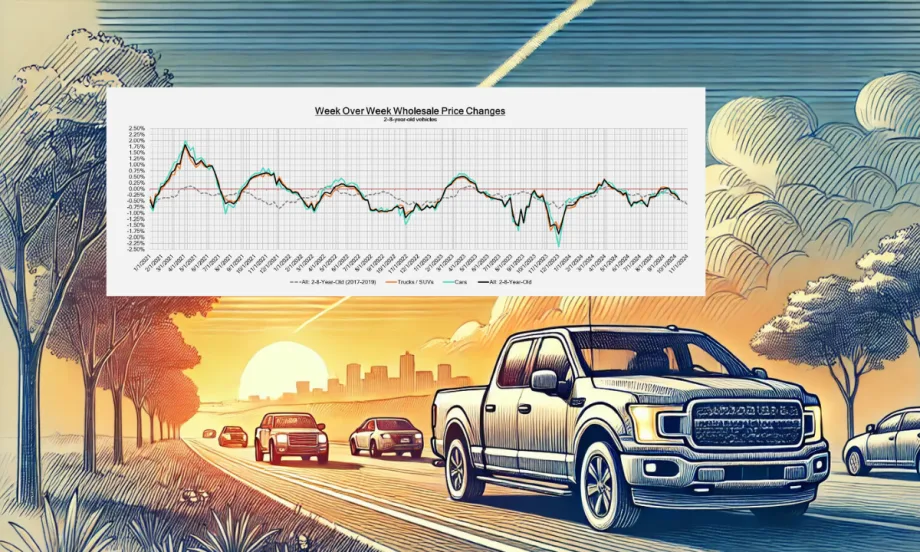
A visual representation of depreciation trends in the light- and medium-duty truck segments, highlighting the recent normalization of vehicle values after a 2022 peak.
Photo: This utilizes an AI-generated image. Refer to our Terms of Use.
6 min to read
Fleet managers face evolving challenges as depreciation trends shift, making strategic vehicle management more important than ever for optimizing costs.
Photo: Work Truck
As the commercial fleet industry adapts to economic shifts and evolving technology, understanding vehicle depreciation trends is more crucial than ever. This knowledge empowers fleet managers, whether their fleet consists of light-duty trucks for service technicians or medium-duty units supporting logistics operations, as depreciation has emerged as a critical factor impacting total cost of ownership (TCO) and overall financial strategy.
"The depreciation rates for light- and medium-duty trucks are influenced by a variety of market dynamics, economic conditions, and sector-specific trends," explained Andrew Floto, Manager of U.S. Residual Values at Black Book. "Recent years have seen a significant valuation 'bubble,' peaking in early 2022 and steadily dissolving over the last 24 months. Currently, values remain inflated compared to pre-2020 levels, primarily due to low used truck supply and high new truck costs."
This nuanced picture of the commercial fleet market has left operators navigating uncharted waters. As new trucks became costlier and scarcer, many fleet managers held onto existing units longer than anticipated. This has created a ripple effect on depreciation rates and vehicle management strategies.
Let’s break down what these shifts mean for fleet operators managing light- and medium-duty truck segments and explore how to optimize your approach.
Market Shifts: The 12-Month Perspective
Over the past year, the market for used light- and medium-duty trucks has been characterized by notable volatility.
Amber Powell, Director of Vehicle Management at Black Book noted, "Increased demand remains strong for SUVs, trucks, and utility vehicles, despite the challenges of low used vehicle supply and high new vehicle costs combined with high interest rates."
However, market behaviors differed between light- and medium-duty segments.
Light-duty trucks, often influenced by consumer preferences and economic conditions, experienced fluctuations. For instance, Ford’s F-Series saw a 10.3% sales drop in early 2024, while Chevrolet’s Silverado 1500 posted a modest 2% increase.
Meanwhile, medium-duty trucks exhibited more stability, buoyed by a consistent 10.8% sales increase in 2023, driven by a surge in e-commerce and last-mile delivery solutions. This divergence underscores the different drivers of demand between the two categories.
“For light-duty trucks, consumer spending and personal vehicle preferences play a larger role, leading to more volatility,” added Mark Simpson, Manager of U.S. Wholesale Valuations for Black Book. “In contrast, medium-duty trucks are more commercially focused, with sales driven by infrastructure projects and the demand for logistics services.”
Why Depreciation Matters: A Fleet 101 Overview
Depreciation may be just one part of the TCO equation, but it is the single most influential factor affecting a fleet's long-term financial health.
“Depreciation directly impacts a fleet’s financial health and efficiency,” stated Floto. “It’s the cornerstone of TCO, affecting not only vehicle purchase and replacement costs but also operational budgets.”
Understanding depreciation allows fleet managers to optimize vehicle replacement cycles, balancing acquisition costs and operational expenses with higher resale values. Lower depreciation rates translate into higher resale values, which can significantly offset initial purchase costs. Conversely, higher depreciation rates can result in substantial financial losses when vehicles are eventually sold.
“Knowing market dynamics and anticipating trends, such as the influx of high-volume rental or lease vehicles, enables fleet operators to sell vehicles at optimal times to maximize returns,” Simpson advised.
Adopting a proactive approach to depreciation management can help fleets better preserve capital and enhance overall profitability. This strategic mindset puts fleet managers in control, allowing them to optimize their financial health.
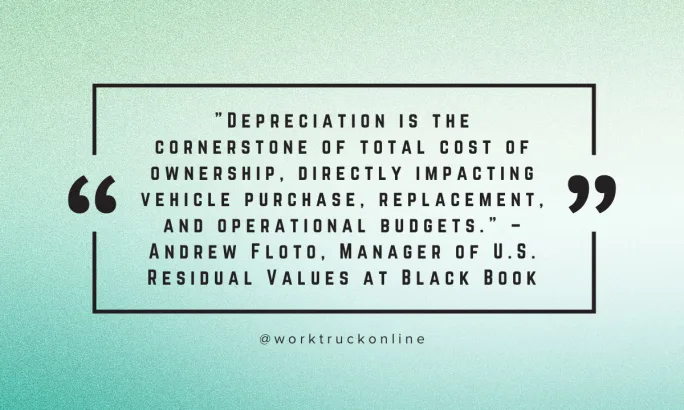
Depreciation plays a critical role in fleet management, influencing purchase decisions, replacement timing, and overall budget strategies.
Photo: Work Truck
Age, Mileage, and Condition: The Triple Impact
While economic conditions play a pivotal role, the depreciation of fleet vehicles is also heavily influenced by age, mileage, and condition.
“Age is an inevitable factor — as all vehicles degrade in value over time, even if they are not actively driven,” Powell emphasized. “But high mileage and poor condition can accelerate depreciation significantly.”
To mitigate these factors, fleets must maintain vehicle condition and implement a strategic replacement cycle. Regular upkeep and timely repairs are essential.
“Vehicles in excellent condition with detailed service records generally retain their value longer, which can be a huge advantage in today’s market,” Floto noted.
For example, fleets can implement optimized routes to reduce unnecessary mileage and manage vehicle utilization more effectively. Maintaining detailed service records supports higher resale values and provides transparency to potential buyers.
Emerging Trends: The Influence of Technology and Configuration
Technology integration is becoming a major determinant of vehicle value in commercial fleets.
Advanced safety features, fuel-efficient engines, and electrified powertrains are all factors that can either mitigate or exacerbate depreciation.
“Trucks equipped with the latest safety systems and electrification technology often experience lower depreciation rates due to strong market demand,” Powell explained. “These features contribute to reduced operational costs, greater driver safety, and compliance with regulatory requirements.”
However, fleet buyers should weigh the initial cost of these technologies against potential resale value.
“Some technologies can have an outsized initial cost relative to the proceeds they generate in the used market, leading to a negative value proposition for fleets,” Powell warned.
Beyond technology, certain makes, models, and configurations have shown better value retention.
“Trucks known for reliability and durability, and those featuring efficient engines and advanced transmission systems, tend to maintain their value well,” Simpson shared.
Higher trim levels, including advanced safety features, technology, and comfort options, are especially attractive in the secondary market and retain value better than base models.
Economic Climate and Depreciation: Interest Rates and Fuel Costs
One of the more immediate factors impacting truck depreciation is the current economic climate, particularly interest rates and fuel costs.
“Higher interest rates increase the cost of financing vehicle purchases, which can reduce the demand for new trucks and impact residual values,” Floto observed. Elevated fuel costs also play a role, making less fuel-efficient vehicles less desirable and thus accelerating their depreciation.
“Trucks with better fuel economy or alternative fuel systems, such as hybrids or electrics, tend to retain their value better, appealing to operators looking to reduce operating costs,” Powell added.
With economic uncertainty on the rise, businesses may delay purchasing new vehicles, increasing the utilization of current fleet trucks and affecting their resale value.
The Road Ahead: Preparing for Future Depreciation Trends
Looking forward, fleet operators should brace for ongoing fluctuations in depreciation rates over the next two to three years. The low used vehicle volume resulting from supply chain disruptions during the pandemic has created a high-demand market for good condition used vehicles.
However, with acquisition costs and high interest rates currently stifling demand, depreciation trends could shift as soon as economic conditions change.
“Interest rates are expected to fall in the near future, which could increase vehicle demand,” Floto forecasted. “Fleet managers should proactively sell or have already sold part of their aging fleet and prepare to acquire new vehicles later in the year when incentives are high.”
In addition to macroeconomic factors, integrating advanced technologies like autonomous driving features, electrification, and growing environmental regulations will influence future depreciation.
As these changes unfold, the role of data analytics and predictive modeling will grow, empowering fleets to make informed decisions about vehicle acquisition and disposition.
Subscribe to Our Newsletter
More Remarketing & Lifecycle

Ford Pro Launches Certified Pre-Owned Program for Class 1-7 Work Trucks
Ford Pro Advantage brings manufacturer-backed inspections, warranties, roadside assistance, and service support to used Class 1-7 commercial trucks and vans.
Read More →
The Hidden Cost of Idling
A low-mileage truck can still be one of the fleet’s hardest-working and most worn assets. Engine hours, idle time, and duty cycle reveal what the odometer misses.
Read More →
Building a Better Vehicle Replacement Model
Meter readings still matter, but engine hours, idle time, maintenance trends, and utilization can help fleets spot costly vehicles before the odometer does.
Read More →
AP Fleet Management Expands Remarketing Program for Commercial Work Trucks
AP Fleet Management expanded its commercial vehicle remarketing program with dedicated resale services and an online marketplace for used work trucks.
Read More →
What Actually Makes a Truck Reliable for Fleets?
What makes a truck reliable for fleets? From uptime to maintenance and spec’ing, here’s what really drives performance, and where fleets can weigh in.
Read More →
REP Inspection Services Launches, Delivering Professional Equipment Inspections
REP Inspection Services, led by someone with more than 30 years of industry experience, has launched its professional inspection services for trucks, trailers, and equipment across the commercial vehicle industry.
Read More →
Introducing Work Truck’s 2025 Remarketing Report Series
Work Truck’s 2025 Remarketing Report Series uncovers how data, timing, and technology are reshaping resale value and driving smarter fleet strategies.
Read More →
Fleet Remarketing Outlook 2026: EVs, Policy, and the Power of People [Part 4]
From EVs to policy changes, the 2026 fleet remarketing outlook is all about people, progress, and finding opportunity in stability.
Read More →
Digital Fleet Remarketing: How Tech and Transparency Build Buyer Confidence [Part 3]
Technology and trust are reshaping fleet remarketing in 2025. See how data, transparency, and partnerships drive better resale outcomes.
Read More →
Fleet Replacement Strategy 2025: When to Hold and When to Fold [Part 2]
Knowing when to sell or hold is key in 2025. Discover how fleet professionals use data and TCO insights to make smarter remarketing calls.
Read More →