




NSC: Traffic Crashes Killed More Than 44,000 in 2023
The National Safety Council, based on its preliminary analysis, estimates 44,450 people died in traffic crashes in 2023. That marks a slight decline from 2022, but a large increase compared to pre-pandemic 2019.

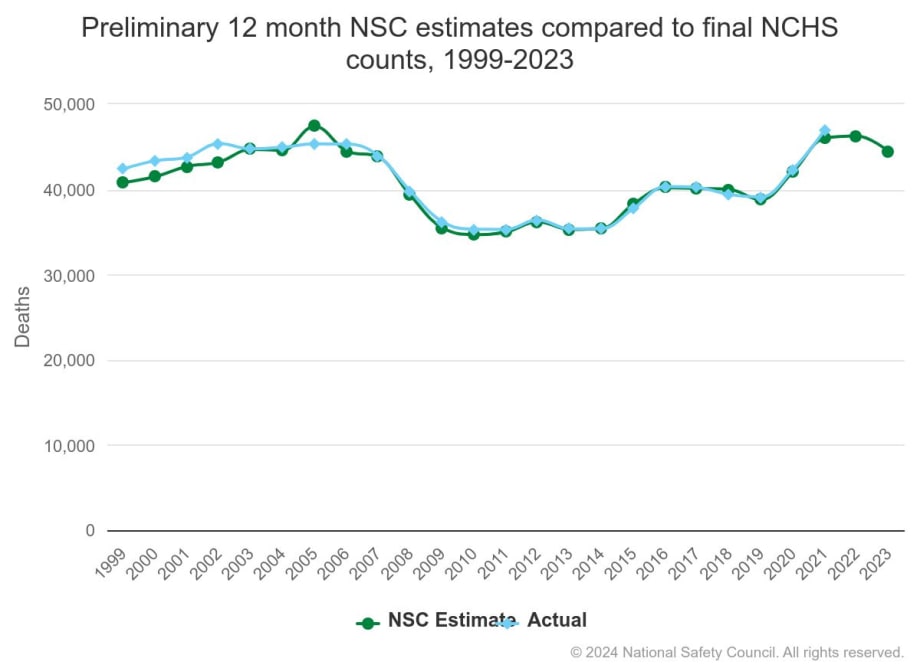
The National Safety Council's 12-month fatality estimates, preliminary and final, are shown since 1999.
Source: National Safety Council
Preliminary analysis from the National Safety Council shows motor vehicle fatalities in the United States remain at a devastatingly high level, as an estimated 44,450 people died in traffic crashes in 2023. While it marks a 4% decline from 2022, compared to pre-pandemic 2019, it’s a 13.6% uptick.
Contributing Safety Issues
Safety issues such as speeding, distracted and impaired driving are all contributing factors to the tens of thousands of people lost in NCS called preventable crashes on U.S. roads each year. To address the importance of policies that support a Safe System Approach to eliminate motor vehicle fatalities, NSC and its advocacy partners are heading to Capitol Hill to meet with federal legislators during infrastructure week to advocate for much-needed change.
“The most dangerous thing most people in our country do in a single day is use the U.S. roadway system. This public health crisis is an atrocity that must continue to be addressed,” said Mark Chung, executive vice president of roadway practice at NSC. “No one should die getting to or from their homes, schools and workplaces, but the current system was not designed with the safety of all road users in mind.”
States with a Decrease in Fatalities
According to the analysis, 12 states experienced decreases in motor vehicle fatalities of 10% or more in 2023. Those states are:
Alaska
Maine
Delaware
Hawaii
Massachusetts
Connecticut
New Jersey
New Mexico
Utah
Georgia
New York
Louisiana
States with an Increase in Fatalities
Conversely, seven states and the nation’s capital experienced increases of 10% or more compared to 2022 preliminary estimates. In addition to the District of Columbia, those states are:
Rhode Island
Arizona
Idaho
Iowa
North Dakota
Maryland
Kentucky
Safe System Approach
Embracing the Safe System Approach at national, state, and local levels is a critical step toward eliminating traffic fatalities nationwide, NSC said.
The Safe System Approach takes a holistic look at road safety by examining five elements of a safe transportation system:
Road users
Speed management
Vehicles
Roads
Post-crash care
Over two years ago, the U.S. Department of Transportation adopted the approach in its National Roadway Safety Strategy and NSC joined as an Ally in Action, pledging to do its part to save lives on the roads. The road ahead may be long, but the shared commitment to saving lives is real and zero is possible, NSC added.
Data Increases/Decreases
Motor vehicle fatality estimates are subject to slight increases and decreases as data mature. The National Safety Council uses data from the National Center for Health Statistics, an arm of the CDC, so that deaths occurring within 100 days of the crash and on both public and private roadways – such as parking lots and driveways – are included in the council’s estimates.
The National Safety Council has calculated traffic fatality estimates since 1913. Supplemental estimate information, including estimates for each state, can be found online.
More Safety

Volvo Trucks Releases New Safety Recommendations for Traveling with Pets
One of the most important recommendations for professional drivers traveling with pets is to ensure pets are properly restrained while the truck is moving. Other tips are available in the new guide from Volvo Trucks North America and Center for Pet Safety.
Read More →
API Issues Refueling Safety Guidelines
The American Petroleum Institute offers a list of safe vehicle refueling guidelines, including ways to avoid potential problems with static electricity discharges in fall, winter, and early spring.
Read More →
Winter Fleet Prep: Expert Tips to Keep Vehicles Running Smoothly
Cold weather can expose weak batteries, tires, fuel systems, and maintenance gaps fast. Use this winter fleet checklist to prepare trucks and drivers before temperatures drop.
Read More →
When a Work Truck Breaks Down, the Job Can Stop, Too
A work truck breakdown can stop more than the vehicle. Discover how payloads, jobsites, and specialty equipment change the roadside response.
Read More →
What Stronger Long-Term Fleet Service Partnerships Actually Require
Fleet service partnerships rarely fall apart all at once. Learn the three warning signs that trust is eroding and what fleets and providers can do before downtime, frustration, and lost revenue follow.
Read More →
Applause & TRUCE Software Partner to Improve Driver Safety Through AI-Powered Telematics & Employee Performance Management
Applause has integrated TRUCE driving metrics directly into its employee-first performance and safety platform that transforms mobile devices into AI-powered telematics.
Read More →
How Detroit Assurance with Active Brake Assist Works
Do you want to see what it is like to experience Detroit Assurance’s Active Brake Assist? In this video, Work Truck will put you in the cab to see how it all works and then hear more details from DTNA’s Mike Young.
Read More →
Get Left of Loss: A 5-Step Workplace Violence Prevention Framework for Fleet Operators
Violence risks do not stop at the driver’s door. Learn five practical steps fleets can take to spot threats early and protect workers before loss occurs.
Read More →
How Better Visibility Cut Speeding Violations by 48%
Fleet leaders don't need more data, they need clearer visibility into what the data is saying. This case study explores how one utility replaced speeding-event counts with a single metric — miles driven in violation — to strengthen safety and significantly reduce speeding violations.
Read More →
13 Safe Driving Tips for Commercial Vehicle Drivers
Make sure you are spending time on the road safely with these important tips.
Read More →