




Walmart Showcases Truck of the Future
The Walmart Advanced Vehicle Experience is a tractor-trailer combination that features leading edge aerodynamics, an advanced turbine-powered range extending series hybrid powertrain, electrified auxiliary components, and sophisticated control systems all in one package.
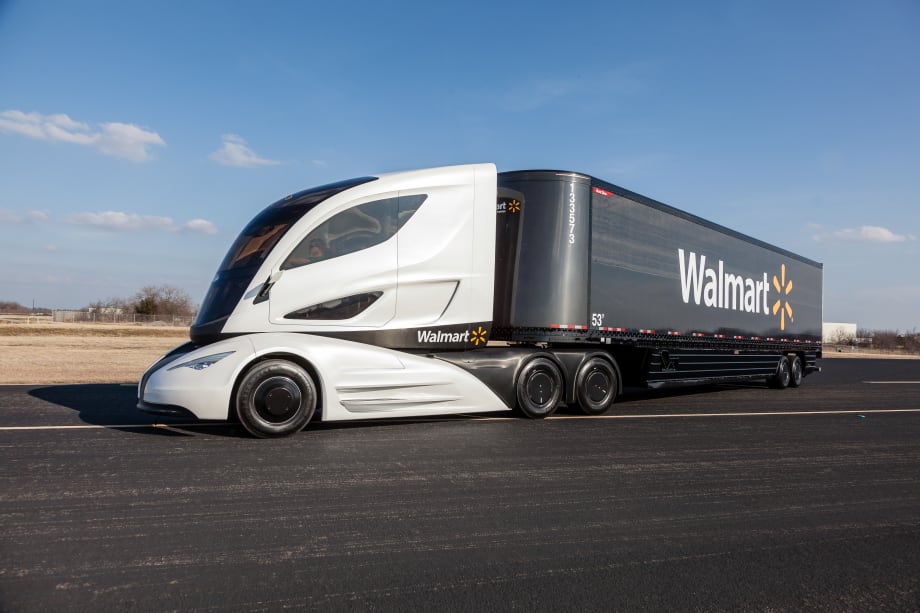
The Walmart Advanced Vehicle Experience is the result of a partnership between many vendor partners. This prototype combines aerodynamics, mictroturbine-hybrid powertrain, electrification, advanced control systems, and cutting edge materials like carbon fiber all in one vehicle. (PHOTO: WALMART)
Walmart showcased its futuristic truck at the Mid-America Trucking Show (MATS) in Louisville, Ky. The Walmart Advanced Vehicle Experience is a tractor-trailer combination that features leading edge aerodynamics, an advanced turbine-powered range extending series hybrid powertrain, electrified auxiliary components, and sophisticated control systems all in one package, developed in support of the company’s industry-leading sustainability program.
In 2005, Walmart, one of the nation’s largest private fleet operators, announced its goal to double fleet efficiency by 2015. Walmart trucks log millions of miles every year, so when it comes to sustainability and fleet efficiency, the goal is simple: deliver more merchandise while driving fewer miles on the most efficient equipment. As of last year, the company had achievedan 84-percent improvement in fleet efficiency over its 2005 baseline.
Although the prototype currently runs on diesel, its turbine is fuel neutral and can run on compressed or liquid natural gas, biofuels or other fuels.
The prototype is the result of collaboration between Walmart and many vendors, including Peterbilt, ROUSH Engineering, Great Dane Trailers, and Capstone Turbine.
About the Walmart Advanced Vehicle Experience
Tractor: Walmart and Peterbilt have collaborated on aerodynamic, hybrid, electrification and alternative fuel projects in the past, each with incremental gains in fuel efficiency and emission reductions. The Walmart Advanced Vehicle Experience tractor combines many of these projects in a single vehicle.
Aerodynamics: Designers used extensive computational fluid dynamics (CFD) analysis to optimize the truck’s styling. The truck’s shape represents a 20 percent reduction in aerodynamic drag over Walmart’s current Peterbilt Model 386. By placing the cab over the engine, the truck’s wheelbase is greatly shortened, resulting in reduced weight and better maneuverability. Walmart relied on product development supplier Roush Engineering to carry out the vehicle’s construction with these detailed design specifications.
Range Extending Series Hybrid: Range extending hybrids are a synergy between electric trucks and series hybrids, and their design reduces the energy storage size required for trucks to run on batteries alone. With Walmart Distribution Centers now located closer to metropolitan areas, transport vehicles have shorter transit times to their delivery destinations. These shorter trips reduce the vehicles’ average trip speed and create more opportunities to recover energy through regenerative braking. The generator and energy storage on the truck are scalable based on the range desired.
Turbine Power: The truck features a microturbine Range Extender generator developed by Capstone Turbine Corporation. The company also engineered the truck’s integrated hybrid drivetrain solution. The use of a hybrid powertrain allows the turbine to remain at optimum operating revolutions per minute (RPM), while the electric motor/energy storage handles acceleration and deceleration. A longer-range version of this powertrain would feature a larger turbine and smaller energy storage system.
Fuel Neutral Capability: Turbines by their nature are fuel neutral and produce very low emissions without the need for aftertreatment. Turbines are also appealing because of their few moving parts, low maintenance requirements and lighter weight.
Component Electrification: With automobiles moving to electrified accessories such as power steering and air conditioning, this truck scales those systems up for use on a larger vehicle. These electrified components are used only when needed and at peak efficiency.
Charge Mode: When keyed on, the truck automatically detects the state of charge of the batteries and starts charging them, if needed, using the turbine engine. Charge mode can be manually selected if an operator wishes to “top off” the batteries prior to shutting down.
Electric Vehicle Mode: For use in urban areas, the truck will run on electric power alone until the battery state of charge hits 50 percent. At that time the turbine will automatically start and begin charging the batteries.
Hybrid Electric Mode: For maximum range, this mode runs the turbine continuously, only shutting down if the batteries run out.
Trailer: The vehicle’s trailer, manufactured by Great Dane Trailers, offers a host of fuel-saving features. The trailer body is built almost exclusively with carbon fiber, including one-piece carbon fiber panels for the roof and sidewalls, saving nearly 4,000 pounds when compared to traditional designs. The trailer’s convex nose also enhances aerodynamics while maintaining storage space inside the trailer. Other special features of the trailer include special low-amperage LED lighting strips, composite trailer skirts, aerodynamic disc wheel coverings, a Posi-lift suspension, and a one-piece, fiberglass-reinforced floor panel with a 16,000 pound forklift rating.
More Green Fleet

Fleet Forward Conference Introduces One-Day Passes for 2026
New one-day registration gives fleet professionals the flexibility to attend Tuesday, Wednesday, or Thursday, with passes available for $199 through Sept. 18.
Read More →
CALSTART Rebrands as Catalyst Mobility, Will Combine with Forth in 2027
CALSTART has rebranded as Catalyst Mobility and will combine with Forth at the start of 2027. The new organization said it is poised to become one of the world's largest, strongest, and most impactful clean transportation nonprofits.
Read More →
Electric Truck and Charging Programs to Boost Sustainability at NY & NJ Ports
Together, the Port Authority of New York and New Jersey and CALSTART will electrify drayage and terminal operations serving the East Coast’s busiest container port. A pair of incentive programs totaling $45 million has launched to accelerate adoption of zero-emission drayage trucks and terminal tractors.
Read More →
Xos Hub Surpasses One Gigawatt-Hour of Energy Delivered in the Field
A single Xos Hub has surpassed one gigawatt-hour of energy across more than 33,600 charging sessions in the field, demonstrating performance that supports Xos' expansion across new products and markets.
Read More →
Carrier Transicold Launches All-Electric Vector 8200 TRU for Diesel-Free On-Site Cold Storage
Carrier Transicold’s first engineless multi-temperature TRU helps fresh- and frozen-food fleets add supplemental cold storage capacity during seasonal peaks.
Read More →
Narro Trucks Introduces Electric Utility Vehicle
Narro Trucks officially launched its operations on Aug. 20 and hosted a ride and drive to showcase its electric truck, which will be produced in Virginia.
Read More →
Samsung SDI Takes Full Control of GM Battery JV as Indiana Plant Pivots to Energy Storage
Samsung SDI is taking full control of its Indiana battery plant with GM, marking a major shift from the EV-focused joint venture Charged Fleet first covered in 2023.
Read More →
NWSA Taps CALSTART to Administer Zero-Emission Drayage Assistance Program
CALSTART will provide free technical assistance services to drayage fleets serving the Ports of Seattle and Tacoma and looking to transition to cleaner technologies and help decarbonize freight hubs.
Read More →
EV Fleet Reality Check: What Operators Wish They Knew Before Electrifying Their Work Vans
Electric work truck upfits bring new compatibility questions. Learn how parts availability, OEM guidance, power demands, and route planning can affect fleet performance.
Read More →
Peterbilt Expands Sourcewell Partnership with Electric Vehicle Lineup
Peterbilt Motors Company’s cooperative purchasing agreement with Sourcewell and its Canadian partner, Canoe Procurement Group, now includes including Peterbilt's battery-electric vehicle lineup.
Read More →