




Keep Fleet Drivers Safe from UV Rays
Follow the Skin Cancer Foundation’s guidance and take a comprehensive approach to protecting drivers from the sun.

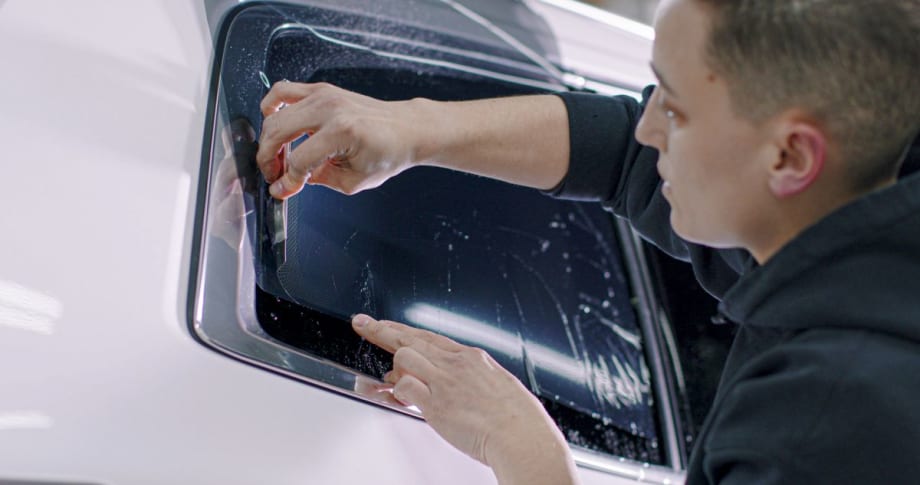
Drivers who spend a lot of time on the road should be particularly concerned about sun exposure. A 2010 study showed Americans who spent more time driving were more likely to develop skin cancer on their left side.
Photo: Avery Dennison
Skin Cancer Awareness Month is an annual May initiative of the nonprofit Skin Cancer Foundation, which for more than 40 years has been helping people understand the importance of skin cancer prevention, early detection, and prompt, effective treatment.
As a member of the Foundation’s Corporate Council, Avery Dennison Graphics Solutions is proud to encourage people to be proactive about daily sun protection, including through the use of non-reflective automotive window film.
According to the Foundation, with over 5 million cases diagnosed in the United States each year, skin cancer is America’s most common cancer. More people are diagnosed with skin cancer each year in the U.S. than all other cancers combined. Fortunately, skin cancer is also one of the most preventable forms.
Ultraviolet radiation (UVA and UVB) from the sun causes skin cancer. UV rays also damage your eyes and cause your skin to lose elasticity, sag, stretch, bruise more easily, and age prematurely. Most of us are aware of these important ways to protect ourselves from the sun, as noted by the Skin Cancer Foundation:
Avoid prolonged exposure, especially between 10 a.m. and 4 p.m.
If you are outside, cover up with sun-protective clothing, including a broad-brimmed hat and UV-blocking sunglasses.
Don’t get sunburned.
Avoid tanning and never use UV tanning beds.
Liberally apply a broad-spectrum sunscreen with an SPF of 15 or higher every day.
Examine your skin head-to-toe every month.
See a dermatologist at least once a year for a professional skin exam.
Commercial Drivers & Sun Exposure
One more, less well-known way that people can protect themselves, according to the Foundation and other organizations, is by having UV-protective window film applied to the windows in their car, truck or commercial vehicle.
“On average people spend at least an hour every day inside their cars with only the car windows between their skin and the sun’s damaging rays,” said Debra Levy, president of the Auto Glass Safety Council. “Car windshields are treated at the factory to shield drivers from most UVA rays, and some sunroofs may provide protection, but the side and back windows often aren’t treated.
“Whenever you are in a car or any kind of vehicle in the daytime, you are being bombarded on your left side if you are the driver and on your right side if you’re the passenger. Window film can provide much-needed protection,” she said.
Drivers who spend a lot of time on the road should be particularly concerned about sun exposure. A 2010 study at the Saint Louis University School of Medicine found that Americans who spent more time driving were more likely to develop skin cancer on their left side. Malignant melanoma, the most serious type of skin cancer, was even more divided, with 74 percent of cases on the left side and only 26 percent on the right.
“Non-reflective automotive window films can be applied that will block 99% of ultraviolet radiation,” said Randy Garcia, Avery Dennison Window Film Regional Technical Specialist. “The best of these aftermarket films also reject heat and glare while protecting vehicle interiors from fading.
“Automotive window films come in a variety of shades and light transmission levels, all of which block UV radiation and glare,” he explained. “The newest window films are available in virtually clear tints and yet still block >99% of UV light and an impressive percentage of glare. Your window film dealer can advise you on how dark you’re allowed to tint car windows in your state. They will help you select a film that meets the legal standard while providing the appearance you are looking for.”
It's Not all Sunshine
A common misconception is that you only need to worry about UV rays on sunny days. Not so.
According to Florida dermatologist Johnny Gurgen, D.O., “When compared with completely clear skies, studies have shown that partially cloudy skies have raised the UVB rays by 25% and increased DNA damage up to 40%.”
Harold Nimitz, owner of House of Tint in Winslow, Arizona, notes another common misperception.
“Down in Phoenix, where I was originally located, people were very aware of the benefit of window film for blocking UV rays,” he said. “But I find that up here in the cooler, higher elevation of Northeast Arizona, people don’t really think about it. In fact, UV exposure at high elevations is significantly greater than at sea lehttps://www.worktruckonline.com/341354/how-to-avoid-vehicle-graphics-mistakesvel.”
Clear skies or cloudy, mountains or valleys, summer or winter, follow the Skin Cancer Foundation’s guidance and take a comprehensive approach to protecting drivers from the sun.
More Safety

When Work Trucks Under 26,001 Pounds Need IRP Registration
Think trucks under 26,001 pounds are automatically in the clear when it comes to IRP? Not always. Learn where lighter vehicles can still run into trip permit, apportioned registration, and IFTA compliance requirements when crossing state or provincial lines.
Read More →
Volvo Trucks Releases New Safety Recommendations for Traveling with Pets
One of the most important recommendations for professional drivers traveling with pets is to ensure pets are properly restrained while the truck is moving. Other tips are available in the new guide from Volvo Trucks North America and Center for Pet Safety.
Read More →
API Issues Refueling Safety Guidelines
The American Petroleum Institute offers a list of safe vehicle refueling guidelines, including ways to avoid potential problems with static electricity discharges in fall, winter, and early spring.
Read More →
Winter Fleet Prep: Expert Tips to Keep Vehicles Running Smoothly
Cold weather can expose weak batteries, tires, fuel systems, and maintenance gaps fast. Use this winter fleet checklist to prepare trucks and drivers before temperatures drop.
Read More →
When a Work Truck Breaks Down, the Job Can Stop, Too
A work truck breakdown can stop more than the vehicle. Discover how payloads, jobsites, and specialty equipment change the roadside response.
Read More →
What Stronger Long-Term Fleet Service Partnerships Actually Require
Fleet service partnerships rarely fall apart all at once. Learn the three warning signs that trust is eroding and what fleets and providers can do before downtime, frustration, and lost revenue follow.
Read More →
Applause & TRUCE Software Partner to Improve Driver Safety Through AI-Powered Telematics & Employee Performance Management
Applause has integrated TRUCE driving metrics directly into its employee-first performance and safety platform that transforms mobile devices into AI-powered telematics.
Read More →
How Detroit Assurance with Active Brake Assist Works
Do you want to see what it is like to experience Detroit Assurance’s Active Brake Assist? In this video, Work Truck will put you in the cab to see how it all works and then hear more details from DTNA’s Mike Young.
Read More →
Get Left of Loss: A 5-Step Workplace Violence Prevention Framework for Fleet Operators
Violence risks do not stop at the driver’s door. Learn five practical steps fleets can take to spot threats early and protect workers before loss occurs.
Read More →
How Better Visibility Cut Speeding Violations by 48%
Fleet leaders don't need more data, they need clearer visibility into what the data is saying. This case study explores how one utility replaced speeding-event counts with a single metric — miles driven in violation — to strengthen safety and significantly reduce speeding violations.
Read More →