




How Do Distracted Drivers Physically Respond?
Texting while driving is much riskier than driving while emotionally upset or daydreaming, according to a new study from the University of Houston and the Texas A&M Transportation Institute.
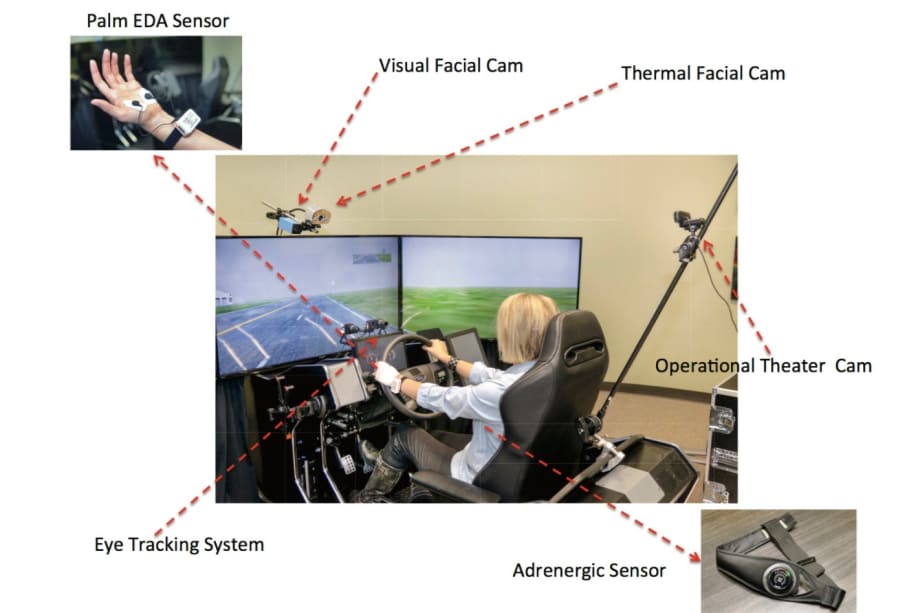
Study volunteers were monitored via standoff and wearable sensors. Graphic courtesy of the University of Houston.
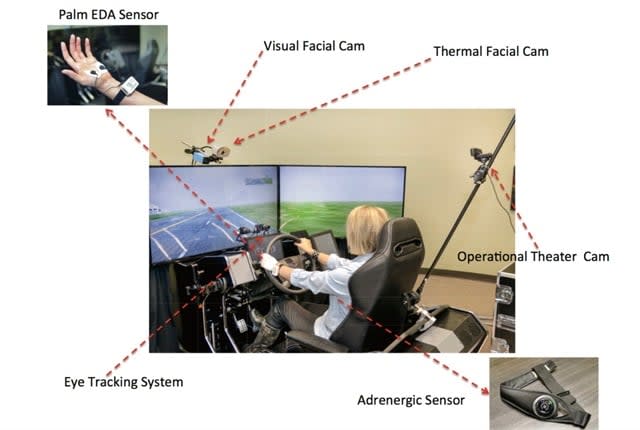
Study volunteers were monitored via standoff and wearable sensors. Graphic courtesy of the University of Houston.
Texting while driving is much riskier than driving while emotionally upset or daydreaming, according to a new study from the University of Houston and the Texas A&M Transportation Institute.
Researchers also found that all forms of distraction produce certain physical reactions in drivers — such as perspiration or accelerated heart rate — and cataloging these responses can help devise better strategies for making driving safer.
The study’s researchers produced extensive data examining how drivers react to different types of distractions and published the findings in Scientific Data.
Researchers conducted the study with 68 volunteers using a driving simulator. The volunteers had a valid driver’s license and normal or corrected-to-normal vision. They drove the same segment of highway four times in the high-fidelity driving simulator with no distraction and with cognitive, emotional and physical distraction. They were monitored using standoff and wearable sensors that recorded perspiration, heart rate, breathing rate, gaze and facial expressions to capture the drivers state as they were overloaded by multitasking. Tracking by thermal and visual cameras was also conducted.
The simulator's computer recorded driving performance variables, including speed, acceleration, braking force, steering angle and lane position, according to a University of Houston press release about the project.
The study split driver distractions into three categories, including sensorimotor, such as texting; cognitive, such as absorbing thoughts; and emotional distractions. Researchers discovered that texting led to far more dangerous driving, while a sixth sense appeared to protect those drivers suffering emotional distress or absent-mindedness. Texting interfered with that sixth sense, and drivers drifted out of their traffic lanes.
Further investigation revealed that "eye tracking and breathing rate proved useful metrics for measuring the impact of texting while driving," said Ioannis Pavlidis, a professor and director of the computational physiology lab at the University of Houston. "But that wasn't helpful in cases of emotional or cognitive distractions."
Nonetheless, researchers discovered that heart rate signals, which were captured using wearable sensors, and perspiration near the nose, which was detected using miniature thermal imagers, could track all forms of distraction, Pavlidis noted.
Such research can provide the groundwork for future safety systems, said Robert Wunderlich, the institute's director of the Center for Transportation Safety. Many drivers already wear smart watches and exercise trackers capable of measuring heart rate. The research paves the way for universal sensing of distraction.
The potential market for distracted-driving intervention is enormous. According to the National Highway Traffic Safety Administration, 3,477 people were killed and 391,000 were injured in motor vehicle crashes involving distracted drivers in 2015.
Originally posted on Automotive Fleet
More Safety

When Work Trucks Under 26,001 Pounds Need IRP Registration
Think trucks under 26,001 pounds are automatically in the clear when it comes to IRP? Not always. Learn where lighter vehicles can still run into trip permit, apportioned registration, and IFTA compliance requirements when crossing state or provincial lines.
Read More →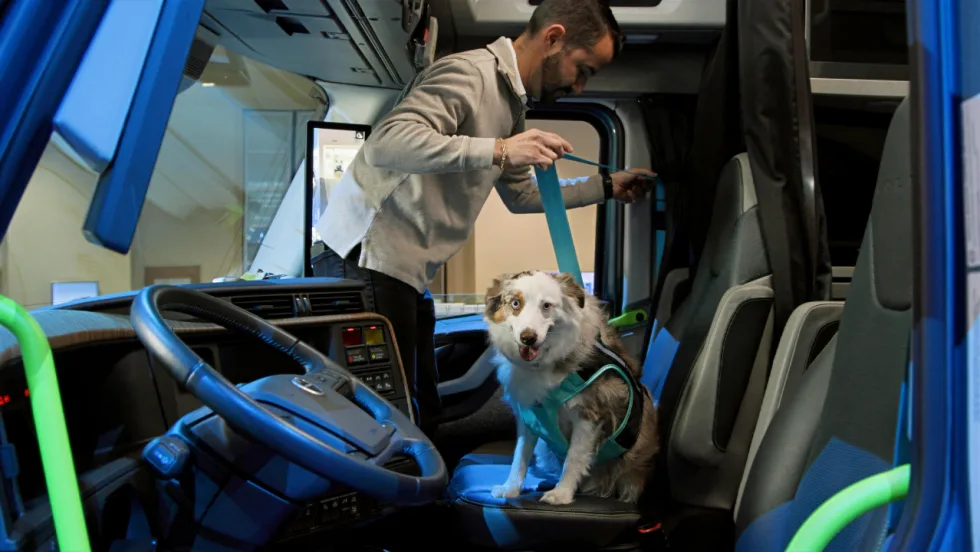
Volvo Trucks Releases New Safety Recommendations for Traveling with Pets
One of the most important recommendations for professional drivers traveling with pets is to ensure pets are properly restrained while the truck is moving. Other tips are available in the new guide from Volvo Trucks North America and Center for Pet Safety.
Read More →
API Issues Refueling Safety Guidelines
The American Petroleum Institute offers a list of safe vehicle refueling guidelines, including ways to avoid potential problems with static electricity discharges in fall, winter, and early spring.
Read More →
Winter Fleet Prep: Expert Tips to Keep Vehicles Running Smoothly
Cold weather can expose weak batteries, tires, fuel systems, and maintenance gaps fast. Use this winter fleet checklist to prepare trucks and drivers before temperatures drop.
Read More →
When a Work Truck Breaks Down, the Job Can Stop, Too
A work truck breakdown can stop more than the vehicle. Discover how payloads, jobsites, and specialty equipment change the roadside response.
Read More →
What Stronger Long-Term Fleet Service Partnerships Actually Require
Fleet service partnerships rarely fall apart all at once. Learn the three warning signs that trust is eroding and what fleets and providers can do before downtime, frustration, and lost revenue follow.
Read More →
Applause & TRUCE Software Partner to Improve Driver Safety Through AI-Powered Telematics & Employee Performance Management
Applause has integrated TRUCE driving metrics directly into its employee-first performance and safety platform that transforms mobile devices into AI-powered telematics.
Read More →
How Detroit Assurance with Active Brake Assist Works
Do you want to see what it is like to experience Detroit Assurance’s Active Brake Assist? In this video, Work Truck will put you in the cab to see how it all works and then hear more details from DTNA’s Mike Young.
Read More →
Get Left of Loss: A 5-Step Workplace Violence Prevention Framework for Fleet Operators
Violence risks do not stop at the driver’s door. Learn five practical steps fleets can take to spot threats early and protect workers before loss occurs.
Read More →
How Better Visibility Cut Speeding Violations by 48%
Fleet leaders don't need more data, they need clearer visibility into what the data is saying. This case study explores how one utility replaced speeding-event counts with a single metric — miles driven in violation — to strengthen safety and significantly reduce speeding violations.
Read More →